
Assam in 2025: 12 months of pride, pain & politics
From tragedy to triumph, elections to evictions, Assam’s year was shaped by ambition and political upheaval
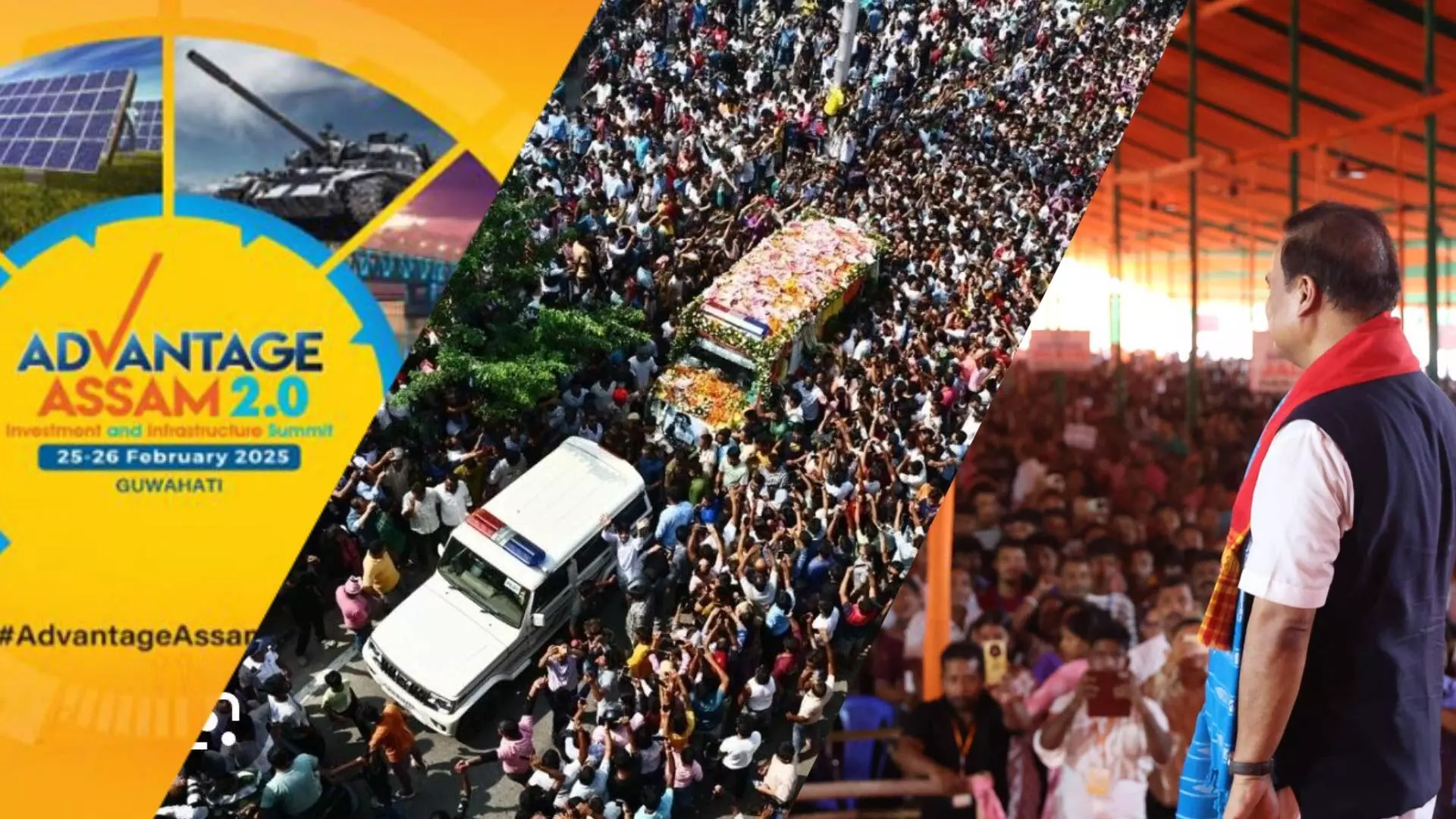
Image depicting pride, pain and politics; emotions that ran high through 2025
As 2025 slips into history, Assam emerged from a year that refused to be quiet. It was a season of political churn and administrative stress-tests, of cultural pride and collective grief, of ambition colliding with accountability.
From a deadly mining tragedy that exposed regulatory rot to high-stakes elections, eviction drives, security anxieties and searching debates on governance, the state lived its news in real time.
There were moments of assertion and aspiration, global investment pitches, technology push, cultural showcases. All set sharply against hospital failures, land conflicts and violent flashpoints.
As part of its year-end coverage, The Assam Tribune presents a month-wise chronicle of 2025’s most defining newsmakers, events and stories that went beyond headlines to leave a lasting imprint on the region’s political, social and cultural landscape.
Read on to flip back through a year that tested, transformed and defined Assam and the Northeast.
Indian Army & Assam Rifles in a rescue mission into the mine at Umrangso, Dima Hasao, Assam (Photo: @prodefgau/X)
January: Umrangso coal mine crisis
2025 opened with a grim mining tragedy at Umrangso in Assam’s Dima Hasao district, where flooding of an illegally operated rat-hole coal mine killed nine workers.
Initial rescue efforts failed, forcing the state to deploy specialised agencies. From January 7, SDRF and NDRF teams were pressed into service, followed by Indian Navy divers, ONGC experts and high-capacity pumps discharging over 1,000 litres per minute. Between January 18 and February 22, five bodies were recovered after nearly six weeks. Police booked and arrested mine managers and facilitators.
Chief Minister Himanta Biswa Sarma announced Rs 10 lakh ex gratia per victim and ordered statewide inspections, exposing deep regulatory failures and illegal mining networks.
File image of a session at Advantage Assam 2.0 (Photo: @advasm2025/X)
February: Advantage Assam 2.0 & Jhumur showcase
February spotlighted both ambition and culture as Assam hosted Advantage Assam 2.0 from February 25 to 26 at Khanapara in Guwahati. The global investment summit drew domestic and international investors, Union ministers and industry leaders. MoUs worth Rs 1.89 lakh crore were signed on day one, with total investment proposals crossing Rs 5.18 lakh crore by the close, spanning sectors such as renewable energy, semiconductors, green hydrogen, AI and infrastructure.
Chief Minister Sarma said improved road, rail, air and riverine connectivity had positioned Assam as the Northeast’s economic gateway, adding that MoU-to-project conversion would be monitored. Earlier, on February 23, over 8,000 tea garden workers staged a mega Jhumur dance in Guwahati, spotlighting tea tribe heritage nationwide.
Ghibli Studio inspired AI image of PM Narendra Modi and Assam CM Himanta Biswa Sarma (Photo: BJP Assam Pradesh/meta)
March: Studio Ghibli & Amritpal Singh in Dibrugarh jail
March was marked by parallel debates on technology and security. Assam, like much of India, saw a surge of AI-generated Studio Ghibli–style images flooding social media, shared by politicians, influencers and citizens, triggering questions over copyright, originality and ethical use of artificial intelligence.
Chief Minister Sarma joined the trend on March 14, posting AI-generated visuals from public interactions, further amplifying the phenomenon. On the security front, pro-Khalistani leader Amritpal Singh remained lodged in Dibrugarh Central Jail under the NSA. On March 28, seven associates were shifted to Punjab after their detention expired, while Assam retained Amritpal, citing security and logistical concerns.
Paramilitary Personnel from CRPF in Pahalgam after the attack (Photo: @jaywankhadejrw/X)
April: Pahalgam terror attack fallout
April was overshadowed by national security concerns after a terror attack in Pahalgam, Jammu and Kashmir, on April 22 killed 26 people, including Indian Air Force Corporal Tage Hailyang from Arunachal Pradesh.
The political temperature rose on April 24 with the arrest of AIUDF MLA Aminul Islam for alleged anti-India remarks seen as justifying the attack, sparking debates on free speech, misinformation and security.
Image associated with Operation Sindoor (Photo: @adgpi/X)
May: Assam panchayat polls & Operation Sindoor drills
May saw political consolidation and heightened security preparedness in Assam following Operation Sindoor. Panchayat elections, held in phases from May 2 to 10, delivered a sweeping victory for the BJP-led NDA alliance, which secured an overwhelming majority across gaon, anchalik and zila parishads. Results declared on May 15 underlined the ruling coalition’s strengthened rural base ahead of future polls.
At the same time, the state carried out large-scale preparedness exercises following India’s launch of Operation Sindoor. Mock drills were conducted at 27 locations between May 18 and 20, involving police, SDRF, civil defence, health services and fire departments.
A file image of Garukhuti Agri Project (Photo: @PramodBoroBTR/ X)
June: Bokakhat blast and Garukhuti Project row
The month of June was dominated by security and governance concerns. On June 24, a blast near Bokakhat sparked fears of resurgence of insurgent activity, but Chief Minister Himanta Biswa Sarma clarified it was linked to poachers, not ULFA-I. Police identified two suspects and tied the explosion to wildlife crime networks near Kaziranga.
The month also saw political heat over the Garukhuti agricultural project, with the Congress alleging corruption exceeding Rs 25 crore in the procurement of Gir cows and demanding a CBI probe.
An eviction drive at Uriamghat (Photo: AT)
July: Uriamghat eviction drive
July opened with Assam’s largest forest eviction drive in Uriamghat along the Assam–Nagaland border, launched on July 8 and targeting nearly 15 lakh bighas of encroached forest land. The week-long operation deployed over 150 excavators, 700 police personnel and forest officials to dismantle illegal settlements and farm structures.
While displaced settlers staged protests, Rengma Naga organisations welcomed the drive, terming it a step to protect indigenous land rights. Chief Minister Sarma described the eviction as crucial to reversing decades of forest loss and ensuring environmental sustainability.
The month also witnessed volatile security developments after a drone strike allegedly hit ULFA-I camps along the Indo-Myanmar border on July 13, reportedly killing three senior leaders and at least 19 cadres, though the Indian Army officially denied carrying out any such operation.
Assam CM reviewing the matter after the death of newborn at NICU, GMCH (Photo: @CMOfficeAssam/X)
August: GMCH infant deaths & hospital inquiry
August was overshadowed by a healthcare crisis at Gauhati Medical College and Hospital after an infant reportedly fell from a NICU bed and died, triggering public outrage, protests and swift government action.
Chief Minister Sarma ordered a three-member inquiry, which flagged lapses in monitoring, staffing and procedural oversight. Investigations also revealed alleged extortion by hospital trolley pullers, with 11 booked.
Authorities initiated administrative measures and accountability processes to prevent further negligence, as public debate exposed systemic weaknesses in Assam’s healthcare infrastructure, particularly in critical care units.
People flooding Guwahati streets to pay last respects to Zubeen Garg's mortal remains (Photo: @_AdilHussain/X)
September: Demise of beloved Zubeen Garg
September plunged Assam into collective mourning with the death of cultural icon and son of the soil Zubeen Garg on September 19 in Singapore, where he had travelled to attend the North East India Festival.
Initial accounts said he drowned while swimming, sending shockwaves through Assamese households. The state government arranged the repatriation of his mortal remains and observed state mourning in his honour. Garg was cremated with full state honours as thousands gathered to bid farewell.
For many, it felt as though a part of Assam’s soul had been torn away; the voice that sang of love, loss, rebellion and home had fallen silent. As candles burned and streets echoed with grief, questions soon emerged over the circumstances of his death.
FIRs were filed and Assam Police constituted a Special Investigation Team (SIT) to probe the incident, while civil society groups and political leaders demanded a thorough and independent investigation, turning personal loss into a major public and political issue.
Poster of Roi Roi Binale (Photo: Zubeen Garg/meta)
October: ‘Roi Roi Binale’ release and Zubeen Garg death probe
October saw the release of Zubeen Garg’s long-anticipated final film, Roi Roi Binale, which hit screens across India on October 31, 2025, fulfilling the late artiste’s wish to see his last work on the big screen. Featuring Garg as the protagonist, the film struck an emotional chord and emerged as one of the year’s most discussed Assamese releases. Its popularity also led to a parallel legal track, with Assam Police arresting several individuals, including a YouTuber, over piracy and illegal online distribution.
Meanwhile, in the continuing probe into Garg’s death on September 19 in Singapore, seven people, including his manager, festival organiser, band members, a cousin and two security personnel, were arrested. The courts placed all the accused in judicial custody in the month.
A file image of Election Commission of India (Photo:X)
November: Special revision of electoral rolls & BTC violence
November was marked by administrative and political tension as the Election Commission of India launched a special revision of electoral rolls in Assam from November 1, fixing January 1, 2026, as the qualifying date.
Officials said over 29 lakh households were surveyed, focusing on removal of duplicate entries, inclusion of eligible voters and correction of demographic details, with citizens urged to verify draft rolls and file claims or objections within timelines. The exercise gained urgency ahead of upcoming elections.
Meanwhile, unrest broke out in Kokrajhar on November 12 when students and activists protesting alleged dilution of ST status for Bodo communities clashed with security forces at the BTC Secretariat, leading to injuries, property damage and heightened security.
The Assam Legislative Assembly on November 27 passed the Assam Prohibition of Polygamy Bill, 2025, banning polygamy and introducing stringent penalties. The law provides for up to seven years’ imprisonment for unlawful polygamy and up to 10 years for concealing a previous marriage.
Protesters set tyres ablaze in Kheroni as violence spills onto the main road (AT Photo)
December: Post Malone concert & West Karbi Anglong violence
The month opened on a high with international artiste, Post Malone performing in Guwahati on December 5, marking Assam’s entry into organised concert economy and drawing massive crowds, with the artiste paying tribute to Garg. The gig positioned Guwahati as an emerging international live-events destination.
The festive mood, however, gave way to unrest in West Karbi Anglong, where eviction-related protests turned violent on December 22. Police firing and clashes left two people dead and over 173 security personnel injured, prompting prohibitory orders and suspension of mobile internet services.
Chief Minister Sarma termed the situation “critical” and chaired emergency meetings. A December 26 tripartite meeting led to withdrawal of hunger strikes and a decision to fence 8,000 bighas of VGR and PGR land, underscoring Assam’s sharp year-end contrasts.