
Are welfare schemes relief or reliance? Assam weighs the trade-offs
From Orunodoi to Nijut Moina, Assam’s welfare model walks a tightrope between support & sustainability
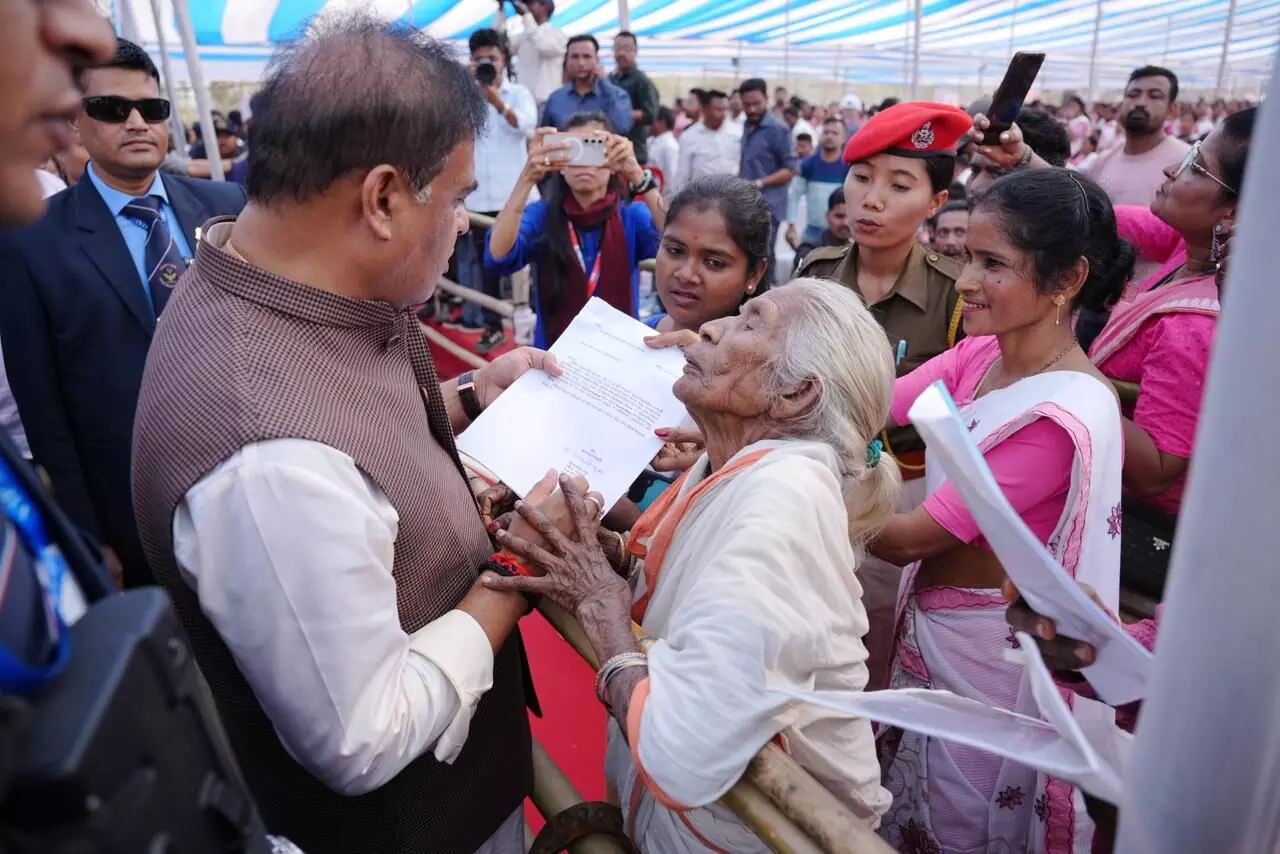
File image of CM Sarma interacting with an elderly person at a public meeting. (Photo:@himantabiswa/X)
Across Assam, a bank notification now signals state support, even as concerns over welfare dependence grow louder.
State welfare schemes have become woven into everyday life. For many beneficiaries, they represent dignity, access and opportunity. For others, they raise uneasy questions about fiscal sustainability and long-term dependence.
The debate over government “freebies” is far from settled. It plays out in kitchens, classrooms and policy corridors alike, cutting across class and region.
With Assembly elections nearing, the debate centres on whether welfare schemes provide essential support or risks weakening the incentive to work.
Students of Kamrup College, Chamata, in Tihu at the financial assistance distribution of Mukhya Mantrir Nijut Moina (Photo - @cmpatowary / X)
Safety net in uncertain times
The COVID-19 pandemic fundamentally altered how governments approach welfare. When incomes collapsed and earning a livelihood became a challenge, direct-to-bank transfers (DBT) emerged as a crucial lifeline.
Assam’s flagship Orunodoi scheme was born in this context, providing monthly financial support to low-income households. Today, it covers nearly 38 lakh women, disbursing Rs 1,250 per month to each beneficiary through DBT.
Many beneficiaries say such schemes are not charity but a necessary response to inequality and crisis. Assam Chief Minister Himanta Biswa Sarma has repeatedly underscored both the emotional and economic impact of these programmes.
“When beneficiaries received their first payment, they felt that the government stood with them,” he has said, highlighting the sense of security the initiatives created during difficult times.
For families grappling with inflation and uncertain employment, even modest financial support can stabilise consumption, improve nutrition and prevent debt. In rural and semi-urban areas, the regular flow of money also helps sustain local markets.
Orunodoi beneficiaries at a meeting in Bokajan (Photo - @himantabiswa / X)
Free ration under the National Food Security Act further ensures food security for millions. Access to healthcare has expanded through integration with Ayushman Bharat, which provides financial protection against major illnesses.
For many recipients, the welfare system is not about dependence—it is about survival.
“My husband’s income is not regular. The government scheme has become our support during difficult times. It helps us get through the month”, Momi Baishya, an Orunodoi beneficiary said.
Welfare as empowerment
Not all welfare measures are designed solely for immediate relief; several aim at long-term empowerment. Take the Nijut Moina initiative, for instance.
The scheme provides monthly stipends to girl students pursuing higher education, with the stated objective of curbing child marriage and improving enrolment. The government claims that dropout rates have declined significantly since its rollout.
For students from modest backgrounds, such assistance also offers psychological reassurance. While the stipend may not fully cover tuition or living expenses, it eases the financial burden on families and makes higher education more accessible.
The Lakhpati Baideo programme goes a step further by promoting women’s entrepreneurship through self-help groups (SHGs) and livelihood support. Unlike direct cash transfers, it emphasises income generation and financial independence.
“Through the Lakhpati Baideo scheme, I started a small business and began earning on my own. Earlier, I depended on others, but now I feel confidetn and respected because I can support my family with my own income”, Polly Gogoi, a Lakhpati baideo said.
This shift signals a growing recognition that welfare must expand opportunity, not merely underwrite consumption.
The cost of compassion
However, the scale of welfare spending has triggered serious concerns. The Seventh Assam State Finance Commission recently cautioned that schemes such as Orunodoi and free ration distribution could exert significant pressure on the state’s finances.
The combined annual outlay is estimated to exceed Rs 10,000 crore, even as Assam’s share in central tax devolution shows signs of strain.
Critics argue that rising expenditure on subsidies may crowd out investment in infrastructure, job creation and industrial development. They warn of a cycle in which welfare spending becomes politically difficult to roll back, regardless of fiscal capacity.
Senior Congress leader Ripun Bora has been among the most vocal critics.
“Women do not become empowered by Rs 8,000 or Rs 1,250. This is nothing but a vote-purchase tendency,” he said, questioning whether such assistance leads to meaningful, long-term improvements in livelihoods.
The Opposition maintains that short-term financial support, particularly in the run-up to elections, risks turning welfare into an instrument of political competition rather than a calibrated social policy tool.
Incentives or political populism?
Beyond direct cash transfers, the state has rolled out a range of incentives - from scooters for meritorious students under the Dr Banikanta Kakati Merit Award to business assistance through the Chief Minister’s Atmanirbhar Asom Abhijan.
These initiatives are designed to promote education, mobility and entrepreneurship. However, they have also sparked debate. Are such benefits genuine instruments of motivation or examples of political populism?
While supporters view them as investments in human capital, critics argue that they risk becoming symbolic gestures that fail to address deeper structural challenges such as unemployment and skill gaps.
Beneficiaries of Chief Minister’s Atmanirbhar Asom Abhijan (Photo - @CMOfficeAssam / X)
The debate is not merely economic or political; it is also psychological. Welfare schemes shape how individuals perceive opportunity, effort and long-term security.
Trinayan Sharma, a psychologist, says the impact depends on how assistance is structured. “Financial support during a crisis builds emotional security and reduces stress. But if assistance becomes permanent without pathways to self-reliance, it may weaken motivation and decision-making,” she said.
Experts note that the most effective programmes are those linked to education, skill development and entrepreneurship, as they foster confidence and agency rather than dependency.
Changing expectations of governance
The rise of beneficiary politics also reflects changing expectations from the state. Citizens today increasingly seek not just development, but direct economic security.
For governments, welfare is both a moral responsibility and a political necessity. For critics, it poses the risk of becoming a fiscal burden. For beneficiaries, however, it often represents the thin line between hope and hardship.
The debate over so-called “freebies” is unlikely to subside anytime soon. Instead, it is likely to evolve.
The real challenge for policymakers lies in designing welfare frameworks that provide relief without undermining productivity. Linking financial assistance to skill development, employment and entrepreneurship could help create a more sustainable model.
Ultimately, the question is not whether welfare should exist, but how it should function. Should it remain merely a safety net, or evolve into a pathway to opportunity?
For many across Assam, the answer may depend on whether these schemes remain temporary support or become stepping stones to self-reliance.