
At 90% completion, Maharaj Prithu Flyover rests on delays, deadlines & public patience
According to PWD, the Rs 852-cr stricture is likely to be inaugurated by the end of February or early March, ahead of the Assembly polls
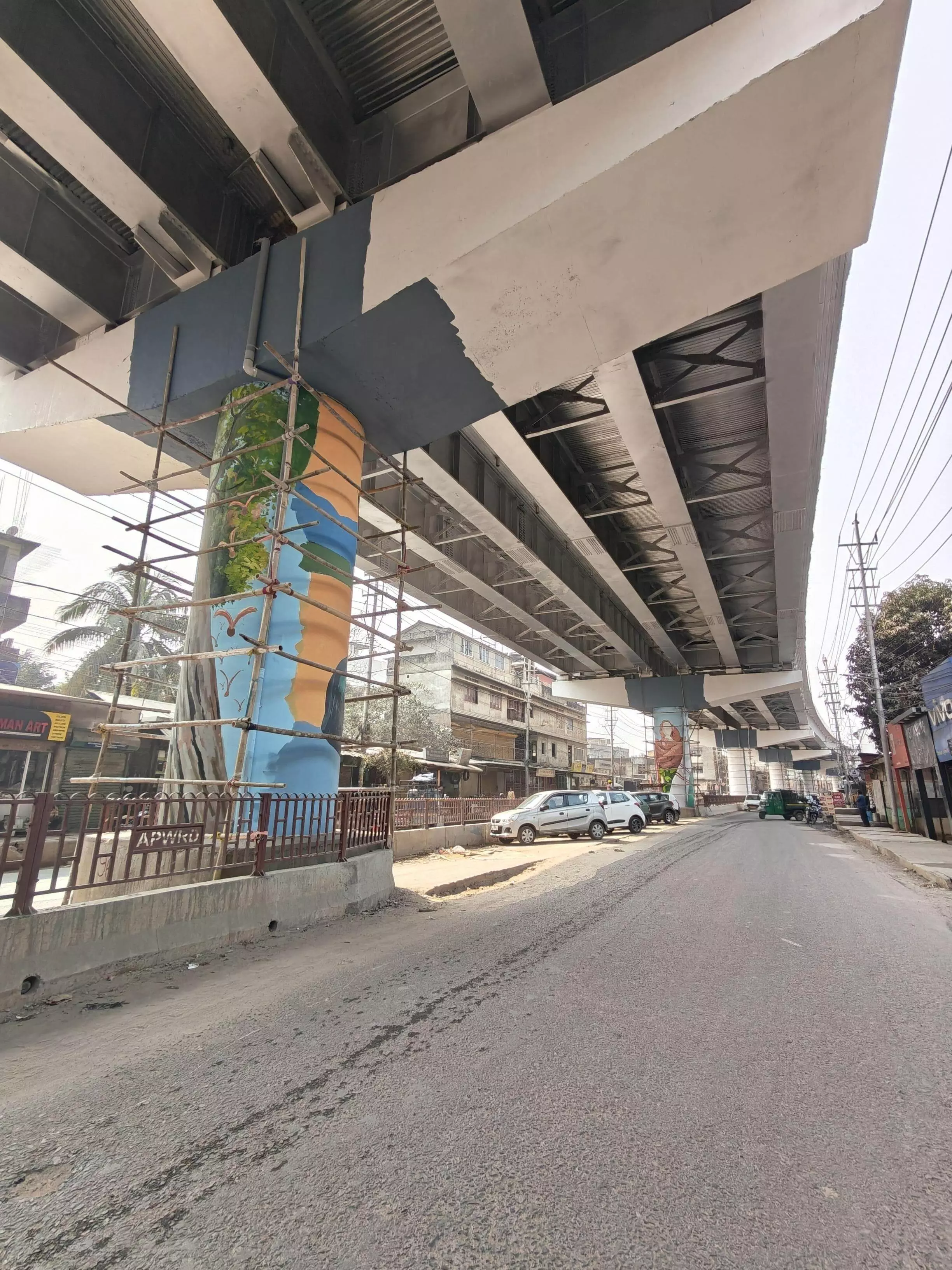
Beautiful murals being painted on the pillars of the Maharaj Prithu Flyover (AT Image)
As the nearly five-kilometre-long Maharaj Prithu Flyover nears completion, the project continues to evoke both anticipation and unease among Guwahati’s residents.
Touted as the longest flyover in Assam and built at a staggering cost exceeding Rs 852 crore along the congested Maniram Dewan Road between Ambari and Noonmati, the structure is over 90% complete, with authorities indicating a possible inauguration by the end of February or early March, ahead of the Assembly elections.
From the government’s perspective, the flyover is a crucial intervention aimed at easing traffic congestion on one of the city’s busiest corridors. Yet, for many citizens, it also represents a phase of disruption marked by missed deadlines, environmental concerns, livelihood losses and safety questions.
According to officials of the Public Works Department (PWD–Roads), the project is now in its final phase, with work underway to connect the new structure with the Chandmari flyover.
Steel girders, night work
The flyover has been built using steel girders rather than traditional RCC structures, which is a choice, the department says, has become standard in urban infrastructure projects.
The flyover features a steel-girder structure which officials say is now standard practice in urban projects.
“Steel girders allow quicker installation and require significantly less construction time compared to RCC structures. They also have a lifespan of more than 50 years, which makes them suitable for large flyovers in high-traffic urban areas,” Bhaskar Bhagawati, a PWD official explained earlier.
However, the same officials acknowledge that the project faced repeated slowdowns due to logistical constraints.
Heavy traffic on MRD Road and the narrow width of the stretch meant that critical operations, such as lifting and placing steel girders, could only be carried out late at night.
“On most days, we had barely five hours to complete extremely sensitive work. The lifting and placing of steel girders could only be done after traffic subsided at night and had to be wrapped up by 5 or 6 in the morning. If we had longer uninterrupted windows, the project timeline would certainly have been shorter,” said the official.
Even as construction enters its final phase, concerns remain over safety and spatial clearances along certain stretches of the flyover.
Responding to questions about the narrow gaps between the flyover and nearby residential buildings or electric poles, Bhagawati clarified that power infrastructure-related matters are being handled by the Assam Power Distribution Company Limited (APDCL).
“Clearance issues involving electric poles and power lines are being supervised by APDCL,” he said, adding that coordination is being maintained to ensure safety standards are met.
Bhagawati further stated that work on the flyover is progressing at a rapid pace.
“We are aiming to complete the project within the next month. The flyover progress has become more visible now as construction has reached the Chandmari flyover stretch. Work is currently underway to seamlessly connect both flyovers,” he added.
The artwork seeks to make the flyover more relatable to everyday commuters.
Pillars turn canvas
As construction winds down, attention has also turned to the flyover’s visual elements. Artists have begun painting murals on the pillars, introducing colour and cultural motifs to what has long been a stretch dominated by dust, barricades and machinery.
Artist Chiranjit Bhaumik, who is part of the team working on the murals, said the artwork is being executed with the intention of making the flyover more relatable to the public.
“Our team has around 15 to 20 artists, and we have divided ourselves into four groups to work simultaneously. Five broad themes have been selected including Assam’s natural beauty, its festivals, the changing seasons, and elements of Assamese art and culture,” he said.
“There are 122 pillars along this flyover, and we will be painting 244 designs on both sides,” Bhaumik added.
The artist added that they are working against time and hope to complete the entire artwork within February.
“As artists, it is encouraging to be given such a large public space to showcase our work. We have worked on flyovers in Dispur, Maligaon and Tezpur earlier, and this project gives us another opportunity to connect art with everyday urban life,” he said.
Ecology versus development
Even as finishing touches are being applied, the flyover remains at the centre of sustained civic and legal scrutiny.
In October last year, the civil society group Concerned Citizens of Guwahati accused the Assam government of violating an affidavit submitted to the Gauhati High Court by extending the flyover approximately 70 metres beyond its approved endpoint at Rabindra Bhawan, allegedly taking it closer to Handique Girls’ College and the Dighalipukhuri area.
The group has argued that the revised alignment threatens the heritage and ecological balance of one of Guwahati’s most historically significant zones.
The stretch near Rabindra Bhavan after the trees were trimmed (AT Image)
They alleged that the extension would result in the loss or severe trimming of mature trees near the State Museum and District Library, and reiterated that the flyover should not extend beyond RabindraBhawan, as earlier assured before the court.
The PWD has strongly denied allegations of tree felling.
Clarifying the department’s stand, Bhagawati said, “From Guwahati Club to Rabindra Bhawan, a total of 77 trees were affected by the project. Not a single tree was cut. All of them were carefully transplanted following standard procedures with 34 trees at the Handloom and Textiles premises and 43 at LachitGhat. The work was carried out by an agency with experience in large-scale tree transplantation.”
The matter has since been taken up by the Gauhati High Court, which, while hearing a PIL on the issue, stressed the importance of striking a balance between development and ecological preservation.
The court observed that such cases should be seen not as adversarial litigation but as an effort to protect nature for future generations.
Urban pain points
Beyond environmental concerns, the prolonged construction has had a tangible impact on daily life and livelihoods along the corridor.
Local shopkeepers along the GNB Road stretch, particularly in Chandmari, report a sharp decline in business due to debris, restricted access and the lack of parking space.
“There are days when we barely see any customers. Earlier, people would stop by in their vehicles. Now, with construction materials lying around and no place to park, footfall has dropped sharply,” said Sanjib Horo, a salesperson at a watch shop in Chandmari.
While the government maintains that the Maharaj Prithu Flyover will substantially ease traffic congestion once opened, its journey from foundation stone laid on January 1, 2024 to near completion reflects the complex realities of urban development.
As Guwahati waits for the flyover to open to traffic, the structure stands as a reminder of the delicate balance between infrastructure growth, environmental responsibility and public patience in a rapidly expanding city.