
How a five-day week push turned bank strike into Guwahati’s work-life debate
What began as a bank shutdown becomes Guwahati’s loudest conversation yet on work culture, stress and time
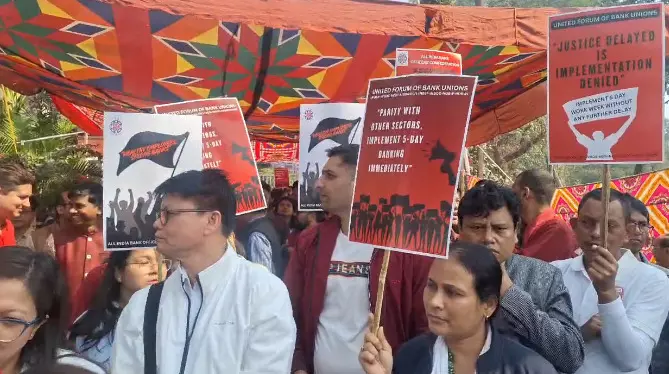
Bank employees stage a protest outside the State Bank of India headquarters in Dispur, Guwahati, demanding the implementation of a five-day work week and highlighting growing concerns over workload and work–life balance.
On January 27, Guwahati woke up to shuttered counters and placard-holding bank employees as a nationwide strike by the United Forum of Bank Unions (UFBU) disrupted public sector banking operations.
What appeared, at first glance, to be yet another labour protest quickly revealed itself as something larger! It was a flashpoint in a growing debate over work culture, urban stress and the quality of life.
The UFBU, an umbrella body representing nine bank unions, called the strike after a conciliation meeting with the Chief Labour Commissioner on January 23 ended without assurances.
But at the heart of the agitation lies a long-pending demand of the implementation of a five-day work week in banks.
Bank officials protest demanding five-hour work week
A long-pending demand
At a protest outside the State Bank of India headquarters in Dispur last week, union leaders stressed that the demand is neither abrupt nor radical.
“Authorities keep saying the proposal is under ‘active consideration’, but the implementation has been delayed for far too long. We are being forced to protest because our voices are simply not being heard,” said a union representative. The frustration, however, is rooted in precedent.
In 2015, banks moved to a system where the second and fourth Saturdays were declared holidays, with assurances that a full five-day week would eventually follow.
That promise resurfaced in the bipartite agreement signed in March 2024, which explicitly stated that five-day banking would be rolled out within two to three months.
Assam State Secretary of the All India Bank Officers Confederation, Sanjiv Sen, clarified that the unions were not seeking reduced output. “Our immediate demand is a five-day work week. To ensure customers are not inconvenienced, we are ready to work 40 minutes extra each weekday. Staffing issues will be taken up separately,” he said.
The impact of the strike rippled across Assam that day, where employees of nationalised banks staged peaceful demonstrations, bringing routine banking services to a halt.
A citywide ripple effect
While the strike is sector-specific, its implications extend far beyond banking halls. Private sector employee Pranab Das believes a five-day work culture could subtly reshape Guwahati’s urban rhythm.
“A citywide shift won’t magically reduce weekday traffic,” he said, adding, “But evenings could become more vibrant. Malls, restaurants and cinema halls are likely to benefit as people have more energy and time.”
Office-goers stuck in traffic during peak hours in Guwahati
He also highlighted the importance of weekends for self-improvement. “Most educational webinars and skill-development programmes happen on Saturdays. Weekends also give people time for family or side hustles,” he adds.
However, Das is sceptical about uniform adoption. “Small private businesses and startups may struggle to afford a five-day week. Unlike Bengaluru or Hyderabad, Guwahati isn’t a tech hub yet. High-tech firms there can absorb such changes more easily,” said Sen.
More than a labour issue
For others, the debate cuts deeper than economics. “In many workplaces, managers are still uncomfortable giving employees autonomy. As long as toxic employer mindsets persist, a five-day work week will remain limited to select sectors,” said Dimple Deka, a Guwahati-based professional.
Deka believes fewer working days translate into higher productivity. “When people have time to recharge, spend time with family, or develop skills, it reflects positively at work. A job isn’t someone’s entire life,” she argues.
She also links the issue to Guwahati’s daily realities. “My office is barely half an hour away, but traffic congestion and ongoing construction often turn it into a struggle. That’s when you realise how valuable rest and flexibility are, sometimes even work-from-home feels like a better option,” she added.
A conversation just beginning
So far, the government and banking authorities have yet to issue an official response to the UFBU’s demands. But observers feel the strike has already achieved something significant - it has sparked a broader conversation about work-life balance in a rapidly growing city.
Employees engage in a office meeting, reflecting the broader debate on working hours and productivity
“Whether or not five-day banking is implemented immediately,” Deka said, noting, “This strike signals the start of a larger discussion on labour rights, urban stress, and how Guwahati wants to evolve.”
Beyond the slogans, the question now facing the city is simple but profound - in the push for growth, how much rest is too much and how much exhaustion is too costly to ignore?