
Guwahati joins nationwide bank strike; employees demand five-day work week
Hundreds of bank employees staged a protest in front of the State Bank of India (SBI) headquarters at Dispur in Guwahati
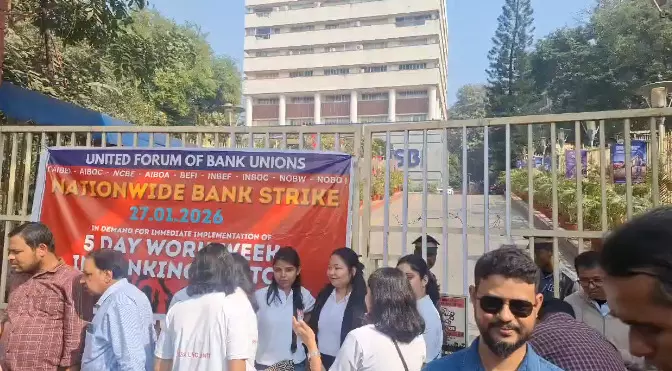
Protesting bank employees outside SBI headquarters in Guwahati (AT Image)
Guwahati, Jan 27: Banking operations at public sector banks across the country were disrupted on Tuesday, following a nationwide strike called by the United Forum of Bank Unions (UFBU), demanding the immediate implementation of a five-day work week.
The UFBU, an umbrella body comprising nine unions representing officers and employees of banks, called the strike after a conciliation meeting with the Chief Labour Commissioner on January 23 failed to yield any concrete assurance from the authorities.
The unions have alleged prolonged delays by the government despite repeated agreements and assurances on the issue.
The impact of the strike was visible across several states, including Assam, where hundreds of bank employees staged a protest in front of the State Bank of India (SBI) headquarters at Dispur in Guwahati.
Demonstrators raised slogans and accused the authorities of ignoring long-pending demands related to work-life balance and staffing shortages.
Speaking at the protest, a union representative said that the demand for a five-day work week was neither new nor unreasonable.
“There has already been a gentleman’s agreement on five-day banking. The authorities keep saying the proposal is under active consideration, but the implementation has been delayed for far too long. We are being compelled to protest because our voices are not being heard,” the protestor said.
Bank employees voicing their demand for five-day work week (AT Image)
He added that the UFBU represents employees from 12 public sector banks, regional rural banks (RRBs), cooperative banks and several private sector institutions.
“This is a united movement. If the demand is not met even after this strike, the protests will intensify and more issues will be added to our charter of demands. The UFBU will meet again and decide the next course of action, but there will definitely be more protests,” he warned.
Bank employees also pointed out that several key financial institutions already follow a five-day work schedule.
“The Reserve Bank of India works five days a week. Many international banks and institutions also follow a five-day system. If that model works for them, there is no reason why commercial banks cannot adopt it,” the protestor said.
Referring to past agreements, a protestor said that in 2015, an agreement was reached with the government under which the second and fourth Saturdays were declared holidays, with an assurance that the first and third Saturdays would also be considered in the future.
“Again, in the bipartite agreement signed in March 2024, there was a clear clause stating that within two to three months, five-day banking would be rolled out. That deadline has passed, but nothing has been implemented,” the protestor said.
Union leaders further highlighted the growing workload and staff shortages in banks.
“Banks today are severely understaffed. One employee is forced to do the work of two or three people. This has left employees physically exhausted and mentally stressed. We have no proper holidays, and the work pressure is continuously increasing,” he said.
The UFBU has warned that if the government continues to delay the decision, the agitation could be extended over multiple days, potentially leading to further disruption of banking services.
Banking operations were also severely affected in districts such as Dhubri and Sivasagar, where officers and employees of public sector banks observed the strike in response to the UFBU’s nationwide call.
In Dhubri, staff of all nationalised banks, including the State Bank of India, staged a central demonstration at SBI’s main branch, holding placards and raising slogans to press for long-pending demands, leading to the suspension of routine banking services and inconvenience to customers. Several private and other banking institutions in the district also remained closed in solidarity, though the protest remained peaceful.
Similar scenes were witnessed in Sivasagar, where bank employees staged a protest in front of the SBI branch, citing excessive workload and deteriorating work-life balance.
Protesters said a five-day banking week was essential for their mental and physical well-being and assured that, if implemented, they were willing to extend daily banking hours by 40 minutes to minimise inconvenience to customers, while warning of intensified agitations if their demands continue to be ignored.
The government and banking authorities are yet to issue an official response on the unions’ latest demands.