
Burhachapori roars back: Eviction clears path for wildlife, sparks conservation talks
Experts at a recent workshop in Nowgong highlighted the ecological value of the Rowmari-Donduwa Wetland Complex for Ramsar status
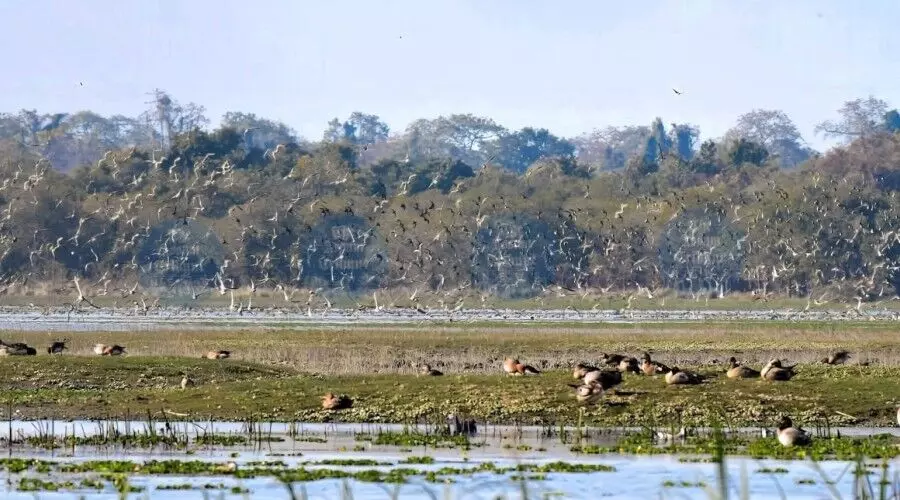
Rowmari-Donduwa complex of Laokhowa Wildlife Sanctuary (Photo: AT)
Tezpur, Nov 1: The massive eviction drive in the Burhachapori Wildlife Sanctuary in 2023 gave the local wildlife the required space for grazing, thereby easing the human-wildlife conflict on both the northern and southern banks of the river Brahmaputra.
The wildlife sanctuary, located on the southern part of the river Brahmaputra in Sonitpur district, was for years under the occupation of suspected illegal migrants. The encroachment drive in question was carried out by the State government as per an order of the Gauhati High Court and the area was totally freed from encroachers, thereby facilitating safe passage for wildlife.
The Burachapori Wildlife Sanctuary – a part of the Laokhowa Wildlife Sanctuary covering 44.06 sq km – has now become a centre for many researchers and students from different schools and colleges based in both Sonitpur and Nagaon districts.
Meanwhile, a one-day workshop on ‘Conservation of Wetlands of Laokhowa Wildlife Sanctuary and Kaziranga National Park and Tiger Reserve’ was held recently at the Nowgong Girls’ College. The event was jointly organised by the Centre for Sustainable Development, the Nowgong Girls’ College, and the Kaziranga National Park and Tiger Reserve (KTR) to deliberate on strategies for conserving the Laokhowa wetlands and their vital role in maintaining biodiversity. The workshop was moderated by Dr Smarajit Ojah, OSD, directorate of higher education, Assam, and Ashish Saikia, assistant professor in the Department of Geography, Nowgong Girls’ College, and it brought together more than 60 researchers, educators, conservationists, students, and forest officials to discuss collaborative measures for the protection and sustainable management of wetland ecosystems.
Dr Sonali Ghosh, director of the Kaziranga National Park and Tiger Reserve, delivered the keynote address and mentioned that Laokhowa and the adjoining Burhachapori wildlife sanctuaries are buffer components of the Kaziranga National Park and Tiger Reserve and function as connectivity corridors for wild animals migrating between the Kaziranga and Orang landscapes.
Dr Bhuban Chandra Chutia, assistant professor in the Department of Zoology at the Nagaon University, and Bipul Kr Bora, retired associate professor in the Department of Botany at the ADP College, presented perspectives on the role of educational institutions, students, and civil society in conservation of wetlands of the region.
Dr Pranab Jyoti Bora, senior coordinator, WWF-India, and Prasanta Kr Bordoloi, eminent wildlife documentary filmmaker, also delivered brief talks on the unique avian and wetland ecology of the wetlands of Laokhowa in particular and the Kaziranga landscape in general. Dilwar Hussain of the Laokhowa-Burhachapori Wildlife Conservation Society presented a historical overview of the wetlands of Laokhowa and called for the declaration of the Rowmari-Donduwa Wetland Complex as a Ramsar Site, citing its ecological vulnerability and the need for habitat restoration.
Noirrita Priyadarshini, research scholar at the Tezpur University, cited the wetlands’ rich biodiversity and habitat value for migratory birds and highlighted that the Rowmari-Donduwa Wetland Complex of Laokhowa fulfilled eight out of the nine criteria to be a Ramsar Site.
The workshop also featured a memorandum from the Assam Bird Monitoring Network, presented to the field director of the Kaziranga National Park and Tiger Reserve, advocating for Ramsar Site status and enhanced protection and special conservation status for the Rowmari-Donduwa wetlands due to their unique ecological potential and avifaunal richness.
The Ramsar Convention, signed by India in 1982, is an international treaty for the conservation and wise use of wetlands. As of October 2025, India hosts 93 Ramsar Sites. Assam, however, despite having over 3,000 wetlands and waterbodies, has only one Ramsar Site – Deepor Beel, which was designated in 2002.
Dr Nilutpal Mahanta, senior manager of the WE Foundation, Nagaon, made a presentation during the workshop on ‘Methodology of Documenting Avian Species of Wetlands’. He explained scientific protocols and monitoring techniques used in avifaunal surveys, emphasising the importance of systematic data collection to strengthen long-term biodiversity assessments. Detailed presentations on the Rowmari-Donduwa wetlands area were delivered by Dr Smarajit Ojah, Neeraj Bora, research scholar at the Nagaon University, and Chiranjib Bora, research scholar at the Gauhati University. They shared their documentation of rare and critically endangered waterbird species recorded during the last two years, including the knob-billed duck, lesser adjutant stork, black-necked stork, ferruginous pochard, and common pochard, all of which highlight the site’s international ecological value.
A video compilation by Suhashini Handique, an MSc student at the Gauhati University, was screened during the session, featuring interviews of some renowned birders.