
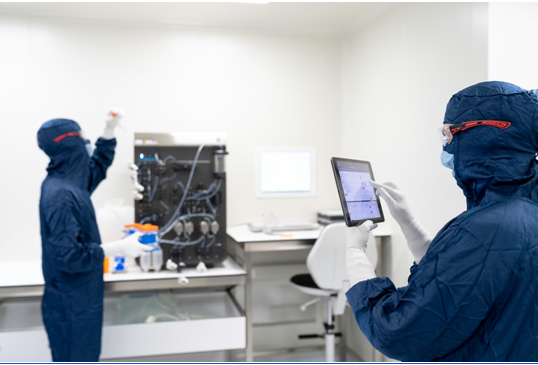
Pharmaceuticals, biotechnology, medical devices — these sectors have always tracked closely with scientific progress, but the pace of the last few years has broken out of any recognizable pattern. Artificial intelligence, cloud platforms, digital twins — none of these are slide-deck concepts anymore. They're operational tools that compress drug timelines and rework how clinical research actually gets done.
At the same time, the industry carries a lot of accumulated baggage: regulatory rigidity, fragmented data ecosystems, aging IT infrastructure at companies that have been running the same systems since the early 2000s. Below are five trends shaping the next several years for anyone working in life sciences.
Where the Market Stands Right Now
The global life sciences market is closing in on $2.5 trillion, and a significant chunk of that growth has nothing to do with new molecules. It's digital transformation applied to processes that have existed for decades. McKinsey estimates that AI adoption in R&D can cut drug development costs by 25–30% and compress the path from discovery to clinical trials from four or five years to under two.
The fact that companies like DXC Technology are building out life sciences IT services tailored specifically to pharma and biotech says something about where the market is headed: IT is no longer treated as a support function. Constructing a coherent technology architecture (from LIMS systems in the lab to cloud platforms handling real-world clinical data) has turned into a genuine competitive differentiator.
A few signals worth paying attention to:
● Roche put money into Flatiron Health precisely to accumulate and analyze real clinical data beyond the controlled walls of an RCT
● Pfizer, after the mRNA experience during the pandemic, is running a serious internal push to digitize manufacturing processes at scale
● FDA has issued over 500 authorizations for AI-based medical solutions and is actively building out its Digital Health Center of Excellence
● At BIO 2024 in San Diego, more than 40% of startup pitches centered on AI tools for drug discovery — a number that would have seemed absurd five years ago
Trend 1: AI in Drug Discovery
From AlphaFold to Generative Molecules
AlphaFold 2 was the clearest proof-of-concept: DeepMind solved protein structure prediction with accuracy that matched experimental data — a problem structural biology had been chipping at for fifty years. That was the moment the industry stopped treating AI as a productivity tool and started treating it as a discovery engine. The AlphaFold DB now sits at 200 million predicted structures.
What came next was generative modeling — not analyzing existing molecules but designing new ones from scratch. Insilico Medicine already ran a Phase I trial for INS018_055, a drug for idiopathic pulmonary fibrosis built entirely by AI. Schrödinger's computational design platform is in active use at Merck and Bristol-Myers Squibb. Recursion Pharmaceuticals is building phenomics image databases of cells and training models on them to flag toxicity before anything goes near a patient.
The Black Box Problem
The real sticking point is model interpretability. FDA and EMA are cautious — sometimes very cautious — about approving decisions where no one can clearly explain why the algorithm landed on a particular molecule. That's pushed the development of explainable AI (XAI) as a parallel track to generative approaches. The goal isn't just to predict an outcome; it's to hand a regulator a coherent, auditable chain of reasoning that traces back to specific chemical substructures or biological mechanisms.
Trend 2: Digital Twins in Pharma
A digital twin is a dynamic model of a real-world object or process, continuously updated with sensor data. Siemens has been the loudest voice pushing this concept in industrial manufacturing, and pharma picked it up. Novo Nordisk, for instance, is building digital twins of its insulin production lines — the goal being to cut downtime and catch quality deviations before they propagate through a batch.
The more ambitious application, though, is the patient digital twin. Dassault Systèmes' Living Heart Project models cardiac activity in enough detail to test cardiovascular devices without animal studies. FDA has already recognized "in silico trials" — computer-simulated clinical studies — as potentially valid evidence in regulatory submissions. EMA's strategy roadmap for 2023–2028 calls out digital twins specifically as a priority area for evaluation and formal recognition.
Practical applications already running in production:
● Process Analytical Technology (PAT) — sensor networks paired with digital twins allow continuous bioreactor monitoring, flagging deviations before a batch falls outside specification
● Clinical operations — Medidata (part of Dassault Systèmes) has integrated twin-based modeling into its Rave platform to optimize patient recruitment and predict dropout rates across trial sites
● Reduced validation batch requirements — direct impact on time-to-market for new formulations, which is the number that tends to get CFOs' attention
Trend 3: Cloud Platforms and Real-World Evidence
A traditional randomized controlled trial runs anywhere from $12 million to $50 million depending on the phase. Patient recruitment can drag on for years. Real-World Evidence — data drawn from electronic health records, insurance claims databases, wearables — has moved from being a curiosity to a legitimate regulatory instrument in certain scenarios. Back in 2016, FDA codified the possibility of using RWE to support label expansions for already-approved drugs. The market for cloud platforms aggregating that data took off from that point.
Key Players
AWS HealthLake normalizes medical records into HL7 FHIR with SageMaker plugged in for modeling. Google Cloud Healthcare API connects to Epic and Oracle Cerner — together they run most major US hospital networks. Microsoft's healthcare cloud carries HIPAA layers and Nuance's capabilities, the latter acquired for $19.7 billion in 2022. Palantir Foundry runs NHS England's Federated Data Platform, letting analysts work across 40+ Trusts without the records ever leaving their source systems.
Federated learning — training models on distributed data without centralizing it — has moved from papers to production. The MELLODDY consortium brought several large pharma companies together specifically around this, and it's probably the highest-profile proof-of-concept the industry has seen so far.
Trend 4: Precision Medicine and Genomics at Scale
Sequencing the first human genome took over ten years and about 2.7 billion dollars; now it’s under 200 on an Illumina NovaSeq X or even a handheld Oxford Nanopore MinION. That price crash turned genomics from a niche lab project into population-scale infrastructure: Genomics England already has 200,000+ genomes tied to NHS records, and NIH’s All of Us has signed up over 800,000 people. At that scale, machine learning finally starts to pull out polygenic risk patterns that small cohorts just can’t reveal.
In the clinic, this no longer feels like “future of medicine” hype. Oncologists routinely choose drugs by mutation profile — EGFR inhibitors for certain lung cancers, HER2-targeted therapies in breast cancer, BRAF inhibitors in melanoma — this is standard practice, not an edge case.
CRISPR: From Lab Concept to Pharmacy Shelf
In December 2023, Vertex and CRISPR Therapeutics finally got the green light for Casgevy — the first CRISPR-based gene therapy to make it through the FDA, for sickle cell disease and beta-thalassemia. Intellia is pushing the boundary further with in vivo editing, where the CRISPR machinery goes into the body and edits cells on-site instead of in a dish. Every one of these approvals doesn’t just help a small patient group; it carves out a regulatory path for a whole generation of gene-editing drugs that, a few years ago, didn’t even have a clear way to reach the market.
Trend 5: RegTech and Compliance Automation
A single FDA Warning Letter can halt a production line, delay a launch, and shave points off a stock price within hours. Compliance Architects puts it plainly: over 60% of those letters aren't about the drug — they're about documentation failures and process gaps. That's a solvable problem.
The toolset is maturing fast. Veeva Vault QualityDocs and MasterControl handle 21 CFR Part 11 document control — versions, e-signatures, audit trails. NLP-based monitoring catches changes in FDA and EMA guidance documents and surfaces the ones that actually affect active programs. LLM-assisted drafting is being used to generate Clinical Study Reports, with human regulatory specialists reviewing the output. On the supply chain side, serialized pack tracking covers DSCSA requirements in the US and the Falsified Medicines Directive in Europe.
What's Being Piloted Right Now
Complete Response Letters from FDA can run hundreds of pages. Several large pharma companies are quietly piloting LLM tools to process them — pulling out deficiency items and drafting initial response frameworks in minutes rather than days. Published case studies haven't appeared yet, but anyone attending regulatory affairs conferences lately knows the pilots are live.
FDA's November 2023 draft guidance on AI in pharmaceutical manufacturing was a notable shift in tone — the first time the agency formally described conditions under which algorithmic systems can participate in GMP decisions. The conversation has started.
A Practical Look at Priorities
These trends don't sit at the same level of maturity, and not every organization should be pushing on all five simultaneously:
Trend | Maturity | Time Horizon |
AI in drug discovery | Medium–high | 1–3 years |
Digital twins | Low–medium | 3–7 years |
RWE and cloud platforms | High | Right now |
Precision medicine / genomics | Medium | 2–5 years |
RegTech | Medium–high | 1–3 years |
Cloud transformation and Real-World Evidence offer the most predictable near-term ROI — the infrastructure is mature, the regulatory framework exists, and the use cases are well-documented. RegTech comes second: regulatory delays and warning letters translate directly into lost revenue in a way that's easy to model in a business case. AI in drug discovery is the longer bet, but the Insilico and Recursion stories have done a lot to move it from "theoretically interesting" to "boardroom-ready."
Most of these transformations demand more than new tools. They require rethinking the underlying IT architecture. Monolithic setups where clinical data lives separately from manufacturing data, and regulatory documentation exists in its own disconnected silo — those structures are increasingly incompatible with the pace that market leaders are setting.
Conclusions
The five trends covered here don't operate in isolation. AI requires high-quality structured data. High-quality data requires cloud infrastructure. Digital twins generate new datasets for precision medicine programs. RegTech keeps all of it within the boundaries of what FDA and EMA will accept. Pull any one piece out and the others lose a support.
Pharma and biotech are entering a phase where competitive advantage is defined less exclusively by the science and more by the technological maturity of the organization running that science. The question "what's your IT strategy?" showing up as regularly as "what's your pipeline?" in life sciences boardrooms — that's probably the clearest indicator of how deeply technology has embedded itself in how this industry actually works.
(The views, opinions, and claims in this article are solely those of the author’s and do not represent the editorial stance of The Assam Tribune)