
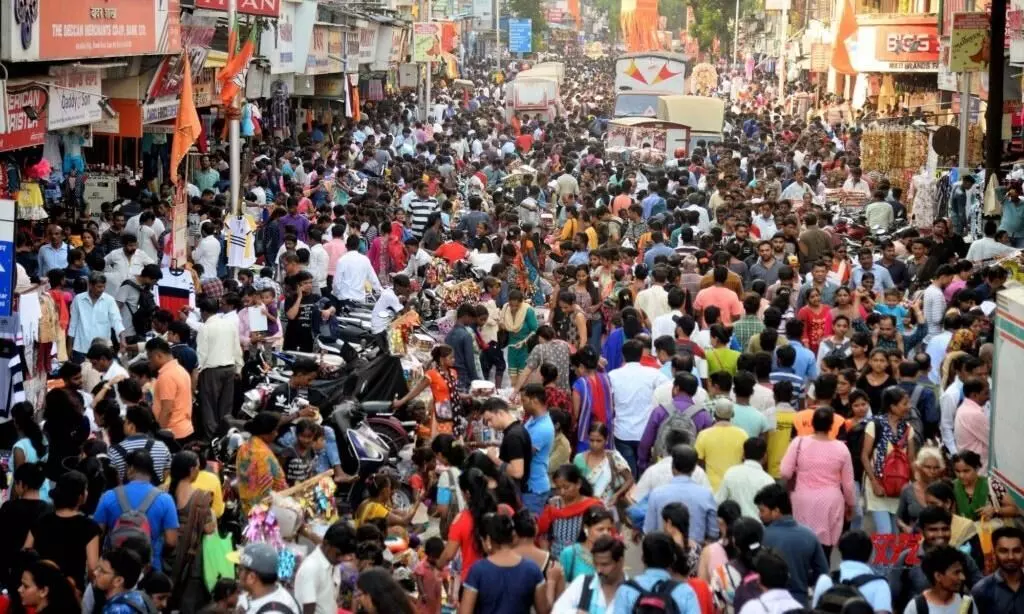
Lack of education and poverty were some of the factors leading to population growth.
No doubt, India is yet to hold its latest census, the last one having been conducted as far back as 2011, because the 2021 census had to be postponed due to Covid-19.
Yet, estimates by UN agencies had asserted that this nation surpassed China in population in April 2023. Such a phenomenon has been a mixed blessing – because of its younger and more productive population, India has been in a better position to keep up the upward progress in its economy. On the other hand, the rapid growth of population is of serious concern too, since it poses an almost insurmountable challenge to all efforts at alleviating hunger and poverty and improving the quality of life.
The dubious “reputation” of being the world’s most populous nation has entailed that our planners are coerced into focusing on ways to decrease the birth rate and enhance effective family planning.
Such a situation is in ironic contrast to what is happening in a number of other countries, where material advancement has resulted in a fall in fertility and birth rates and induced an unwillingness in the youthful generation to have children.
South Korea, for instance, which has the lowest birth rate in the world of 0.72, significantly below the replacement level of 2.1 necessary to maintain a stable population, is struggling to reach that level!
The biggest irony is the plight of China, once the most populous country in the world. The fly in China’s ointment had been that for a long time, to artificially control its burgeoning population, it had imposed a stringent one child per family policy, which had pushed the nation into what was described as an “era of negative population growth.”
However, even after the ruling Communist Party abolished this policy almost a decade ago, the country’s birth rate kept falling, primarily because the people had become aware of the advantage of having a small family, given the exorbitant cost of raising children. According to a study by a China-based Population Research Institute, raising a child to the age of 17 in China costs an average of $75,700! Therefore, in an ironic reversal, the Chinese government has been undertaking a slew of measures to halt the declining birth rate trend. The latest such measure is the offer by Beijing of 3,600 yuan (£375; $500) a year for each of their children under the age of three in the government’s first nationwide subsidy aimed at boosting birth rates.
The handouts will help around 20 million families with the cost of raising children, according to state media. Several provinces across China have piloted some form of payouts to encourage people to have children, a far cry from what had prevailed just a decade ago!