
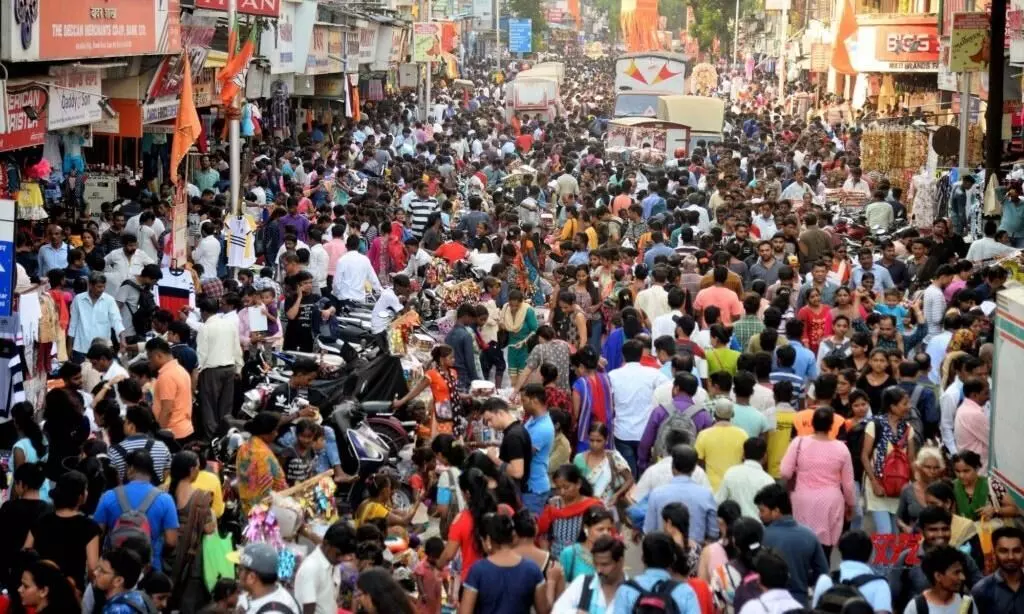
Lack of education and poverty were some of the factors leading to population growth.
Taking a leaf out of the Opposition's book, the NDA government's Cabinet Committee of Political Affairs has decided to make caste-based enumeration a part of the upcoming decadal census. It may be noted that the Opposition, particularly the Congress party, has been reaping dividends from its demand for caste-based enumeration so as to be able to identify the societal segments most in need of state assistance for empowerment at the political and economic levels.
Analysts believe that this demand has been greatly responsible for the relatively good show by the Opposition during the last Lok Sabha elections. When they had been ruled by non-BJP alliances, Bihar, Telangana, Andhra Pradesh and Karnataka conducted caste-based surveys - in fact, the very first such survey in Bihar by the Janata Dal (United) when it was part of the Opposition alliance, which showed backward communities make up nearly two-thirds of the State, had gone a long way to shore up Nitish Kumar's political fortunes.
Having resisted caste-based enumeration so far, the NDA leadership has finally seen the virtue of making this a strategic part of its future electoral planning, and has announced its commencement at the national level from the next census, which is most likely to begin from next year. Expectedly, they have tried to paint it as an original and "historic" decision designed to help the government draft "equitable and targeted" policies!
They have also attacked the caste-based surveys carried out by the States as having been conducted in a non- transparent manner, not with altruistic but political motivation. They insist that to ensure the social fabric is not disturbed by politics, caste enumeration should be transparently included in the census instead of being part of surveys, a step which will "strengthen the social and economic structure of society." They have simultaneously launched a critique of the preceding UPA government headed by Manmohan Singh for not heeding the widespread demand for caste-based enumeration, though the Congress has not been chary of using it as a political tool.
By taking this decision, the NDA hopes to neutralise any gains the Opposition may have made by asking for it-it is no wonder that the decision has been made prior to the Bihar elections, which will be a test of how effective it will be as a strategy in future elections.
Opponents of the universal tendency among Indian political parties to use caste as a political instrument point out that this does not suit a country that is striving to emerge as a major, modern global power, while expressing fear that such a step will lead to an expansion of caste-based quotas beyond the 50 percent mandated by the Supreme Court. But, now that the Centre, too, has buckled to the demand, rather than disappearing gradually, caste politics appear to be destined to remain.