
Rodent outbreak hits Mizoram, over 4,700 farming families affected
Triggered by rare bamboo flowering, rats destroy crops in 150 villages; govt scrambles to contain damage
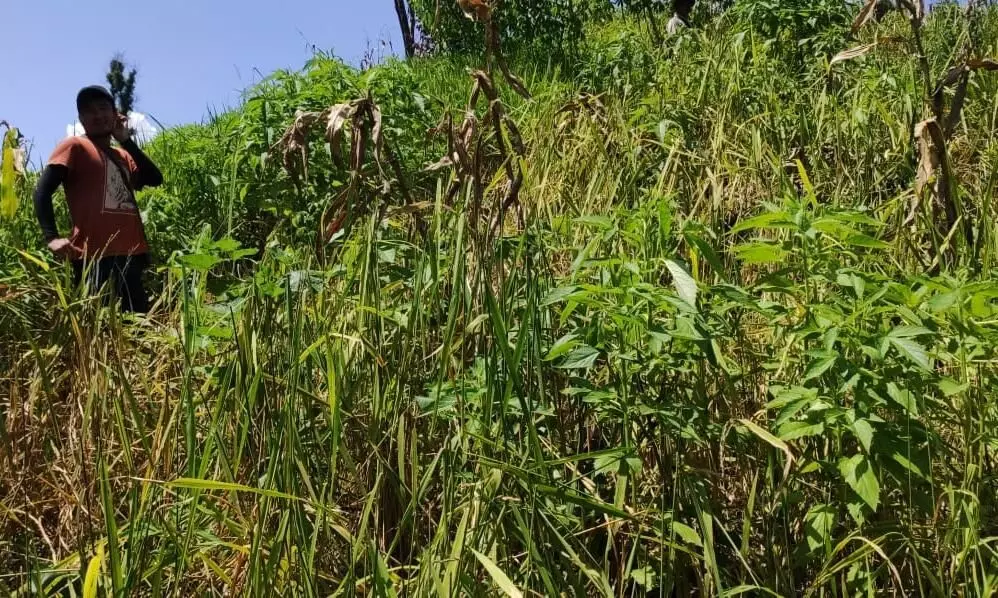
A file image of crop destroyed due to rodent outbreak in Mizoram. (Photo: @airnews_aizawl/x)
Aizawl, Oct 22: Reports of large-scale crop destruction caused by a massive rodent outbreak continue to pour in from across Mizoram, with the number of affected farming families climbing to 4,756 in at least 150 villages spread across all 11 districts of the State, officials from the Department of Agriculture and Farmers’ Welfare said on Monday.
The rodent population explosion has been linked to the gregarious flowering of “rawthing” (bambusa tulda), a bamboo species whose cyclical blooming, known locally as “Thingtam”, triggers an ecological chain reaction that leads to mass breeding of rats. Officials reported that of the 6,938.154 hectares of farmland identified so far, 1,988.34 hectares have been either completely or partially ravaged by rat swarms.
While paddy has borne the brunt of the destruction, other crops, including maize, sugarcane, cowpea, ginger, eggplant, chilli, pumpkin, sesame, and cucumber, have also suffered extensive damage in some regions.
To contain the outbreak, at least 186 kilograms of rodenticides – mainly bromadiolone and zinc phosphide – have been deployed in affected areas. Alongside chemical control measures, farmers are also resorting to traditional methods such as slingshots and locally designed traps known as “vaithang,” “mangkhawng,” and “thangchep” to cull rats invading their paddy fields.
Experts have long warned that a Thingtam event was imminent this year. The rare bamboo flowering, similar to “Mautam”, which occurs when Melocanna baccifera species blooms, follows a 48-year cycle. The last Thingtam occurred in 1977, making the 2025 episode a near-exact recurrence.
However, officials admitted that the State government’s preparedness to tackle the phenomenon has fallen short of scientific recommendations. Despite early forecasts from agricultural scientists about the likely resurgence of Thingtam, preventive and mitigation measures were reportedly inadequate, leaving many villages vulnerable to the ongoing rodent menace.
The Agriculture department continues to assess the extent of damage and coordinate with district authorities to deliver emergency supplies of rodenticides and relief to affected farming communities, as the crisis shows no sign of abating.