
Racism in plain sight: Why Northeasterns still face bias in big cities
Recent Delhi incidents expose enduring racism faced by Northeastern people despite years of policy debate and awareness
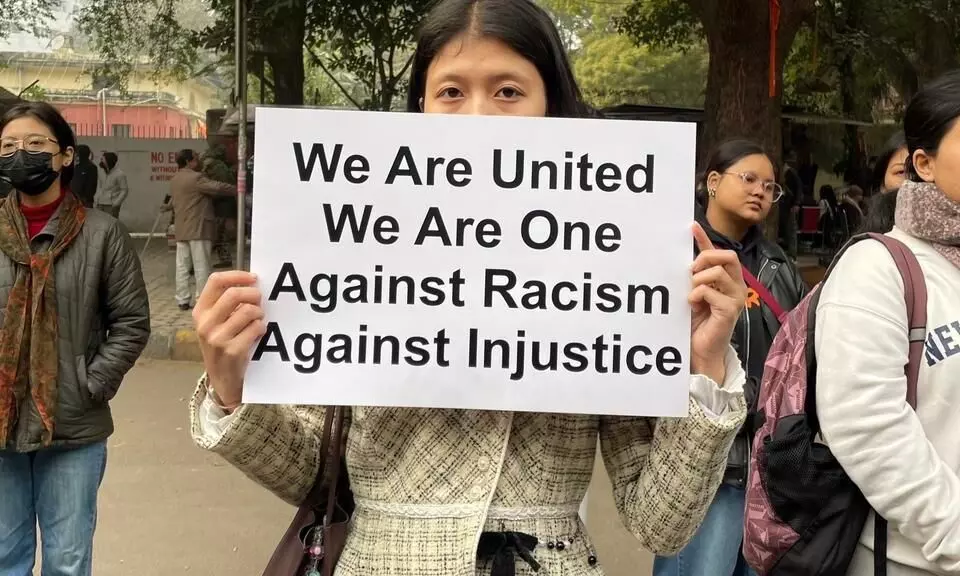
A file photo of a protest held at Jantar Mantar over the death of Tripura student Angel Chakma (Photo: Meta/ H Allyang Chakma)
For many people from Northeast who live, study or work in metropolitan cities, subtle prejudice and overt racism remain uncomfortable and recurring realities.
While the region’s young population increasingly migrates to cities like New Delhi in search of education, employment and opportunity, they often find themselves confronting stereotypes, discrimination and, at times, outright hostility.
The issue has once again come under scrutiny following the alleged assault of a woman from Manipur and a third-gender person from Assam near Saket Court in New Delhi on March 8.
The incident has sparked public outrage and renewed concerns about the safety and dignity of people from the region living in the national capital.
Political leaders from the region were quick to condemn the attack. Meghalaya Chief Minister Conrad K. Sangma described the incident as “sickening” and urged that racial bullying must not be accepted as the new normal.
Former Manipur Chief Minister N. Biren Singh also condemned the assault, stressing that such incidents “have no place in our society”.
What has heightened concern, however, is the recurrence of such incidents in the country’s capital. The alleged assault near Saket comes barely weeks after a Delhi couple was arrested for hurling racial slurs at three women from Arunachal Pradesh on February 20.
Taken together, these incidents have revived a long-standing debate. Despite years of discussion and repeated calls for change, racism against people from the Northeast continues to surface, raising troubling questions about identity, belonging and acceptance in India’s social fabric.
A woman from Manipur was allegedly assaulted in Delhi on March 8
Everyday bias still lingers
Many members of the Northeastern community argue that while policy discussions have continued, the everyday experiences of discrimination remain far from resolved.
“Sometimes it is the jokes, sometimes people asking if we are from China or Nepal. It makes you realise how little people know about us,” said Debajani Sonowal, a resident of Guwahati who previously worked for a private organisation in Delhi.
Another young professional from Assam who studied in the capital recalled similar encounters during his time there.
“I used to get called ‘chinky’ or ‘Chinese’; this was around 2015–16. Even when we go out for daily chores, people would hurl slurs at us. That was one of the reasons I eventually left Delhi,” said Nirupam Basumatary.
For thousands of students and professionals who move to cities like Delhi each year, the hope is not merely for justice after such incidents occur, but for a broader societal shift where respect and inclusion become the norm rather than the exception.
A Delhi couple was arrested for hurling racial slurs at three women from Arunachal Pradesh on February 20. (Photo:'X')
‘Racism exists in India’
The persistence of such incidents has also prompted questions about whether enough has been done at the institutional level to address discrimination faced by people from the Northeast.
Pradyot Bikram Manikya Debbarma, chief of the Tipra Motha Party, said the issue is widely recognised but rarely acknowledged openly.
“Everybody knows these things are happening. It is because of ignorance and the belief that certain communities are superior to others. Racism exists in India. We are the world’s largest producer of Fair & Lovely. Whether we admit it or not, racism exists,” he said.
According to Debbarma, the problem is also closely linked to the limited awareness about the Northeast within mainstream Indian discourse.
“There is the Bezbaruah Committee that produced a report which is yet to be properly taken up by the Government of India. The committee addressed these issues in 2014 and if its recommendations are tabled in Parliament and acted upon, it would be of great help,” he said.
The Bezbaruah Committee was constituted by the Ministry of Home Affairs in 2014 following the murder of Nido Tania, a student from Arunachal Pradesh in Delhi.
The panel was tasked with examining racial discrimination and safety concerns faced by people from the Northeast living in other parts of India, particularly in metropolitan cities, and recommended several legislative and policing reforms.
Debbarma said broader societal efforts were also necessary to address stereotyping and discrimination, adding that implementing the committee’s recommendations could be an important step forward.
“The Committee report itself talks about issues related to accommodation, creating awareness and sensitivity, and education. People across India should be taught more about our region. There are several recommendations in the report that can help address these concerns,” he added.
For many people from the Northeast, the hope remains that conversations sparked by such incidents will eventually translate into meaningful change, ensuring that every Indian, regardless of where they come from, feels safe, respected and accepted anywhere in the country.