
Over 2.6L trees cut for highway expansion in Manipur in 5 years: RTI reveals
RTI replies from NHIDCL units indicate over 6 lakh trees felled across the Northeast in five years, says activist
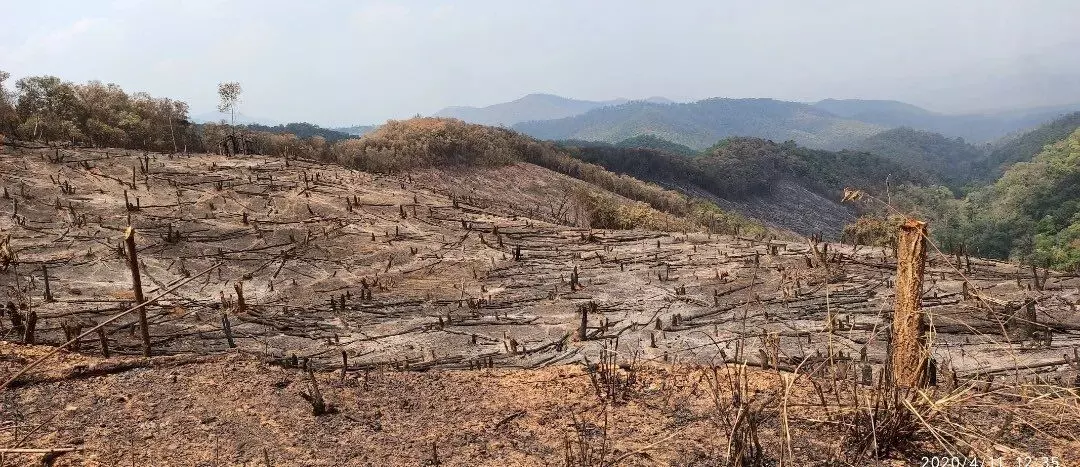
A view of deforestation in Manipur’s hill region. (Photo:@TheBlueHills49/X)
Imphal, March 15: More than two lakh trees have been felled for highway construction and widening projects in Manipur over the past five years, with crores of rupees deposited for compensatory afforestation, according to information obtained under the Right to Information (RTI) Act.
The information was obtained by activist Rahul Roy, who sought details from the National Highways & Infrastructure Development Corporation Limited (NHIDCL) on tree felling, afforestation measures and funds deposited for compensatory plantation in connection with road projects in the Northeast.
Replies from various Project Monitoring Units (PMUs) of NHIDCL in Manipur indicate that 261,084 trees were cut across several districts for highway expansion works.
Under the PMU-Noney jurisdiction, 2,18,665 trees were reported to have been felled in the past five years for road construction and related infrastructure projects.
In the Tamenglong sector, projects under the Tamenglong–Mahur corridor accounted for significant tree loss, including 14,911 trees in Package-01, 15,516 in Package-02 and 11,992 in Package-03, besides several thousand more in other project packages and the Tamenglong–Khongsang stretch.
The Churachandpur PMU reported tree felling linked to projects along the Churachandpur–Tuivai stretch of NH-102B and the Imphal–Moreh highway, with individual packages reporting between 1,000 and 2,700 trees felled.
In Senapati district, projects such as Maram–Peren, Imphal–Kohima and Ukhrul–Talloi–Tadubi also involved large-scale tree clearing, with several packages reporting thousands of trees cut.
The PMU-Ukhrul reported substantial tree felling along projects including the Yainagngpokpi–Finch Corner road and the Choithar–Marrem Khullen and Marrem Khullen–Jessami stretches, where individual packages recorded between 35,000 and nearly 48,000 trees felled.
Speaking to The Assam Tribune, Roy claimed that over 6 lakh trees have been felled across the Northeast in the past five years, based on RTI replies from various NHIDCL project units.
Referring to the floods experienced in Manipur last year, Roy said indiscriminate and poorly planned tree felling could aggravate environmental risks in the region.
“All this is happening because of lack of planning. The government is not taking the matter seriously,” he said, adding that unchecked tree cutting could increase the risk of floods, landslides and ecological degradation in hill areas.
NHIDCL officials stated that compensatory afforestation funds were deposited with the State Forest Department as required under environmental regulations.
Under PMU-Tamenglong, funds deposited for compensatory afforestation ranged from Rs 1.41 crore to Rs 4.85 crore, while Rs 19.08 crore was deposited under the PMU-Noney jurisdiction.
In the Churachandpur sector, compensatory afforestation payments ranged from Rs 0.28 crore to Rs 3.70 crore for projects including the Imphal–Moreh corridor, with similar payments reported under the Senapati and Ukhrul PMUs.
NHIDCL said the required approvals were obtained from the concerned forest authorities and that funds were deposited in the CAMPA account for compensatory afforestation and avenue plantation.
Responding to the concerns, Director of Environment and Climate Change, T. Brahakumar Singh said development projects involving tree felling must follow prescribed environmental procedures.
He said project proponents, including agencies such as NHIDCL and the Public Works Department (PWD), are required to apply for clearances through the “Parivesh” online portal.
According to him, both forest clearance and environmental clearance are processed through the same portal but examined by different authorities. “For forest clearance, the proposal goes to the Forest Department, while environmental clearance is examined by our department,” he said.
Singh said proposals are examined by the Environmental Impact Assessment (EIA) Authority and forwarded to the State Level Expert Appraisal Committee, which evaluates the project before recommending whether clearance should be granted.
Environmental safeguards, including protection of existing trees, pollution control and mitigation measures, are examined during the appraisal process, he added.
“If trees are present, we advise project proponents to preserve them wherever possible and follow environmental safeguards. Only after complying with these recommendations is clearance granted,” he said.