
Meghalaya CM defends 50-yr-old reservation policy, warns of court scrutiny
Sangma says reservation cannot be based solely on population, stresses constitutional criteria, equity
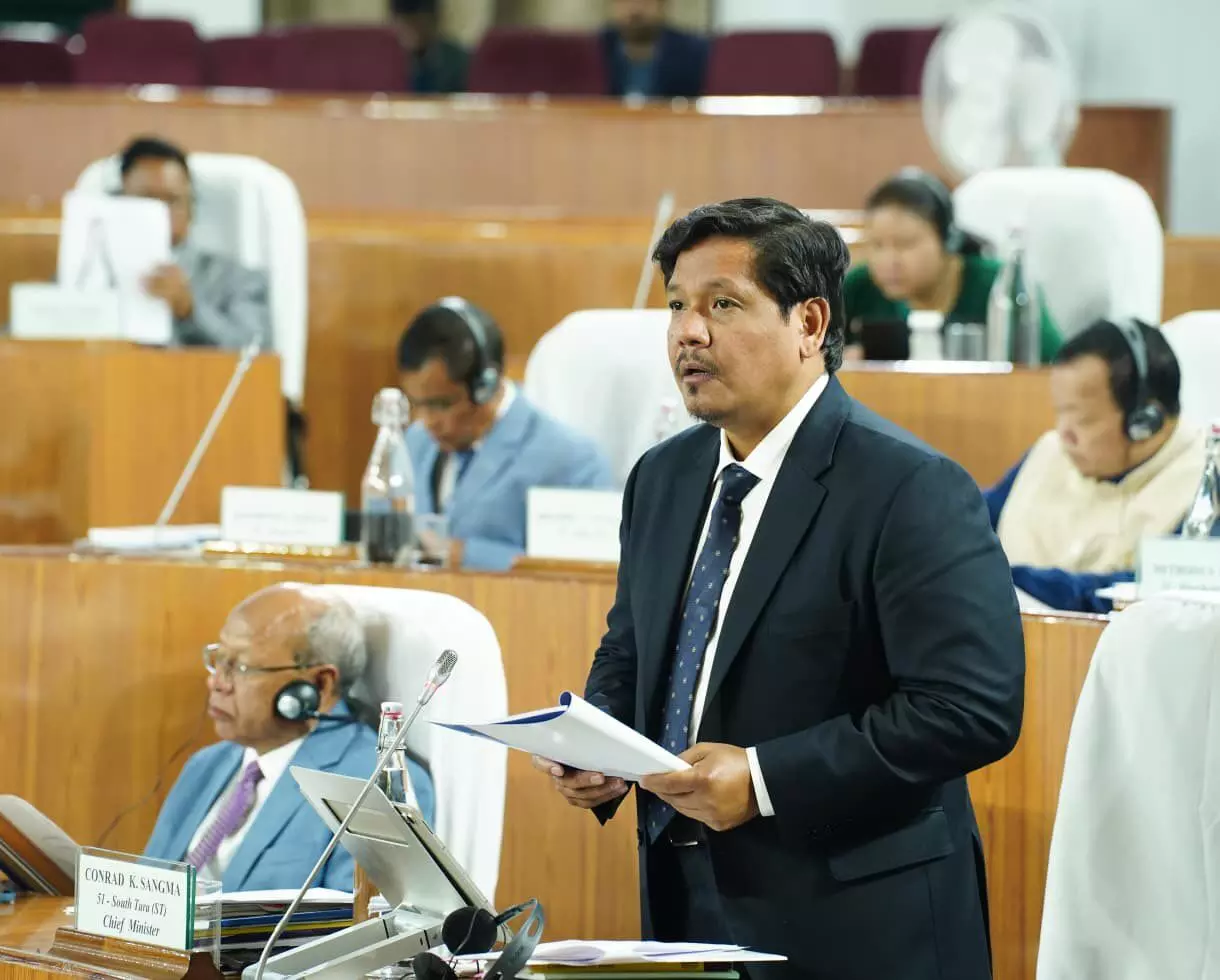
CM Conrad Sangma addressing the budget session of Meghalaya Assembly 2026. (Photo:@SangmaConrad/X)
Shillong, Feb 26: Meghalaya Chief Minister Conrad K. Sangma has defended the state’s existing reservation policy, stating that any attempt to alter the framework could be subject to judicial review.
He emphasised that while no policy is flawless, changes must be approached cautiously, keeping constitutional principles and legal scrutiny in mind.
Replying to a Zero Hour notice and participating in a short-duration discussion raised by Voice of the People Party (VPP) legislator Ardent Miller Basaiawmoit on the report of the Committee on the Reservation Policy, Sangma, on Wednesday, informed the Assembly that the panel itself had cautioned against abrupt changes.
“The committee clearly stated that any attempt to change the Reservation Policy could be subject to judicial review. Therefore, we must proceed carefully and in accordance with constitutional safeguards,” the Chief Minister said.
At the same time, he acknowledged the need for periodic review.
“No policy is perfect, and policies must evolve with time. The present exercise is aimed at examining the framework to see how it can be improved without violating constitutional norms,” he added.
Sangma referred to the 1972 office memorandum under which 40% reservation was allocated to the Garo community and another 40% to the Khasi and Jaintia communities in state government jobs.
According to him, the committee noted that the then government had taken a balanced decision based on available data and socio-economic realities.
“The panel opined that the distribution of reservation at that time was done after considering all relevant aspects and was appropriate in the context of the prevailing conditions,” he said.
However, the Chief Minister acknowledged that socio-economic conditions have undergone significant changes over the past five decades. Despite this, he pointed out that disparities among the major tribal groups continue to exist.
“Over the last 50 years, there have been notable changes in socio-economic indicators. Yet, the differences among the communities largely remain, which indicates that the foundational objectives of the policy still hold relevance,” Sangma said.
He also underlined that the present reservation structure has been in place for over 50 years and has not faced serious judicial scrutiny so far. Any change, however, could attract legal challenges.
“The current policy has stood the test of time. While its chances of being challenged now may be minimal, any change or restructuring could invite judicial examination,” he cautioned.
Addressing demands for population-based reservation, the Chief Minister clarified that such an approach may not align with constitutional provisions.
“Reservation cannot be determined solely on the basis of population. Smaller communities may require greater support, while larger groups may not necessarily be underrepresented,” he said.
He reiterated that the primary criteria for reservation remain socio-economic backwardness, historical injustice and adequacy of representation in public services.
“These are the principles laid down by the Constitution and the Supreme Court. The focus has always been on ensuring justice and equitable representation,” he noted.
Sangma also dismissed suggestions that reservation in the state was influenced by religious considerations.
“The criteria for reservation have always been socio-economic backwardness and not religious affiliations,” he said.