
Manipur maps 1,000 springs, 173 critical sources identified for revival
Manipur’s Directorate of Environment and Climate Change mapped over 1,000 springs, with 173 critical springs in Ukhrul and Noney districts proposed for revival
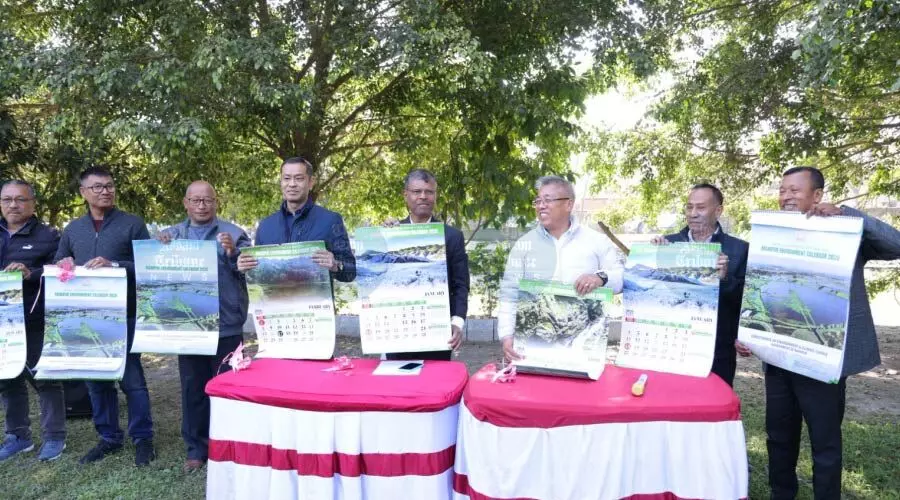
An environment calendar being released on the office premises of the Directorate of Environment and Climate Change, Manipur
Imphal, Dec 28: The Directorate of Environment and Climate Change (DoECC) in Manipur has mapped more than 1,000 springs across the State. Out of them, 173 critical springs located in Ukhrul and Noney districts, have been proposed for revival under a priority scheme.
This was disclosed by the Principal Secretary (Forest, Environment and Climate Change), Arun Kumar Sinha, at a function held to release the annual Environment Calendar, 2026 at Porompat in Imphal East district today.
“As the State nodal agency, the DoECC has also delineated and mapped 71 wetlands. As many as three wetlands have been notified and four are being rejuvenated,” Sinha said while stressing that collective responsibility is essential to ensure that natural resources are preserved and conserved for future generations.
He stated that the environment calendar is part of an information and dissemination programme about environmental events and observances in the State, country, and world. The first such calendar of the department was released in 2013.
The observances begin with the World Wetlands Day on February 2, followed by the World Water Day in March, the World Earth Day in April, the International Day for Biological Diversity in May, the World Environment Day in June, the World Nature Conservation Day in July, the International Day of the World’s Indigenous Peoples in August, the World Ozone Day in September, and the International Mountain Day in December.
Sinha added that most months in the released calendar are themed around important environmental observances. For example, the January page showcases the Dzuko Valley of Manipur, highlighting its natural body during the winter season.
The February page features a water body in Tamenglong district. In March, the calendar depicts the natural flow of the Barak river. The April page highlights the beauty of spring, and the month of May showcases migratory birds across wetlands.
Dr T Brajakumar Singh, Director of Environment and Climate Change, also spoke in the function, which was attended by staff and officials as well functionaries of the media resource centre of the DoECC.