
India pitches Meghalaya’s living root bridges to UNESCO’s World Heritage list
Crafted over centuries, Meghalaya’s living root bridges reflect Khasi and Jaintia communities’ enduring bond with nature
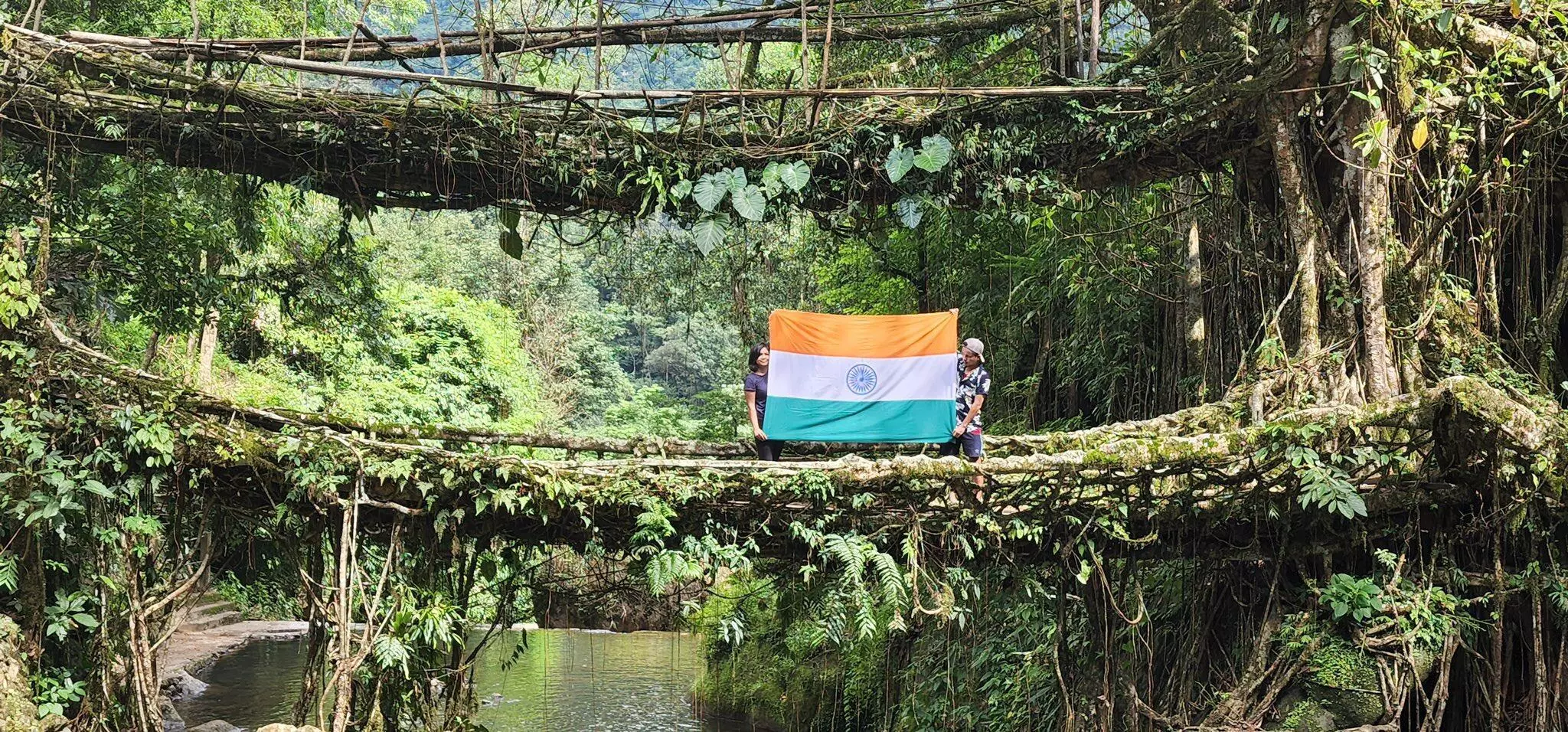
Two local residents hold the Tricolour atop one of Meghalaya’s living root bridges. (Photo:@SangmaConrad/X)
Shillong, Jan 29: India has submitted to UNESCO in Paris the nomination dossier of Meghalaya's living root bridges for consideration to include in the World Heritage list 2026-27, Chief Minister Conrad K Sangma said, on Thursday.
The dossier was handed over by India's Ambassador Vishal V Sharma to UNESCO's World Heritage Centre Director Lazare Assomo Eloundou.
"We are hopeful that the living root bridges will be inscribed this year, ensuring that the indigenous communities, the true guardians of this living heritage, receive the global recognition they so richly deserve," Sangma said in a social media post.
While submitting the dossier, Sharma, the Permanent Representative to UNESCO, thanked Prime Minister Narendra Modi, Union Culture Minister Gajendra Singh Shekhawat and the Meghalaya CM for their support to the nomination, the Permanent Delegation of India to UNESCO said in a statement.
Sharma also acknowledged the role of Meghalaya Principal Secretary Frederick Kharkongor, officers of the Archaeological Survey of India, the Ministry of External Affairs, experts and the local communities in safeguarding the property and preparing the nomination.
Located across the southern slopes of the Khasi and Jaintia Hills of Meghalaya, the nominated bridges represent a living cultural landscape shaped over centuries by indigenous Khasi and Jaintia communities.
"The landscape reflects a deep-rooted and harmonious relationship between people, nature and spirituality, embodied in traditional systems of land use, governance and ecological stewardship," a statement said.
The indigenous worldview underpinning the cultural landscape is anchored in principles of respect, reciprocity and responsibility towards Mei Ramew (Mother Earth), it said.
"The submission of this nomination underscores India's commitment to recognising and preserving living cultural traditions and indigenous knowledge systems, and to advancing global heritage conservation efforts through UNESCO," the statement added.
PTI