
Arunachal govt tables Rs 36,607 Cr budget with Rs 701 Cr deficit for 2026–27
Dy CM Mein calls the budget ‘people-centric & growth-oriented’, structured around six priority sectors
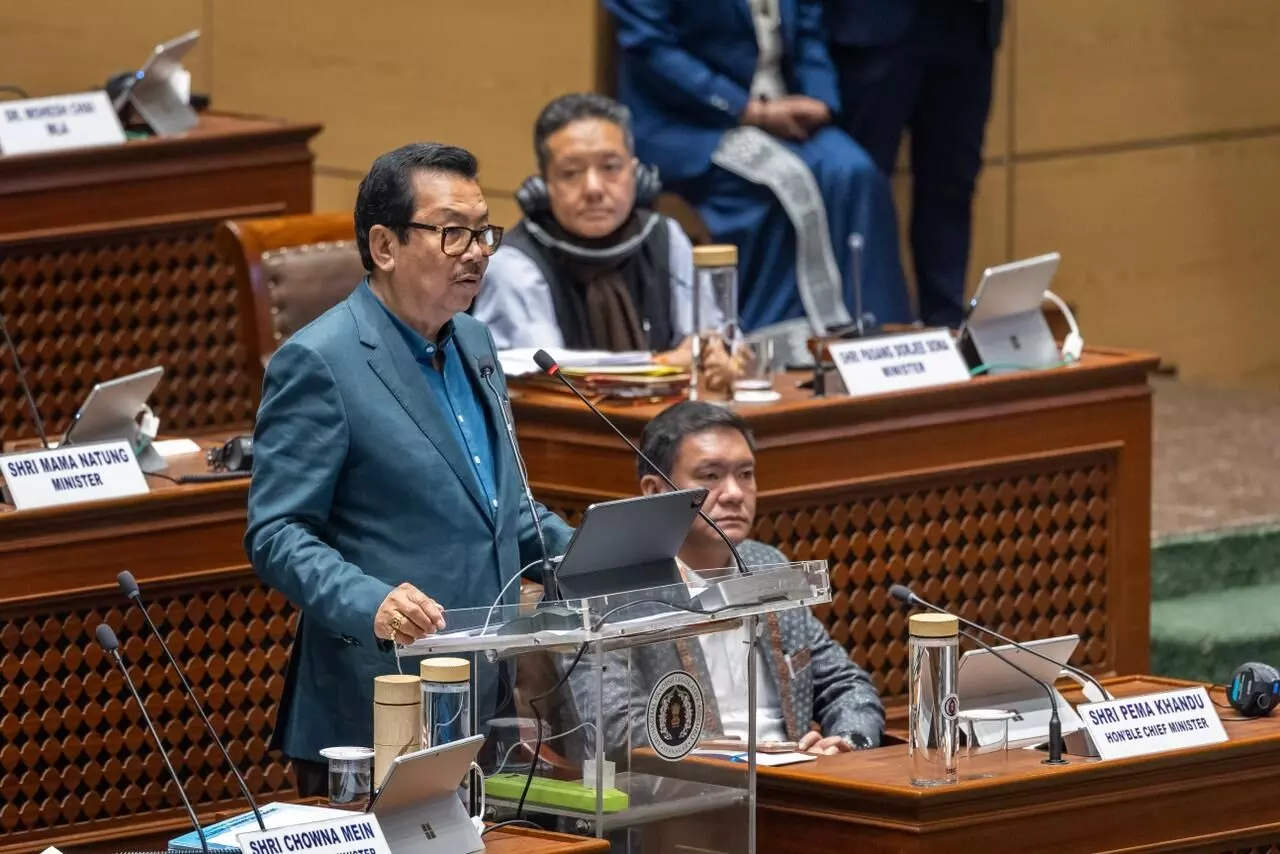
Dy CM Chowna Mein tabling the state budget for financial year 2026-27, on Tuesday. (Photo: @ChownaMeinBJP/X)
Itanagar, March 10: The Arunachal Pradesh government, on Tuesday, presented a Rs 36,607-crore state budget for the financial year 2026–27 in the Legislative Assembly, outlining a development roadmap centred on six key sectors aimed at strengthening infrastructure, improving governance and promoting inclusive economic growth.
Deputy Chief Minister Chowna Mein, who also holds the finance, planning and investment portfolios, said the proposed budget carries a deficit of Rs 701.43 crore.
The budget for the upcoming fiscal year reflects a reduction compared with the previous year’s outlay of Rs 39,842 crore, representing a decrease of around 8.1%.
According to Mein, the reduction is primarily due to a shortfall in allocations from the Centre following the recommendations of the 16th Finance Commission, particularly in terms of horizontal devolution.
Despite the reduction in the overall outlay, Mein described the budget as “people-centric and growth-oriented,” aimed at ensuring balanced development across sectors and regions.
Mein said the budget has been designed to benefit all sections of society in the state.
“This budget is designed to reach every section of society. Through its focus on health, education, livelihoods, connectivity, safety, culture and governance, it ensures that all 16 lakh-plus people of Arunachal Pradesh benefit from one or more of the measures announced,” he said.
The budget has been structured around six major priority sectors, each targeting critical aspects of the state’s development.
The first focus area emphasises infrastructure strengthening, with an allocation of Rs 2,038 crore. This includes investments in road connectivity, hydropower and border infrastructure, electricity transmission and distribution, solar energy generation and off-grid electrification, reflecting the government’s push to enhance connectivity and energy access across the state.
The second focus area centres on people-centric development, which has been allocated Rs 3,320 crore.
The sector prioritises improvements in health infrastructure, disease prevention, public health services, school education, early childhood care, higher education and skill development.
The initiatives also aim to support youth and girls through targeted welfare and educational programmes.
Another key component of the budget is sustaining economic growth, with Rs 630 crore earmarked for initiatives such as oil palm cultivation, Atmanirbhar youth programmes, promotion of millets, agricultural education, diversified high-value farming, tourism and the emerging wine economy in the state.
To boost employment and entrepreneurship, Rs 307 crore has been allocated for programmes under the Arun MSME Mission, corporate partnerships, promotion of medium and large industries, skill development initiatives for working women, and support for startups and self-employment.
The government has also emphasised resource mobilisation and fiscal stability, allocating Rs 188 crore to improve revenue generation and strengthen financial management systems.
Measures include monitoring centrally sponsored schemes, restructuring the state tax department and introducing reforms in the power sector. The state is also exploring innovative financing mechanisms such as carbon markets and green bonds.
The sixth focus area concentrates on governance and administrative reforms, with Rs 727 crore earmarked for improving service delivery and institutional efficiency.
Key initiatives include strengthening police and fire services, implementing the e-Inner Line Permit (e-ILP) system, enhancing border management and adopting technology-driven governance systems to improve transparency and efficiency.
The deputy chief minister noted that sustained investments in sectors such as education, healthcare, infrastructure, connectivity and human capital development are helping shape a long-term development agenda for the state.
Mein also stressed the importance of balancing development with the preservation of Arunachal Pradesh’s rich cultural heritage.
“Through the preservation of indigenous cultures, protection of languages, documentation of rare manuscripts, strengthening museums, festivals and cultural missions, we envision an Arunachal that is modern yet rooted, globally connected yet proudly indigenous,” Mein said.
Expressing optimism about the state’s future, he said collective efforts and forward-looking governance would enable Arunachal Pradesh to emerge as a model of balanced and sustainable development.
“With faith in our people and the spirit of Sabka Saath, Sabka Vikas, Sabka Vishwas and Sabka Prayas, we will continue to move forward towards inclusive and sustainable growth,” Mein added.
The budget will now be taken up for further discussion and approval in the Assembly in the coming days.