
750-yr-old human skeletal remains unearthed in Mizoram cave, carbon dating confirms
The discovery was first made on January 11, 2025, when a villager from North Khawlek stumbled upon skeletons, skulls, femurs, and fragments of earthen pots inside Thingkuang cave.
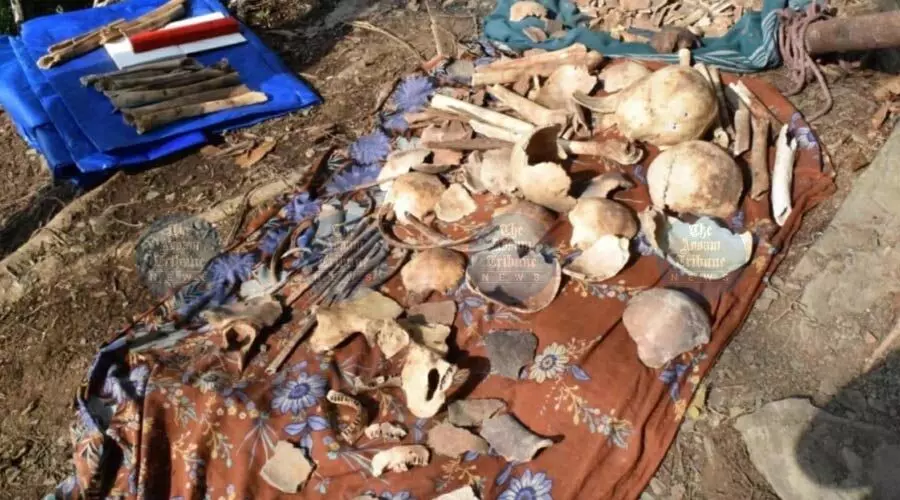
Human skeletal remains discovered in Mizoram
Aizawl, Sept 4: Human skeletal remains discovered in a cave in Saitual district have been dated to between 1260 and 1320 CE through carbon-14 testing, the Mizoram chapter of the Indian National Trust for Art and Cultural Heritage (INTACH) stated on Tuesday.
INTACH Mizoram convener Rin Sanga, a retired IAS officer, said samples from the cave in Thingkuang forest near North Khawlek village on the Mizoram-Manipur border were analysed by Beta Analytic, Florida, one of the world’s leading radiocarbon dating laboratories. The results confirmed the remains to be over 750 years old.
“Our samples, coded NKHL1, have been dated to the late 13th or early 14th century,” Sanga said.
The discovery was first made on January 11, 2025, when a villager from North Khawlek stumbled upon skeletons, skulls, femurs, and fragments of earthen pots inside Thingkuang cave, located on a steep cliff about 50 feet above the ground between North Khawlek and Vanbawng villages.
According to INTACH, further tests, including DNA sequencing, are being planned to establish the identity and origin of the people whose remains were found. Experts said that such analysis could help trace the ancestry of the population, provide insights into their diet and health, and shed light on possible migration routes into present-day Mizoram.
Historians have described the find as potentially significant for understanding Mizoram’s past. “Such discoveries are extremely rare in Mizoram. If further analysis confirms these remains to be linked with early Mizo settlers, it could offer valuable clues about their origins and way of life,” said a historian familiar with the development.
Many scholars believe the 14th century marked the migration of the Mizo tribes from the Kabaw valley into present-day Mizoram.