
Snow leopard population in Himachal Pradesh rises 62% in four yrs, hits 83: Survey
The findings highlight successful community-led conservation and expanding habitats beyond protected areas.
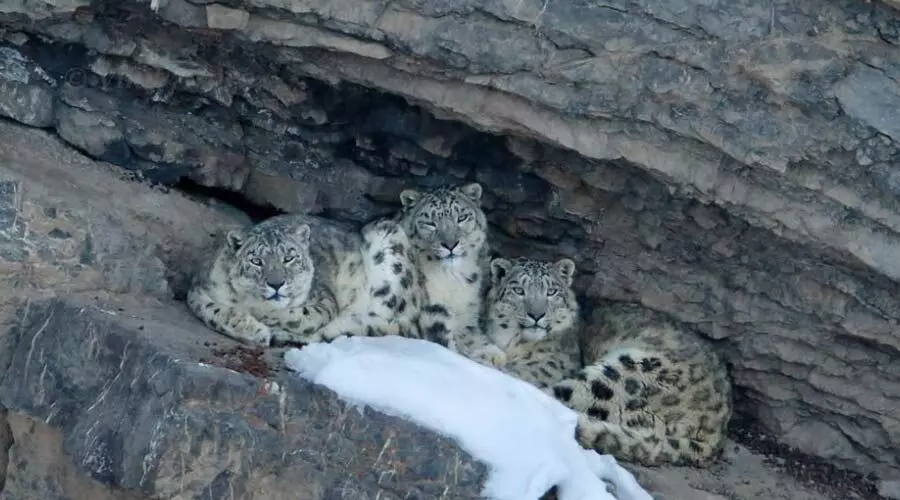
An image of Snow Leopard's in Kibber Wildlife Sanctuary, Spiti Valley, Himachal Pradesh. (photo:@BeingHimachali/X)
Shimla, Oct 3: The population of rare snow leopards in Himachal Pradesh’s high-altitude tribal regions has grown by 62 per cent over the past four years, according to a new state-wide survey released by the Forest Department’s Wildlife Wing. The number has risen from 51 in 2021 to 83 in 2025, marking a major milestone in India’s snow leopard conservation efforts.
The findings were announced on Thursday to mark the launch of Wildlife Week (October 2–8). Conducted over the past year, the assessment reflects the success of long-term conservation strategies that actively involve local communities living in remote mountain terrain.
Officials highlighted that the new figure excludes cubs and surpasses the earlier estimated upper confidence limit of 73 set in the 2021 baseline survey, suggesting a possible expansion of snow leopard habitat across Himachal Pradesh.
The survey was carried out using large-scale camera trapping across approximately 26,000 sq km, covering six distinct high-altitude locations. Snow leopards were recorded in the tribal districts of Lahaul-Spiti, Kinnaur, and Pangi Valley — reaffirming these as key strongholds for the elusive species.
Notably, snow leopards were also documented outside designated protected areas such as Kibber Wildlife Sanctuary, Great Himalayan National Park, Sechu Tuan Nallah Wildlife Sanctuary, and Asrang Wildlife Sanctuary, pointing to an adaptation and reoccupation of habitats within the species’ historical range.
The survey further mapped populations of prey species like blue sheep, Himalayan ibex, and musk deer, along with other high-altitude carnivores and mammals including Himalayan wolves, brown bears, leopards, red foxes, and martens.
Among its most significant discoveries were the first official sighting of the elusive Pallas’s cat in Kinnaur and the rediscovery of the woolly flying squirrel in Lahaul — two rare species underscoring the region’s rich biodiversity.
Community involvement was central to the study’s success. Youth and women from Kibber village in Spiti helped in deploying and monitoring camera traps and assisted with data analysis, alongside frontline forest officers. Their participation enabled the survey to be completed within one year, compared to the three years taken for the 2021 baseline assessment.
Authorities described the exercise as both cost-effective and scalable, offering a replicable model for snow leopard monitoring across the Indian Himalayas. Himachal Pradesh has now become the first state in India to conduct two comprehensive, state-wide snow leopard population surveys, setting a precedent for wildlife monitoring and conservation.
As climate change and human-wildlife conflict continue to challenge the survival of snow leopards, officials said consistent monitoring and community-driven conservation will be key to safeguarding this iconic species and the fragile alpine ecosystems it inhabits.
PTI