
The apex court also expressed deep concern over the state of district courts, where even judges, particularly in rural areas, still lack access to proper washroom facilities.
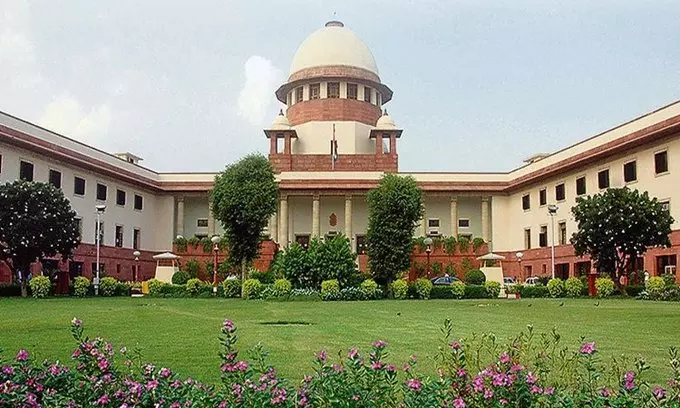
Photo: PTI/ Supreme Court of India
Guwahati, Oct 21: Taking cognizance of the ‘inhumane conditions’ involved in the practice of manual scavenging, the Supreme Court on Friday announced a slew of directives asking the central and state governments to eradicate manual scavenging completely across the country and compensate the kin of those who die while cleaning sewers adequately.
As per reports, the apex court observed that manual scavengers have lived in bondage, systematically trapped in inhuman conditions for a long time, following which it has directed the central and state governments to put a halt on manual scavenging and call for more compensation in the event of fatalities or injuries.
The apex court also demanded that the central and state governments give the next-of-kin of people who pass away while cleaning sewers Rs. 30 lakh in compensation, Rs. 20 lakh to people who suffer permanent impairments, and Rs. 10 lakh for other injuries.
"Ours is a battle not for wealth of power. It is a battle for freedom. It is a battle for reclamation of human personality," Justice S Ravindra Bhat quoted B R Ambedkar as he along with Justice Aravind Kumar pronounced the verdict on a PIL against manual scavenging.
"The Union and the state governments must ensure that manual scavenging is completely eradicated," the bench said.
The bench gave 14 directives to the central and state governments for the efficient implementation of the 2013 Prohibition of Employment as Manual Scavengers and their Rehabilitation Act. Moreover, the bench posted the PIL for further observation on February 1, 2024.
According to government figures provided in the Lok Sabha in July 2022, as many as 347 people died in India in the last five years while cleaning septic tanks and sewers, with 40% of these deaths occurring in Uttar Pradesh, Tamil Nadu, and Delhi.