
Rezang La: A battlefield where sacrifice outshines time
Rezang La Memorial, built in honour of Charlie Company of the 13 Kumaon Regiment, who fought a now-legendary battle here during the Sino-Indian War of 1962.
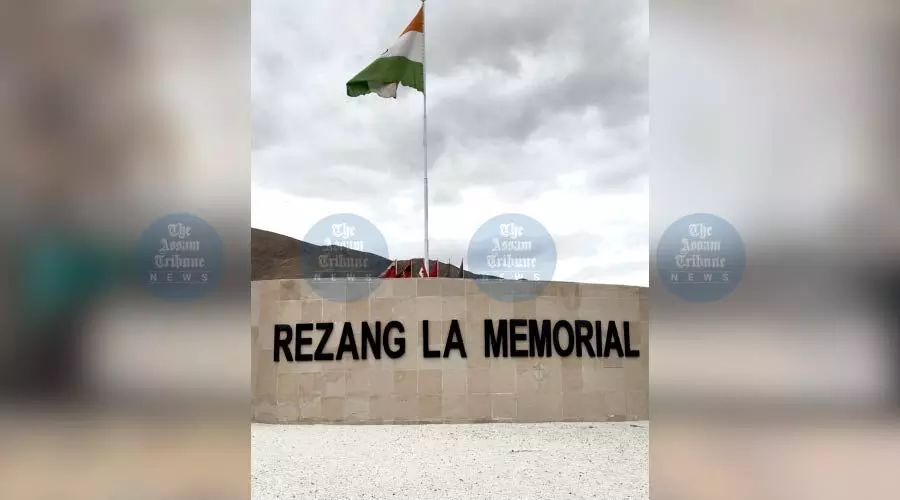
The words etched on the stone at Rezang La Memorial felt almost like a whisper in the wind, echoing across the stark and silent expanse of Ladakh. It wasn't just a line from Horatius here, it felt like the very soul of a battle- field that had witnessed extraordinary courage.
I stood in Chushul, near the India- China border, on a pleasant, warm early August afternoon. Before me lay the Rezang La Memorial, built in honour of Charlie Company of the 13 Kumaon Regiment, who fought a now-legendary battle here during the Sino-Indian War of 1962.
"Vir Chakra to a nursing assistant?" I murmured aloud, pausing mid-sentence, eyes on a name etched in stone Sepoy (NA) Dharam Pal Dahiya. The man in uniform standing nearby stout, proud, with a curled and waxed moustache seemed to have heard me.
"Yes, Ma'am," he said with a quiet, polite firmness, stepping closer. "When his body was found days later, he was still holding a syringe and a roll of bandage. He had died trying to save the wounded even as bullets flew and the cold claimed everything." His voice trembled slightly, but it wasn't emotion-it was reverence.
He went on to narrate the Battle of Rezang La, an episode of sheer grit, loyalty, and sacrifice so audacious and one-sided that military historians still marvel at it.
It was the early hours of November 18, 1962. The temperature had plum- meted to below -30°C. The Chinese, numbering over 3,000, launched wave after wave of attacks on the 120 Indian soldiers of Charlie Company, most of whom belonged to the Ahir community from Haryana and Rajasthan. They were stationed at Rezang La Pass, sitting at over 16,000 feet above sea level, guarding the crucial Spanggur Gap.
Due to the terrain, no artillery support could reach them. The Indian soldiers fought with light arms and mortars and unparalleled determination.
At the helm was Major Shaitan Singh, a man whose name would become synonymous with courage. When the Chinese began their assault, Singh moved between platoons, reorganising defences and rallying his men, all under relentless fire. He refused evacuation even after sustaining critical injuries. Instead, he ordered his comrades to leave him behind to avoid endangering their lives. His body was found months later, hidden behind a rock, still facing the enemy's direction-still guarding his post.
"Do you know what they found when they came to recover the site, after nearly three months of the battle?" the officer asked, his voice lowered. "When the snow receded in February 1963, a search party arrived at the battlefield. They discovered 97 frozen bodies still in their trenches, holding weapons. Out of 120 soldiers, 114 had died, many at their posts, their fingers frozen to their rifles."
I stood speechless. My eyes scanned the terrain - the brown ridges, the rugged silence. Nothing moved. But the place didn't feel empty. It felt full... of stories, sacrifice, and spirits that refused to fade.
It wasn't just about numbers or war stories; it was the way these soldiers had died. Not one of them turned away Thou fought till the last man, last round, creating a legacy that even their enemies couldn't ignore.
The man beside me pointed to a plaque listing the names of the martyred. Each name, each rank, each village etched into it held a lifetime. Among them: Dharam Pal Dahiya, the nursing assistant who earned the Vir Chakra for choosing duty over fear.
For their unmatched gallantry, Char- lie Company of 13 Kumaon was decorated with an exceptional number of military honours. The unit received one Param Vir Chakra (India's highest war- time gallantry award), awarded posthumously to Major Shaitan Singh, eight Vir Chakras, four Sena Medals, and one Mention-in-Dispatches. It remains one of the most decorated single company actions in Indian military history.
"Recovery teams found little spare wood for funeral pyres," the man continued. "So, officers' mess furniture was gathered and used as firewood. With full military honours, the soldiers were cremated on the Chushul high ground the very place on which this memorial stands today." Major Shaitan Singh's remains, flown to Jodhpur, were accorded a regal farewell before his cremation at his native village followed by national mourning.
"Nearly 1,300 Chinese soldiers were killed. It was not a defeat," the officer added. "It was an immortal stand."
Indeed, Rezang La was not about territory gained or lost. It was about values held and honoured-duty, hon- our, sacrifice. A company of just 120 soldiers had held back a battalion-size Chinese offensive. And they hadn't just slowed the enemy they had made them bleed.
As the sun dipped behind the mountains, casting long shadows over the memorial, I felt an unexpected tightness in my throat. We often read about he- roes in textbooks or watch dramatised versions on screen, but standing here, at this very ground where frostbitten courage was tested, I understood what it meant to live for a country and die for it without hesitation.
I left Rezang La with more than memories. I carried with me the weight of a story every Indian should know. A story that reminds us that our freedom. today was paid for not just by famous generals, but by young soldiers from dusty villages, nursing assistants with bandages in hand, and a major who chose death over desertion.
The next time I hear the wind whistle through the mountains, I will remember Rezang La. Not just as a pass in Ladakh. But as a shrine of unmatched heroism...