
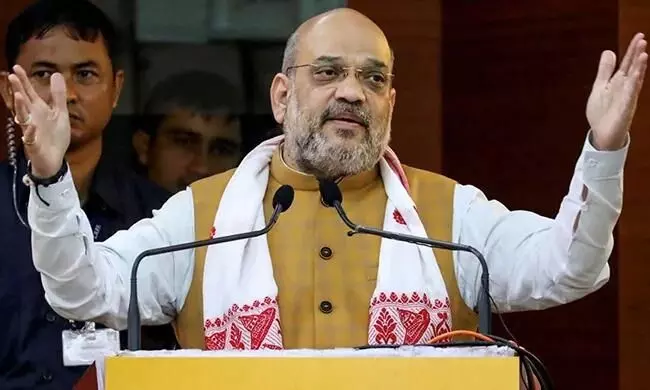
Amit Shah
- By Ramanuj Dutta Choudhury
Guwahati, Jan 25: The Union Home Minister, Amit Shah, has said that replacement of the British criminal justice laws with the new laws would bring about a sea change in the criminal justice system in India.
In an interview with The Assam Tribune, the Home Minister said that the laws made by the British were made to protect the rulers, but the new laws are aimed at protecting the victims.
The following are the excerpts from the interview:
The Assam Tribune: What forced the government to think about replacing the British laws, including Indian Penal Code, Code of Criminal Procedure and Indian Evidence Act with Bharatiya Nyaya Sanhita, Bharatiya Nagarik Surakshya Sanhita and Bharatiya Saksya Sanhita?
Amit Shah: The British made the laws to protect the British rulers and not to protect the victims of crimes. The laws were loaded heavily in favour of the rulers. Our aim is to give justice to the citizens of the country and not to the rulers. Cases are pending before the courts for years and the people hardly got any justice. That is why, the decision was taken to replace the British laws with Indian laws, which can give justice to the citizens of the country. Moreover, there were different sets of laws for different areas of the same country and there was need for bringing in unified laws.
AT: If the criminal justice laws were loaded in favour of the rulers, why did no government in the past try to change the laws and the British laws were allowed to run for more than 75 years since Independence?
Shah: (Laughing) You have to ask this question not to me but to the parties that ruled the country for years since Independence. As soon as we came to power, efforts to change the laws started. You know we cannot change the laws in a day and it is a time-consuming process.
AT: When did the process of preparing the new laws actually start?
Shah: It started in August 2019. We started by taking the opinion of the judges of the Supreme Court, High Courts, law colleges and universities, bar associations, IPS officers, etc. Personally, I have attended more than 1,500 meetings. The drafts were then sent to the Parliamentary Standing Committee and there were around 700 suggestions, of which more than 690 were incorporated. You must admit that when the en- tire criminal justice system in the country is to be changed, it needs a huge exercise.
AT: But the Opposition parties have alleged that the government did not discuss the new laws thoroughly…
Shah: (Interrupting) They may make such allegations. But I can vouch that no law in the country was discussed in such detail since Independence. I can vouch for it because I was personally involved with every step of the process.
AT: When does the Centre put the new laws in place?
Shah: The date has not yet been finalised. But we are planning to issue the requisite notification by the end of this month.
AT: But the police personnel have to be trained up to adapt to the new laws.
Shah: Yes. But that should not be a major issue. We have already prepared training modules and sent those to the states for training up the police personnel. At the same time, police training is a continuous process. We do not think that police personnel will find it difficult to adapt to the new laws once they start implementing the same on the ground.
AT: Since the laws were passed in the Parliament, you have been saying that the time taken for delivering justice would come down. But our experience over the years shows that in India cases keep pending for years. Do you really believe that the new laws will expedite the process?
Shah: Definitely. You will notice that the entire ecosystem of the criminal justice system will see a major change immediately after the new laws come into place. The laws make it sure that chargesheets are filed within a specific time frame. Charges will have to be framed within seven days and judgements will have to be delivered within 45 days. This will become possible be- cause use of technology has become le- gal now. Earlier, people did not get summons, but technology will be used to deliver summons by mails, messages, etc, and judges will also be able to carry out online hearings whenever required.
AT: It is said that the new laws give stress on dealing with crimes against women and children. Can you please elaborate a little?
Shah: Yes. It is true that we are laying emphasis on bringing down crimes against women and children. Crimes against women and children are a priority for the government and that is why special emphasis has been laid on the issue. Under the new laws, the punishment for gang rape is up to death penalty. The victims in such cases are often scared of coming out to the police stations and courts and that is why, as per the new laws, videography of the statements of the victims is made admissible in the court of law. If required, videography of the statements of the victims can also be carried out at her residence in the presence of her family members. In this way, the victims will feel comfortable to record statements in the comfort of their homes in the presence of family members. Moreover, the victims will not have to go to the police station to file FIRs. They can file FIRs online and the same will be sent to the police station concerned for investigation.
AT: You have also tried to deal with organised crime and terrorism...
Shah: Yes. Those are some of the priority areas. As you know, we have adopted a zero-tolerance policy against terrorism and same is the case with organised crime. The new laws will also deal with these issues adequately. Fingerprints of all the criminals will be fed in the NAFIS software and once a known criminal commits a crime, the police will be able to detect the same immediately. Earlier, the fingerprints had to be matched manually and it took a long time.
Moreover, they were instances where criminals committed a crime in India and escaped to another country and the cases are pending for years. To deal with this issue, provision has been made in the new laws for in absentia hearing of cases. If a person who escapes to another country is convicted by a court, we can now take advantage of international treaties to bring that person back.
AT: Cyber crimes have become a matter of serious concern. How do you propose to deal with that?
Shah: Efforts are on to ensure that cyber crime cases are taken to their logical conclusion with the improvement of forensic laboratories. After the implementation of the new laws, if a bank fraud takes place, the amount will be frozen as soon as the fraud is reported online so that the victim does not lose the money. Upgradation of technology is going on at all levels to deal with such issues.
AT: For years, the post of Director of Prosecution has remained more like an ornamental one. Will the new laws change that?
Shah: Yes. There will be a total change of the system. There will be director of prosecution, who will be assisted by the Deputy and Assistant Directors. The government, in consultation with the High Court concerned, will appoint them. They will keep a close watch on the prosecution of all cases and this will improve the conviction rate.
AT: In case of investigating agencies like the CBI, the chargesheets are vetted by advocates before they are filed in the court. Can such a system be applied in case of the police as well?
Shah: It will be difficult. The CBI handles a handful of cases but police has to deal with loads of cases. But with Di- rector of Prosecution monitoring the cases and with proper monitoring by senior officers, the situation will definitely improve. You know, almost all the police stations have been computerised. The jails and more than 15,000 courts have been computerised. The Departments of Home in the states are also computerised. Now, even the Home Ministers of the states can monitor the cases sitting in their offices. Such monitoring will definitely increase the conviction rate to give justice to the victims.
AT: All through this interview, you have been giving stress on providing justice to the victims. But very often, the filing of chargesheets is delayed because of the delay in receiving reports from the forensic laboratories and the criminals are bailed out. How do you propose to deal with the problem?
Shah: Yes, we are fully aware of the issue. We are planning to provide mo- bile forensic vans to all the districts of the country. When this is done, forensic experts will be able to rush to crime scenes immediately to collect evidence and process the same so that the police can thoroughly investigate the cases and file chargesheets on time.
We are also setting up new forensic universities so that we have adequate trained manpower to deal with the issue. These things take time, but we are moving in the right direction.