
Lok Sabha admits motion to remove Speaker Birla; Gaurav Gogoi opens debate
Gogoi questions constitutional procedure, flags absence of Deputy Speaker during debate on motion seeking Om Birla’s removal
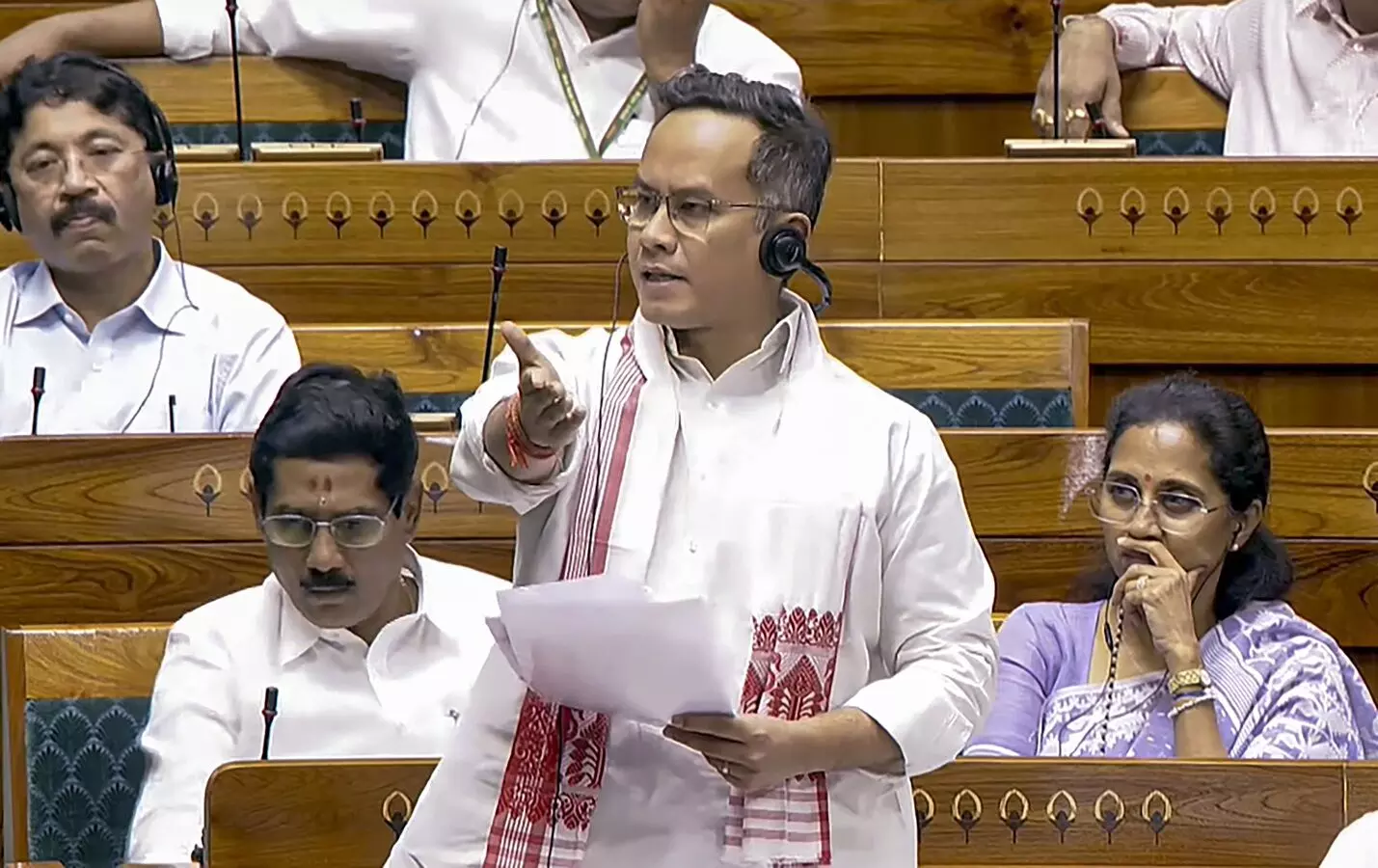
Gogoi speaks in the House during the second part of Budget session of Parliament, on Tuesday. (Photo:PTI)
Guwahati, March 10: The Lok Sabha, on Tuesday, admitted a resolution moved by the Opposition seeking the removal of Speaker Om Birla from office, triggering a heated debate in the House over constitutional provisions, parliamentary procedure and the issue of who should preside over the proceedings while the motion is under consideration.
The notice to move the resolution was read out by Congress MP Mohammad Jawed and backed by party colleagues K. Suresh and Mallu Ravi.
Soon after, AIMIM MP Asaduddin Owaisi raised a point of order, questioning Jagdambika Pal presiding over the proceedings as he had been appointed to the panel of chairpersons by Speaker Om Birla.
BJP MP Nishikant Dubey countered the objection, citing constitutional provisions and parliamentary rules. Parliamentary Affairs Minister Kiren Rijiju also rejected the claim, stating that Pal was competent to chair the proceedings.
Trinamool Congress MP Saugata Roy suggested appointing a separate presiding officer for the discussion. Amid the exchanges, Pal proceeded to put the notice to the House and asked at least 50 MPs to stand in support. Once the required number rose, the motion was admitted for discussion.
Congress MP Gaurav Gogoi then initiated the debate, for which ten hours have been allocated.
Gogoi, while referring to a landmark Supreme Court judgment, said, “In the Supreme Court judgment in the Nabam Rebia case, the court clearly stated that the Speaker is expected to demonstrate elevated independence, impeccable objectivity and above all, absolute impartiality. These are the standards expected of the presiding officer of the House,” Gogoi said.
Gogoi continued by questioning the constitutional procedure governing who should preside when a motion seeking the Speaker’s removal is under discussion.
“Article 96 clearly states that the Speaker or Deputy Speaker shall not preside when a resolution for their removal is under consideration. The Speaker may remain present in the House but cannot preside over the proceedings. If a panel of chairpersons exists, how was it decided that honourable Jagdambika Pal should preside? The House has no record indicating how this decision was made. We register our strongest protest,” he said.
Responding to the objections, Union Home Minister Amit Shah intervened, arguing that the Speaker’s office cannot remain vacant and that the House must continue to function.
“The word ‘preside’ refers to conducting the proceedings of the House. Even when elections for the Speaker take place, the functioning of the office continues. The House cannot be left without a presiding authority,” Shah said.
Gogoi further argued that the absence of a Deputy Speaker had complicated the situation.
“Under Article 95, the House must determine who will act as Speaker in such circumstances. That determination has not been made. Historically, whenever a motion was brought against a Speaker, the Deputy Speaker presided. Today, despite the House functioning for several years, there is still no Deputy Speaker. The nation must know how Parliament is being run,” he said.
He also accused the treasury benches of frequently interrupting Opposition members during debates.
“The Speaker is not the voice of the government but the custodian of the rights of the entire House. Constitutional morality demands impartiality. Unfortunately, opposition leaders are often denied adequate opportunity to speak, and interruptions from the treasury benches disrupt the discussion,” Gogoi alleged.
Clarifying the intent behind the resolution, Gogoi said the motion was not driven by personal animosity.
“On a personal level, Om Birla shares cordial relations with members across parties. Bringing such a motion is not something we take lightly. But when we believe that parliamentary values are being compromised, we have a duty to raise the issue,” he said.
Gogoi also cited instances where the Leader of Opposition allegedly faced interruptions while attempting to raise critical issues, including discussions related to trade negotiations and agricultural concessions.
“When the Leader of Opposition attempted to raise important matters affecting farmers and national policy, he was repeatedly interrupted despite agreeing to authenticate documents being cited. Such disruptions undermine meaningful debate in Parliament,” he said.
The House later adjourned for a one-hour lunch break at 1 pm, with the debate on the resolution scheduled to continue afterward.
With inputs from PTI