
India, US reach framework for first phase of bilateral trade agreement
Implementation of the pact will lead to concessions and the elimination of duties on American goods by India
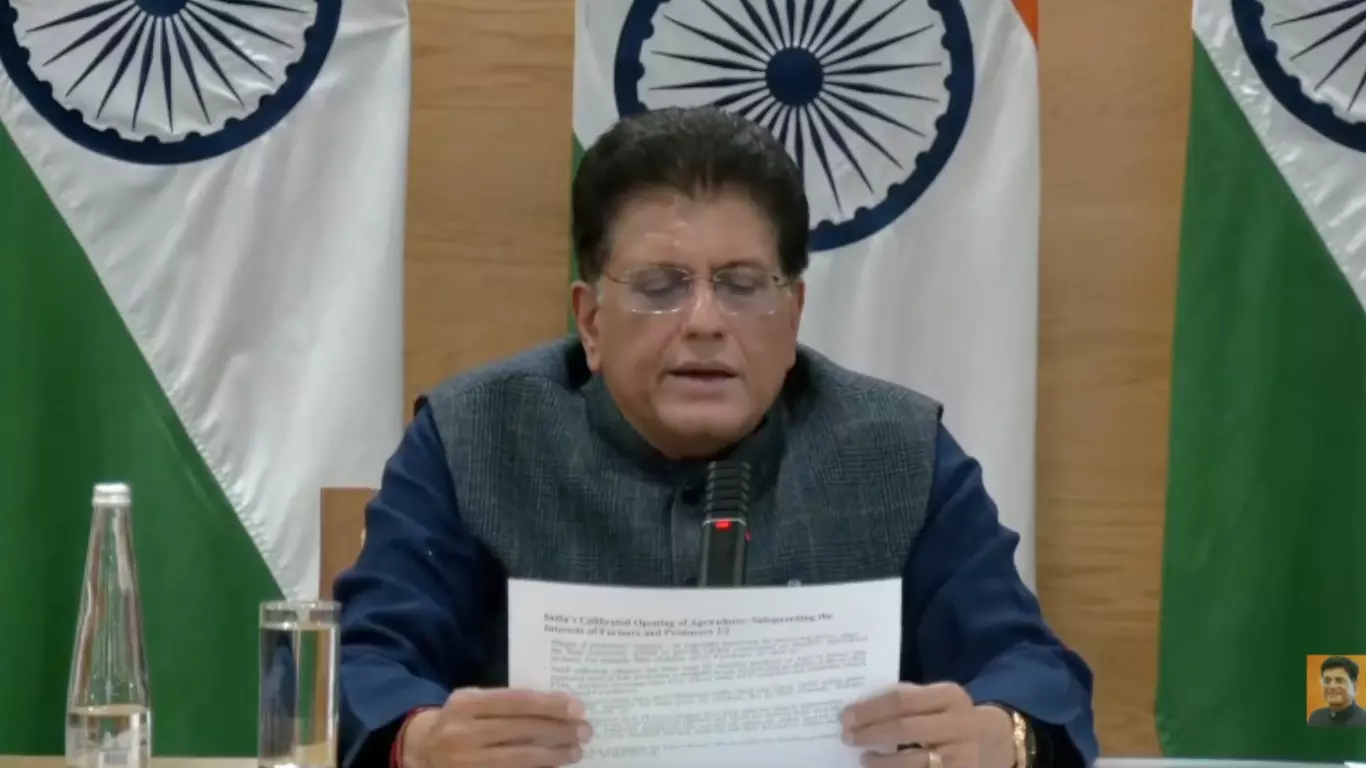
Union Commerce and Industry Minister Piyush Goyal briefing press on the India-US trade deal, on Saturday (Photo: @PiyushGoyal/X)
Washington/ New Delhi, Feb 8: India and the US announced that they have reached a framework for the first phase of the bilateral trade agreement under which both sides will reduce import duties on a number of goods to boost two-way trade.
The framework reaffirms the two countries’ commitment to the broader US-India Bilateral Trade Agreement (BTA) negotiations, launched by President Donald Trump and Prime Minister Narendra Modi on February 13, 2025, according to a joint statement issued on Saturday.
While the US will reduce tariffs on Indian goods to 18 per cent from the present 50 per cent, India will eliminate or cut down import duties on all US industrial goods and a wide range of American food and agricultural products, including dried distillers’ grains, red sorghum for animal feed, tree nuts, fresh and processed fruit, soybean oil, wine and spirits.
The first phase of the pact is expected to be signed by mid-March. Implementation of the pact will lead to concessions and the elimination of duties on American goods by India.
The US, through a separate executive order, has eliminated the 25 per cent tariffs on India for purchasing Russian oil from February 7, as New Delhi has committed to stopping directly or indirectly importing oil from Moscow.
Trump’s order has said that the US officials will monitor whether India resumes directly or indirectly importing Russian oil.
If it finds that India has resumed directly or indirectly importing the oil, the US officials shall recommend “whether and to what extent I should take additional action as to India, including whether I should re-impose the additional ad valorem rate of duty of 25 per cent on imports of articles of India,” the order said.
The reciprocal tariff of 25 per cent will be reduced to 18 per cent after the US issues an executive order in this regard, which is expected soon.
The statement also said that India has expressed its intention to purchase $500 billion of US energy products, aircraft and aircraft parts, precious metals, technology products and coking coal over the next five years.
“The US and India are pleased to announce that they have reached a framework for an Interim Agreement regarding reciprocal and mutually beneficial trade,” it said.
On the development, Prime Minister Narendra Modi said the interim trade pact will strengthen ‘Make in India’ by opening up new opportunities for farmers and entrepreneurs, and create jobs for women and youngsters.
Commerce and Industry Minister Piyush Goyal said the interim pact will open a $30 trillion market for Indian exporters, especially MSMEs, farmers and fishermen, as the US duties on Indian goods will come down to 18 per cent from 50 per cent earlier.
When asked about the oil issue, Goyal said that the external affairs ministry will respond to the matter.
In August last year, the US imposed 25 per cent reciprocal tariffs and an additional 25 per cent levy on India for its purchase of Russian oil, hitting Indian exporters hard as America is their largest export destination.
The reduction in tariffs will help boost exports of India’s labour-intensive sectors such as textiles and apparel, leather and footwear, plastic and rubber, organic chemicals, home decor, artisanal products and certain machinery.
Additionally, tariffs will go down to zero on a wide range of goods, including generic pharmaceuticals, gems and diamonds, and aircraft parts, thereby further enhancing India’s export competitiveness and Make in India.
India will also get exemptions under section 232 on aircraft parts, tariff rate quota on auto parts and negotiated outcomes on generic pharmaceuticals, leading to tangible export gains in these sectors.
“At the same time, the agreement reflects India’s commitment to safeguarding farmers’ interests and sustaining rural livelihoods by completely protecting sensitive agricultural and dairy products, including maize, wheat, rice, soya, poultry, milk, cheese, ethanol (fuel), tobacco, certain vegetables, meat, etc,” Goyal said.
PTI