
US, Iran agree to 14-day ceasefire; Trump calls it ‘big day for peace’
Ceasefire hinges on Iran opening Strait of Hormuz, easing global oil route concerns during fragile negotiation window
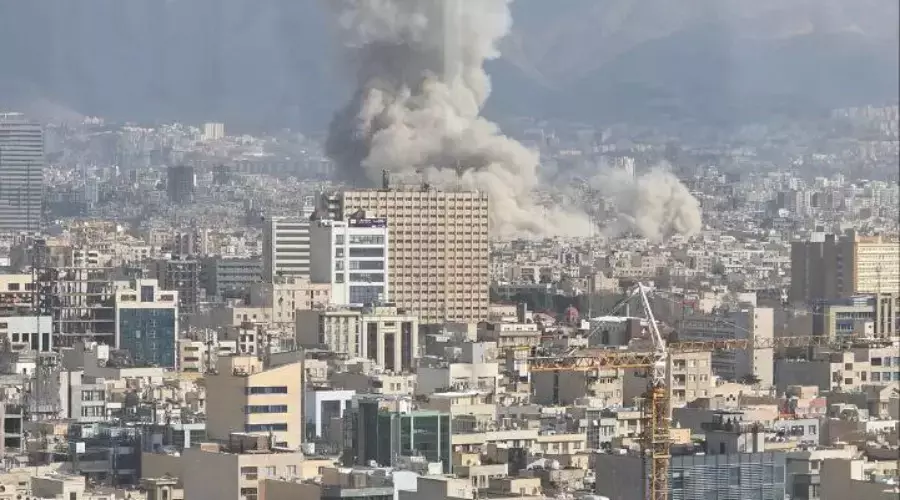
File image of thick smoke billowing over Tehran after US–Israel airstrikes on Iran. (Photo - @Vahid / X)
Washington, April 8: Calling it a “big day for World Peace” and saying Iran “had enough”, US President Donald Trump on Wednesday said Tehran could begin reconstruction after a two-week ceasefire with Iran.
Pulling back from the brink of a major military escalation in West Asia following a Pakistan-brokered proposal, the announcement came just 90 minutes before Trump’s deadline for Tehran to comply or face military retaliation.
Trump also said the US would help manage traffic buildup in the Strait of Hormuz and that American troops would “hang around” to ensure everything “goes well”.
Posting the details on a social media platform, Trump said the decision came after conversations with Pakistan Prime Minister Shehbaz Sharif and Army Chief Field Marshal Asim Munir, who urged restraint amid escalating tensions in West Asia.
“Based on conversations with Prime Minister Shehbaz Sharif and Field Marshal Asim Munir, of Pakistan, and wherein they requested that I hold off the destructive force being sent tonight to Iran, subject to the Islamic Republic of Iran agreeing to the COMPLETE, IMMEDIATE, and SAFE OPENING of the Strait of Hormuz, I agree to suspend the bombing and attack of Iran for a period of two weeks,” Trump said.
He described the move as a “double-sided ceasefire” and said the pause would be used to negotiate a broader agreement aimed at ending the conflict.
“The reason for doing so is that we have already met and exceeded all Military objectives, and are very far along with a definitive Agreement concerning long-term peace with Iran, and peace in the Middle East,” Trump said.
Trump added that Washington had received a “10-point proposal” from Iran, which he termed “a workable basis on which to negotiate.”
“Almost all of the various points of past contention have been agreed to between the United States and Iran. A two-week period will allow the Agreement to be finalised and consummated,” he said.
In Tehran, Iran’s Supreme National Security Council confirmed that it had accepted the temporary ceasefire arrangement and would enter negotiations with the US in Islamabad beginning Friday.
Pakistan Prime Minister Shehbaz Sharif has invited delegations from both countries to Islamabad on April 10 for talks aimed at securing a conclusive settlement.
White House Press Secretary Karoline Leavitt said discussions regarding in-person talks were underway, but added that “nothing is final until announced by the President or the White House”.
Iran also indicated its willingness to temporarily open the Strait of Hormuz, one of the world’s most strategically vital oil transit routes, during the ceasefire period.
Iranian Foreign Minister Seyed Abbas Araghchi said Tehran would halt military operations if attacks against it cease.
“If attacks against Iran are halted, our Powerful Armed Forces will cease their defensive operations. For a period of two weeks, safe passage through the Strait of Hormuz will be possible via coordination with Iran’s Armed Forces and with due consideration of technical limitations,” Araghchi said.
Meanwhile, Israel backed Washington’s decision to suspend military action, with Prime Minister Benjamin Netanyahu’s office saying it supports Trump’s move provided Iran opens the strait immediately and halts attacks on the US, Israel and regional countries.
However, Israel clarified that the proposed ceasefire arrangement remains limited in scope.
“The two-week ceasefire does not include Lebanon,” Netanyahu’s office said, while reiterating support for US efforts to eliminate Iran’s nuclear and missile threat.
The announcement marks a dramatic pause in what had appeared to be an imminent military escalation in the Gulf after Trump earlier warned Iran to agree to a deal or risk being bombed to the “Stone Age”.
The US had launched military operations against Iran on February 28 over Tehran’s refusal to relinquish its nuclear fuel stockpile.
With inputs from agencies