
India first to support Nepal with election logistics, says Minister Anil Sinha
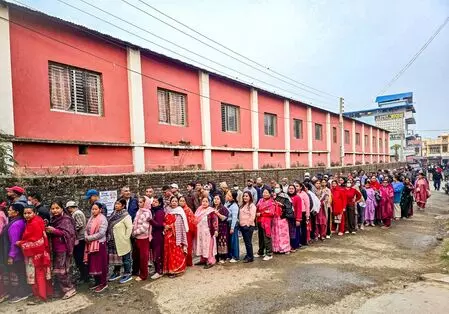
Representational Image
Kathmandu, March 7: India was the first country to extend assistance to Nepal for conducting the national election held on Thursday, following the political upheaval last year that forced former Prime Minister K.P. Sharma Oli to resign after widespread protests led largely by younger citizens.
In an interview with IANS, retired Justice Anil Sinha, a senior minister in the interim government led by Sushila Karki, said Nepal sought logistical help from India during the election preparations.
“We have to maintain good relations with all our neighbours,” Sinha said. “In the run-up to the election, India was the first country to come forward and offer help. We asked New Delhi to help us with logistical requirements, mainly for the poll process.”
According to the minister, India provided around 310 vehicles and other election-related supplies to Nepal in January in two initial tranches. These included SUVs and pickup vehicles. A third tranche delivered in February included more than 270 additional vehicles, among them 50 trucks meant for the Nepali Army, along with other supplies.
Sinha added that China later extended financial support for the election process.
“Later, China came forward with financial support for conducting the election. Thus, the neighbours were keen to see the democratic process continue and that a constitutional government be formed,” he said.
“At the same time, there are other countries with which we have friendly diplomatic relations. They too gave full support and asserted that relations will not be affected by what has happened in the past,” he added.
The interim cabinet will continue to function until a new government assumes office. In September 2025, when Ramchandra Paudel, President of Nepal, approved the interim cabinet recommended by Prime Minister Karki, Sinha was assigned several key ministries, including Law, Justice and Parliamentary Affairs, Industry, Commerce and Supplies, and Land Management, Cooperatives and Poverty Alleviation.
“Later, I urged the Prime Minister to shift the last portfolio since my hands were full, and she complied but asked me to look after Civil Aviation, Culture and Tourism,” Sinha said.
“Then one minister resigned to run for Parliament, and PM Karki decided to continue with the team she had rather than add more ministers for a short period. Thus, Energy, Water Resources and Irrigation came to me again. At one point, I was holding four ministries, which included 12 departments,” he said with a laugh.
Discussing challenges before the incoming government, Sinha pointed to deep-rooted institutional issues. He said sections of the bureaucracy, intelligence agencies and security forces had become politicised.
“Except the army,” he stressed.
He also criticised the previous government for excessive spending on politically driven projects. “There was hardly any money in the treasury. The coffers were empty. There were unnecessary expenses, some incurred on projects with political aims,” he contended.
Sinha alleged that appointments and promotions in security agencies had often been influenced by political considerations over the past two decades.
“Every time, when appointing the chief of security agencies or granting promotions, there were many manipulations that we heard about in the last two decades,” he said. “Even their investigations were politically influenced. Nepal Police and the Armed Police Force need to be independent of political interference.”
He also accused the previous regime of politicising the intelligence apparatus, which he said had affected its functioning. However, he claimed that the interim government had begun restoring institutional independence.
“In less than two months after the regime change, the system started restructuring itself,” Sinha said. “And soon credible information started flowing in.”
“Now there is excellent coordination among the security agencies and also with the government,” he added, asserting that the security system was now functioning more efficiently and without political interference.
As vote counting continues, early trends suggest a strong performance by the relatively new Rashtriya Swatantra Party, raising expectations for political change in the Himalayan nation.
--IANS