
Controversies behind the Royal jewels set out during coronation ceremony
Source: Twitter
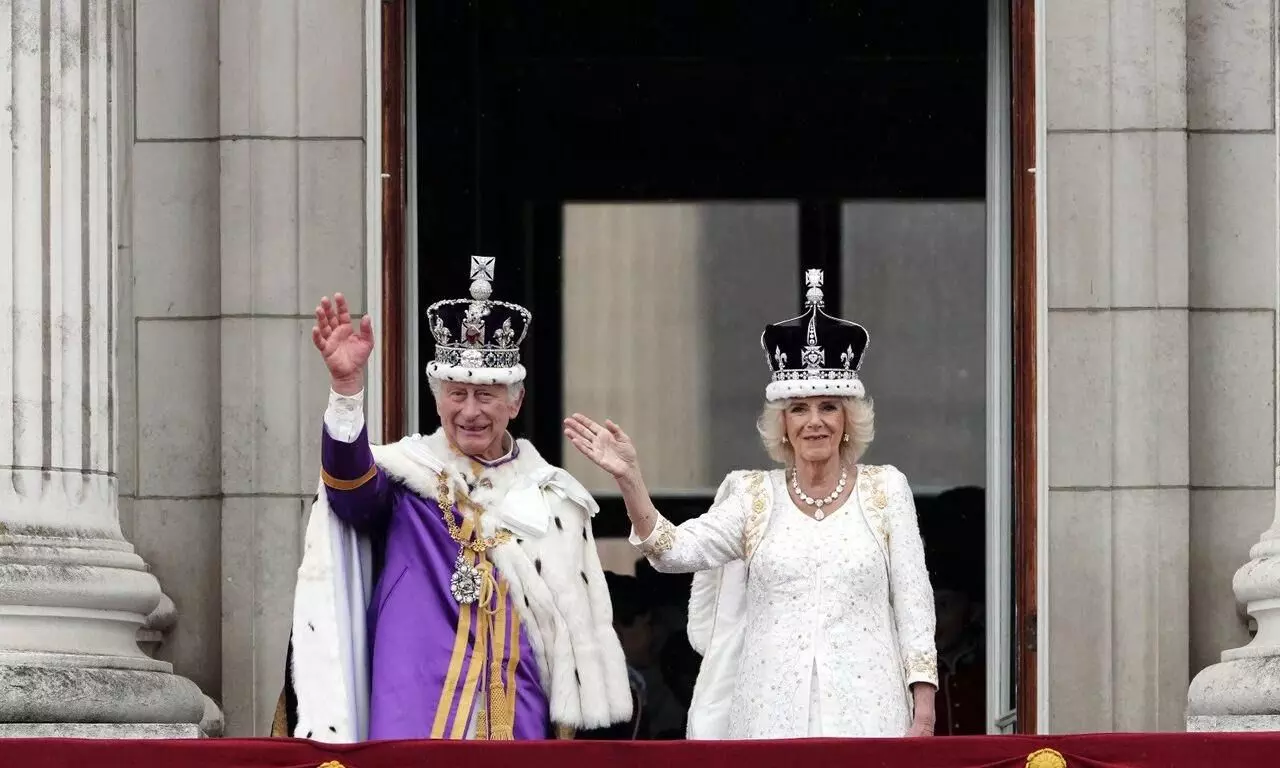
Guwahati, May 7: As the world witnessed the once-in-a-generation coronation ceremony of King Charles III, all eyes were on the royals at Westminster Abbey in London. Seven decades later, Queen Elizabeth's eldest child, Charles, officially ascended the throne as the Archbishop of Canterbury placed the St. Edward’s Crown on Charles’ head.
The historic ceremony which saw the congregation of world leaders featured an array of historical regalia from golden orbs and bejeweled swords to a sceptre holding the world’s largest colourless cut diamond.
The Coronation reflected the monarch’s role today and look towards the future, while being rooted in longstanding traditions and pageantry. The ceremony also attracted some debate as the crown jewels holds some controversial history.
Cullinan Diamonds
The Cullinan Diamonds are the world’s largest gem diamond, which weighed about 3,106 carats in rough form when found in 1905 at the Premier mine in Transvaal, modern-day South Africa. The colourless stone was purchased by the Transvaal government and was presented (1907) to the reigning British monarch, King Edward VII.
Cullinan produced stones of various cuts and sizes. The two biggest, perfect stones removed from the Cullinan diamond are now a part of the British regalia. The Great Star of Africa, also known as Cullinan I, is the largest cut diamond in existence at 530.2 carats. The stone is mounted in the head of the Sovereign's Sceptre with Cross. The 317-carat Cullinan II, also known as the Second Star of Africa is mounted in the Imperial State Crown. Cullinan III through IX, the remaining numbered diamonds, have carat weights that vary from 94.4 to 4.4 carats. Eventually, they were added to the British monarch's personal collection.
After the Second Boer War, which concluded in 1902 and resulted in the Dutch-led South African Republic, also known as the Transvaal Republic, being incorporated into the British Empire, the Cullinan was offered to the king in an effort to mend relations between local colonial leaders and the British Empire.
Of late, some South Africans are calling for the return of Cullinan I as it is a sign of pride, heritage and culture. Mothusi Kamanga, a lawyer and activist based in Johannesburg, told Reuters, “The diamond needs to come to South Africa. It needs to be a sign of our pride, our heritage and our culture,”
The Sovereign's Sceptre with Cross
According to the Royal Collection Trust, the sceptre represents the sovereign's temporal power and is associated with good governance. During the coronation service the new sovereign is presented with the spectre. The sceptre comprises a gold rod, formed in three sections, with enamelled collars at the intersections, and surmounted by an enamelled heart-shaped structure, which holds a huge drop-shaped diamond, Cullinan I.
Imperial State Crown
The Royal Collection Trust notes that the Imperial State Crown was made for the Coronation of King George VI in 1937 replacing a crown made for Queen Victoria. The crown is set with 2,868 diamonds, as well as several famous jewels. It includes St Edward's Sapphire, said to have been worn in a ring by Edward the Confessor. The crown also includes the Cullinan II diamond. The Imperial State Crown is worn by the monarch to leave Westminster Abbey after the coronation ceremony.
The Koh-i-Noor
"Koh-i-Noor" started trending on social media shortly after Queen Elizabeth II passed away last year as individuals talked about royal regalia and the reminders of colonisation they bring. During the coronation ceremony the royals have a good reason to dodge the famed Kohinoor diamond out of the public eye. The Ministry of External Affairs in India also raised the issue of bringing the Kohinoor back to Indian soil.
Considered as the most controversial gem it was presented to Queen Victoria in 1850 as one of the spoils of war following the two Anglo-Sikh Wars and has been the subject of ownership disputes since 1947, when India gained independence from the UK. Claims to it have since been made from India, Pakistan, and Afghanistan.
Following the controversy earlier this year, Buckingham Palace released a statement confirming the Koh-i-noor diamond would not be worn by the Queen Consort.
Queen Mary's Crown
The Queen Mary’s stunning Crown is set with 2,200 diamonds. The crown was designed for the Coronation of Queen Mary in 1911. At the 1911 Coronation the crown contained three large diamonds - the Koh-i-nûr, Cullinan III and Cullinan IV. These were later replaced with crystal replicas. The crown was reset with the Cullinan III, IV and V diamonds for the Coronation of The King and The Queen Consort.
According to reports, anti-monarchists mocked Camilla's crown's choice of the Cullinan diamonds over the Koh-i-Noor, which have also been the subject of calls for their repatriation to South Africa.
Queen Consort's Rod with Dove
Although the Queen avoided the controversy over Koh-i-Noor, however, the Queen Consort's Rod with Dove which she hold during the coronation was also a subject of debate as it was made of ivory.
This sceptre is formed from an ivory rod in three sections, tapering towards the top, and is surmounted by a gold monde enamelled with the national emblems, with a cross above on which perches an enamelled dove with wings folded.
The Queen Consort's Ivory Rod with Dove was made in 1685 for Mary of Modena, consort of King James II, in 1685 by the royal goldsmith, Sir Robert Viner. It has been used by every subsequent Queen Consort. The dove represents the Holy Ghost.
Earlier, Prince William, expressed his resentment over the use of ivory, calling it “a symbol of destruction, not of luxury”.
Images sourced from Royal Collection Trust