
At UN, Assam BJP chief slams report linking Pahalgam attack to Rohingya issue
MP Dilip Saikia, part of an Indian delegation at the United Nations General Assembly, slammed allegations made by SR for human rights in Myanmar
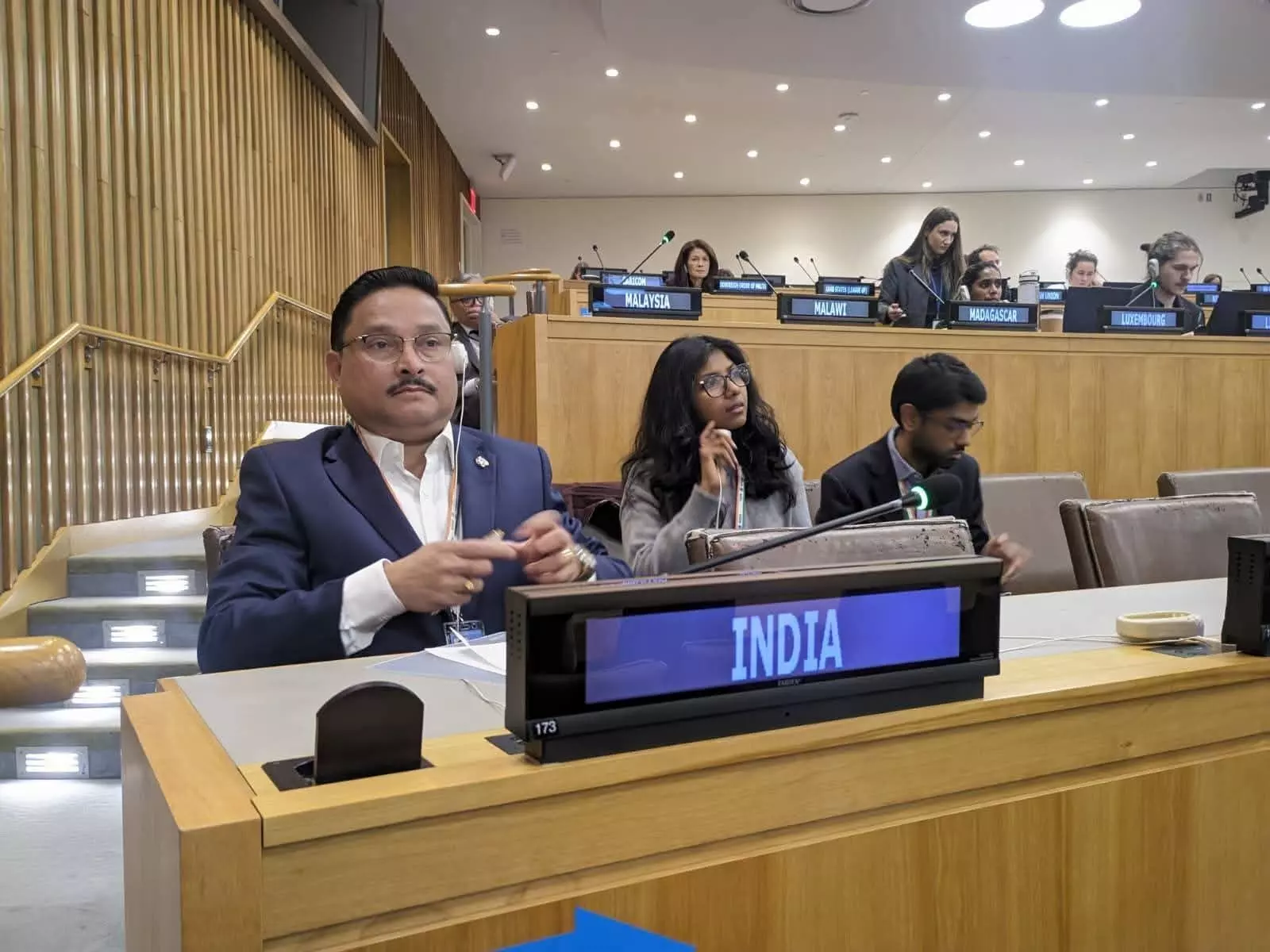
MP Dilip Saikia at the United Nations General Assembly. (Photo:@BJYMAssamPrdsh/X)
United Nations, Oct 29: India has strongly rejected a human rights report on Myanmar that claims the Pahalgam terror attack in April 2025 influenced the treatment of Rohingya migrants in the country.
Assam BJP president and Darrang–Udalguri MP Dilip Saikia, part of a 13-member Indian delegation at the United Nations General Assembly (UNGA), dismissed the allegation as baseless, stating that the report’s claim “has absolutely no factual bearing.”
“I strongly denounce the biased approach adopted by the SR (special rapporteur) of the innocent civilian victims of the April 2025 terrorist attack in Pahalgam through biased communal lens,” Saikia told a briefing on human rights in Myanmar, on Tuesday.
He was reacting to the allegations made by the Special Rapporteur for human rights in Myanmar, Thomas Andrews, a US Democrat politician-turned Harvard academic.
“My country rejects such prejudiced and blinkered ‘analysis’ by the special rapporteur,” said Saikia.
Referring to the Rohingyas in India, he said, “My country is seeing an alarming level of radicalisation among the displaced persons leading to consequential pressure and impact on the law and order situation”.
Regarding India’s approach to its neighbour, Saikia said India is for an immediate cessation of violence, release of political prisoners, unhindered delivery of humanitarian assistance, and inclusive political dialogue.
“We firmly believe that sustainable peace can only be secured through inclusive political dialogue and the early restoration of democratic processes through credible and participatory elections”, he added.
In his report, Andrews claimed that after the Pahalgam terrorist attack, “refugees from Myanmar have been under severe pressure in India even though no individuals from Myanmar were involved in the attack”.
Saikia told Andrews “not to depend upon unverified and skewed media reports whose sole purpose appears to be maligning my country where people of all faiths live, including more than 200 million Muslims, which is about 10 per cent of the world’s Muslim population”.
Special Rapporteurs are unpaid independent experts appointed by the UN Human Rights Council to monitor human rights situations in countries or about issues and do not necessarily reflect the views of the Secretary-General or the UN.
The Rohingya exodus began after the terrorist group Arakan Rohingya Salvation Army (ARSA) led by Ataullah abu Ammar Jununi, a Karachi-born Rohingya, attacked Myanmar security posts in August 2017 sparking a massive retaliation.
IANS