
VIP visits, vanished buses: When Guwahati pauses for power
As Assam Assembly polls near, VIP visits bring massive rallies but quietly derail Guwahati’s everyday commute
A typically busy bus station in Guwahati wears a deserted look.
At around 6.30 pm on a weekend, Arunima Kalita stood by the roadside in Chandmari, scanning the darkening stretch for a city bus that never arrived. A resident of Hatigaon, Kalita had just shut her roadside kiosk and was heading home after a long day’s work.
Like most evenings, she depended on city buses - the most affordable mode of public transport in Guwahati. But that evening, the city’s roads appeared to be operating by a different rulebook.
It was December 2025 and Prime Minister Narendra Modi was paying Assam a visit. The visit brought with it tightened security, traffic diversions and, for many commuters, the sudden disappearance of city buses.
Kalita later learnt that several buses had been requisitioned to ferry people to a political rally. For her, that decision to await a city bus on a wintry December evening meant being stranded on the streets.
“I waited for a long time, but there were no buses. I can’t afford to travel by auto. It’s too costly for me,” she recalls.
A mother of two daughters, Kalita lives with her mother and is the sole breadwinner of the family. Like many working-class residents of the city, every rupee matters and every delay carries consequences.
What should have been a routine journey home became a stark reminder of how VIP movements can quietly disrupt ordinary lives. “When VIPs come, they should think about the public. We are the reason they came to power, and it’s us they are elected to serve,” she says.
A file image of the city
When protocol overrides public need
In Guwahati, such scenes have become familiar whenever senior leaders visit Assam. Large numbers of city buses are routinely pulled off their regular routes and reassigned for rally duty, ferrying supporters from different localities to event venues.
While the authorities often justify the move as a logistical necessity, its impact on daily commuters is rarely addressed.
For thousands who depend on city buses, the shopkeepers, office-goers, students and domestic workers, this sudden absence of public transport throws everyday routines into disarray.
“On ‘VIP days’, it feels like the city belongs to someone else. You either reach late or spend extra money on autos or cabs. Not everyone can afford that,” says Rakesh Das, an office employee who commutes daily from Maligaon to Pan Bazaar.
Traffic restrictions add another layer of difficulty. Roads are blocked and routes diverted, making travel times unpredictable. For those living on fixed incomes, these disruptions are not minor inconveniences but tangible financial setbacks.
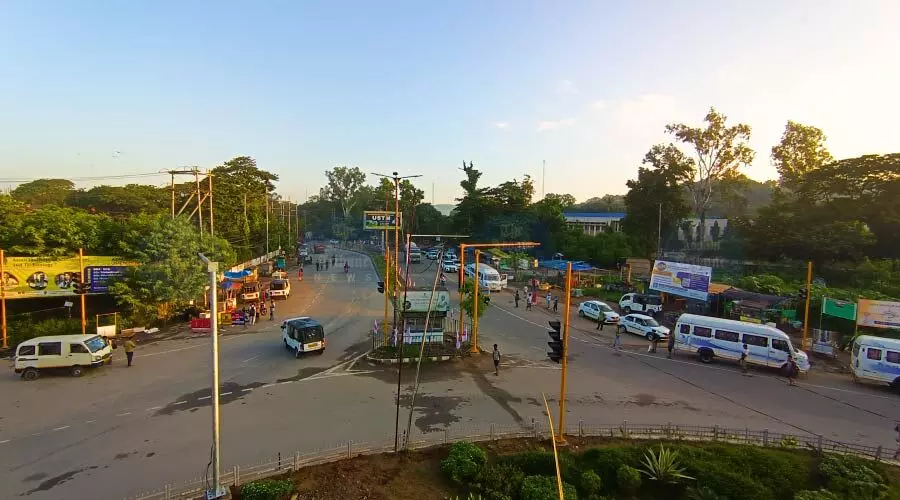
Top angle view of Guwahati city
Invisible costs of political spectacle
Public rallies are often projected as symbols of mass support and democratic participation. Yet behind the spectacle lies an invisible cost, borne by those who are not part of the crowd.
“Why should daily wage earners suffer so that a rally can look big? Public transport exists for public use. Diverting buses for political events crosses a line,” asks Rita Saikia, a teacher.
She says such arrangements reflect a system that tends to prioritise protocol, often at the cost of ordinary commuters.
For women like Kalita, the consequences can be particularly harsh. Being stranded late at night raises concerns not just about money, but also about personal safety.
“I kept thinking about my daughters and my mother waiting at home. I just wanted to get back,” Kalita adds softly.
Guwahati is already grappling with rapid urbanisation, inadequate public transport and rising traffic congestion. On normal days, commuters brace themselves for delays; on VIP days, the strain multiplies.
Abdul Rahman, a city bus driver, says the system often lacks planning. “Sometimes even drivers are informed at the last minute that buses will be used for rallies. Regular routes suffer, and passengers are left confused,” he says.
The repeated sidelining of commuters raises a basic question - who does the city really serve?
For Kalita, the answer feels clear. “People like me don’t matter when big leaders come. Our problems are small for them,” she says.
Yet these “small problems” add up - missed work hours, extra expenses, exhaustion and a growing sense of exclusion from a system meant to serve citizens.
With Union Minister Amit Shah set to visit Assam again on January 29, the familiar cycle of heightened security and large public gatherings is expected to return to Guwahati’s streets.
For many residents, the hope is not for fewer visits or smaller events, but for better planning that does not come at the cost of everyday life.