
Jorabat flood more man-made than natural, locals blame faulty drains, hill cutting
Traders, commuters, and ambulances suffer as Jorabat floods each year
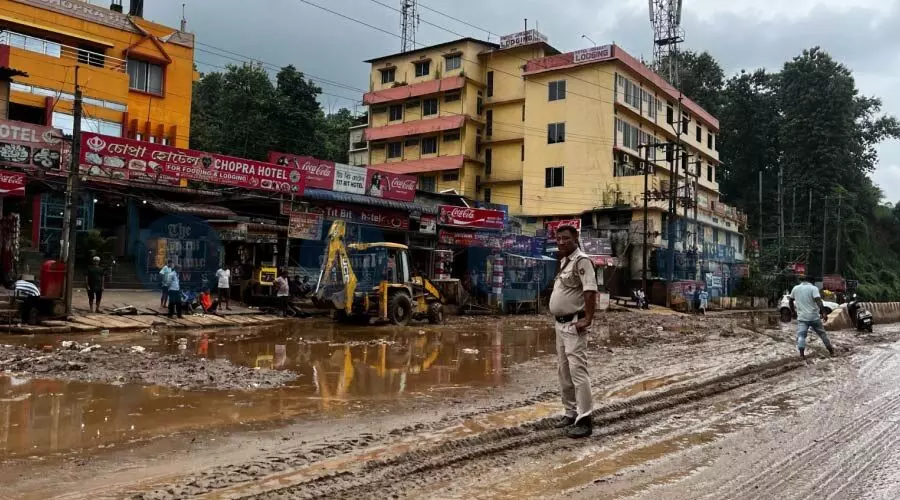
An excavator put in action after Jorabat flooding (Photo: AT)
Jorabat, Sept 15: Each monsoon, the tri-junction of Jorabat – Assam’s gateway to Upper Assam and Meghalaya – is drowned in a familiar chaos. National Highways 27 and 6, lifelines of the region, sink under muddy waters, traffic is paralyzed, and businesses count their losses. What should be a seasonal inconvenience has turned into a man-made disaster, and locals say the reasons are no longer a mystery: faulty design, short-sighted maintenance, rampant hill cutting, and corruption.
The perennial drain that carries rainwater from Ninth Mile to Byrnihat is supposed to channel stormwater safely away. Instead, it has become a symbol of neglect. While the stretch along the highway in Jorabat is occasionally cleaned – often in full public view – the interior stretches remain clogged and encroached. “The cleaning is just for show,” said Pranay Biswas. “The real blockages in the village stretches are ignored.”
The greatest choke point lies under the flyover at the tri-junction. The culvert’s low height and narrow span trap silt and debris, forcing rainwater to spill over the road. “This culvert is the system’s weak link,” explained Pulak Das. “Had it been built higher, today’s waterlogging could have been avoided.”
Compounding the problem is unscientific hill-cutting in Meghalaya, visible just across the road. Devoid of vegetation, the hills no longer retain water; instead, mud and debris rush down into Assam, choking the already-weak drains below. “We watch excavators tear down the hills daily,” said commuter Shivam Paul. “It feels like watching our own floods being manufactured.”
Allegations of corruption trace back to the highway’s four-laning, when the original plan to raise the road’s height to withstand waterlogging, was mysteriously altered. The Detailed Project Report (DPR) was allegedly changed midway, leaving the highway built at a lower level. Today, that decision has left the area chronically vulnerable. “It is an open secret,” said Bala Pareek, a vocal local resident, saying that we are drowning every year because someone changed the DPR.
The flyover, built at a lower clearance, restricts engineers from raising the culvert or the adjoining road. Any attempt to elevate the drainage system would risk blocking the passage of heavy vehicles. The structure has effectively frozen the problem in place.
Shops lose stock to water damage, commuters lose hours in traffic, ambulances struggle to cross the junction, and administration spends lakhs each year on “emergency response.” Yet the underlying flaws remain untouched. Environmentalists warn that continued hill-cutting on the Meghalaya side will only worsen the floods in coming years.
Experts and locals alike believe the crisis is sustained not by natural forces, but by deliberate inaction and systemic failure. “This is not an act of nature, but an act of neglect,” said Rakesh Hazarika. “The floods are not just water on the road – they are public money washed away, year after year.”
Until the culvert is redesigned, the drains from Ninth Mile to Byrnihat are revived, and the hills across the border are protected from reckless cutting, Jorabat seems condemned to relive this nightmare every season.
By Parmeshwar Puri