
Guwahati’s ACA stadium hosts seven international matches in five months
The run included five ICC Women’s ODI World Cup matches, Guwahati’s first-ever Test between India and South Africa, and a T20I vs New Zealand.
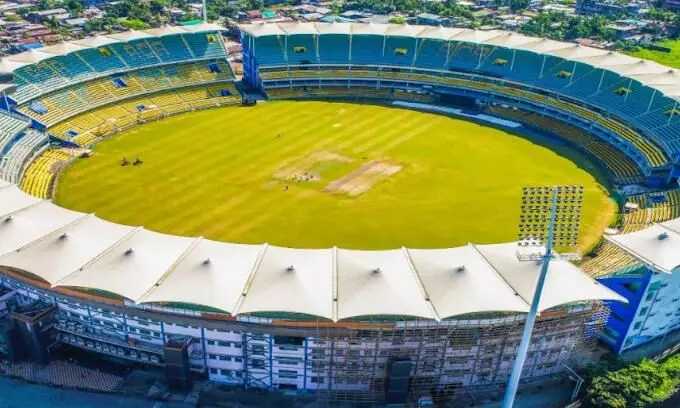
ACA stadium at Barsapara, Guwahati (Photo: Google maps)
Guwahati, Jan 26: Guwahati’s ACA Stadium has quietly scripted a landmark chapter in the city’s sporting journey by hosting seven international matches in the last five months, a run that has rarely been seen in the region before.
The sequence included five matches of the ICC Women’s ODI World Cup, the venue’s first-ever Test match between India and South Africa in November last year, and on Sunday, a T20 International between India and New Zealand.
For a city that once waited years between international fixtures, the steady flow of top-level cricket has been embraced with pride by fans across Guwahati and the region. Many see it as a significant step for Assam in establishing itself on the global sporting map.
Beyond the numbers, the smooth conduct of the matches has drawn attention. From crowd management and pitch preparation to hospitality, the city handled high-profile fixtures with confidence, underlining its readiness to host marquee events.
“Guwahati has grown as a venue. The credit must be given to BCCI secretary Devajit Saikia for his proactive role in cricket affairs in the country and also in the development of cricket in Assam and the region,” former Assam captain Zakaria Zuffri told The Assam Tribune on Sunday.
ACA Stadium hosted the inaugural match of the ICC Women’s ODI World Cup on September 30 in 2025. The city also hosted one of the semifinals between South Africa and England on October 29. The first ever Test match at the venue from November 22-26 last year drew praise from players and experts.
Veteran sportsman Shankar Datta Lahkar said Guwahati’s credentials as a sporting host go back several decades. A former State Ranji Trophy and table tennis player and a noted tennis player, Lahkar recalled that the city had successfully organised national-level events even with limited resources.
“Right from the 1960s, Guwahati has always held national-level events successfully in all games. With limited resources, visits by teams like Australia in the 1960s and England in the 1970s never drew complaints about playing conditions or hospitality,” he said. “It is because of the hospitable nature of the people of this region. In 1967, all teams from India praised the conduct of the National Table Tennis Championships, particularly for the food and lodging. I participated in that tournament,” the 79-year-old added.
For local supporters, the recent spate of international matches has brought the global game closer to home. “We used to travel to Kolkata or other places once in a while to watch a big match. Now world-class cricket is at our doorstep,” said Anupam Das, a schoolteacher who attended two World Cup matches at the stadium.
College student Rituparna Kalita said the atmosphere during the India-New Zealand T20 International was unforgettable. “The crowd energy, the organisation, everything felt international. It makes us proud to say Guwahati can host matches of this scale,” she said.
Guwahati’s recent run suggests the city is no longer an occasional stop on the cricketing calendar, but a venue ready to be counted among India’s dependable international hosts.