
From rallies to reels: How social media is reshaping election campaigns
Campaigns no longer pause after polling; politics now unfolds daily across screens, feeds and algorithms
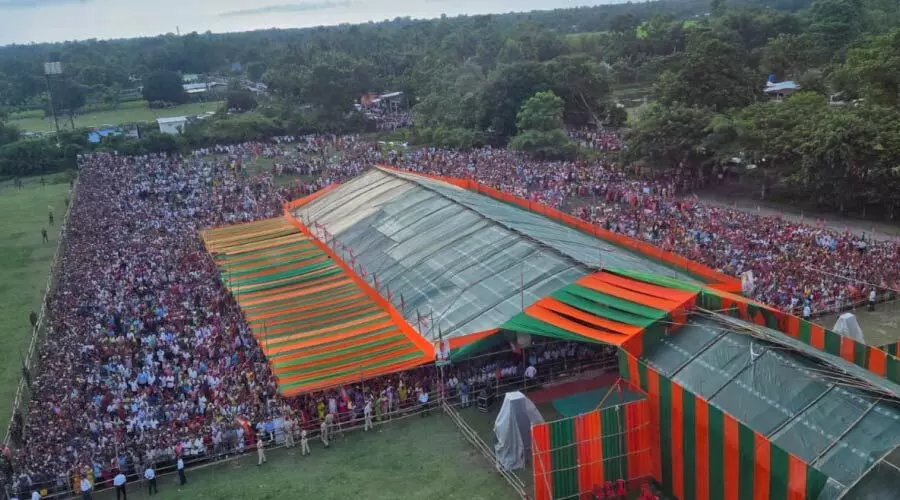
An aerial shot of a campaign rally in Mwdwibari, Udalguri (Photo - @himantabiswa / X)
Not very long ago, election campaigns followed a familiar rhythm. Streets echoed with loudspeakers, party flags lined market squares and candidates addressed crowds in person, promising development and change. Once polling ended, the noise receded and governance resumed. Now, that pause has largely disappeared.
Today, campaigning is continuous. Every speech is amplified online, every government announcement doubles as a political message and every social media post is part of a larger narrative. In an age of permanent campaigning, politics unfolds in real time and the audience is always watching.
From crowds to screens
The transition from physical rallies to digital outreach has been gradual but decisive. Public meetings still matter, but they now share space with reels, live streams and targeted posts.
Kasturi Chetia Baruah, spokesperson of the Asom Gana Parishad (AGP), says social media has changed the tone and tempo of campaigns.
“Earlier, campaigns were built around banners, rallies, posters and public meetings. Today, social media sets the tone. Messaging has become sharper and more aggressive. Young people are more vocal about development and local issues, and they often shape the narrative,” she says.
The shift is visible beyond urban centres. In rural areas, voters who once relied primarily on newspapers now track political developments on smartphones.
Campaigning without boundaries
For parties, the digital turn is strategic. Campaigns are no longer confined to election seasons; they are continuous, layered and highly targeted.
Ranjib Kumar Sarmah, spokesperson and Social Media Pravari of the BJP Assam Pradesh, says outreach now combines booth-level engagement with an expansive online push.
“Earlier, campaigns were district-level and focused on large gatherings. Now, engagement happens at the booth level. We interact with local influencers, senior citizens and community leaders in small groups,” he says.
At the same time, social media has expanded reach. “Social media campaigns, including reels, posts and live interactions, have become central. With minimum time and resources, we can reach tens of thousands of people. Virtual meetings allow multiple interactions in a single day, even in remote areas,” Sarmah explains.
Behind this approach lies data-driven strategy. Voter preferences, concerns and demographics are analysed, enabling customised messaging. Two voters in the same town may encounter entirely different political narratives on their screens.
Politics as communication
Congress MP Gaurav Gogoi argues that while the tools have evolved, the core remains the same.
“At its heart, politics is about communication. Earlier, people consumed information through newspapers and television. Today, digital platforms have taken precedence. Political communication has adapted to that reality,” he says.
Yet the nature of public discourse has shifted. Instead of a single shared conversation, there are multiple parallel discussions shaped by algorithms. Digital spaces often reinforce existing beliefs, fragmenting audiences even as they expand participation.
The digital sphere has also opened new avenues for civic engagement. Citizens can respond directly to leaders, question policies in real time and mobilise around specific issues. Grassroots campaigns can gain traction quickly, and younger voters increasingly participate in politics beyond the ballot box through daily online engagement.
The always-on electorate
But the same platforms have also intensified divisions. Misinformation spreads rapidly, emotional appeals often outpace fact-based debate and online harassment has become commonplace. Organised trolling and polarising content have sharpened political identities.
Awareness has widened, but so have concerns. “There is more awareness, but there is also more toxicity. Cyberbullying and trolling have increased. We need to move towards constructive discussions,” Baruah adds.
The challenge is not only the speed of information, but the erosion of trust when competing narratives collide.
In this landscape, the electorate is no longer a passive recipient of campaign messages. The audience includes the young voter sharing a protest video, the student debating policy online and the elderly citizen watching digital addresses instead of television broadcasts.
Election campaigns today are fought not just on streets and stages, but on screens - continuous, interactive and immediate. Politics is no longer something that pauses between polls. It is lived, shared and contested every day in the digital public square.