
Climate shifts shrink Panidihing Sanctuary wetlands, threaten biodiversity: Study
A new study finds declining rainfall and rising temperatures have altered hydrology and reduced biodiversity at Panidihing Bird Sanctuary
Guwahati, Dec 9: Changes in precipitation patterns and temperature are directly impacting wetlands in the State, changing their hydrological cycles and reducing their ability to maintain biodiversity and offer ecological services, a study has found.
The study by Namita Sharma and Anup Saikia of Gauhati University’s Geography department used Landsat imageries accessed from Google Earth Engine (GEE) to examine the relationship between high flood level and South West monsoon, as well as the climatic profile of Panidihing Bird Sanctuary (Sivasagar) over 20 years, from 2001 to 2021.
The study area saw significant changes throughout the period 2001-2021 during which precipitation, temperature, and humidity fluctuated considerably. While there was a rising trend in temperature and humidity, there was a declining trend in precipitation. Annual precipitation decreased significantly from 1,343.02 mm in 2001 to 1,055.8 mm in 2021.
The HFL (high flood level) of the Desang river at the Akhoiphutia gauge site is declining, which is consistent with a trend of declining precipitation.
The area of flooding was higher in 2001 at 18.9 sq km, than in 2021, when the water pixels encompassed 5.9 sq km area of the habitat on rainy days. The seasonal variation in water pixels was 18 sq km in 2001 and 4 sq km in 2021. The Relative Humidity also experienced an increase during the period.
The vegetation cover was at its peak in 2021, accounting for 27.6 sq km. During the monsoon of 2001 and 2021, the vegetated area was estimated to be 18.6 and 23.5 sq km.
During the monsoon season, the majority of the wetland region was submerged. However, after the monsoon season, only the wetland areas had water during 2001. The monsoon and post-monsoon NDWI (normalized difference water index) during 2021 showed markedly less water compared to 2001 levels.
The post-monsoon scenario suggests that the wetlands within the sanctuary may experience drastic changes in terms of water retention capacity thereby reducing their flood mitigation effectiveness. Although factors such as run-off, groundwater recharge, and land-use change contribute to wetland degradation, rising temperatures increase evapotranspiration, causing dryness and water loss in wetland ecosystems worldwide, the researchers noted.
“The sanctuary experienced most changes during the monsoon due to flooding and this is proven to alter the carbon and nitrogen cycles. This can reduce soil fertility and expedite biodiversity loss. Species that are prone to habitat instability may be at risk from the dynamic habitat of the sanctuary. Rising temperatures altered rainfall patterns as well as frequent inundation could aggravate ecological pressures, further exacerbating the susceptibility of the sanctuary’s resources.
“Panidihing’s dynamic pattern might have an impact on shorebirds, diminishing habitat quality, and food availability, eventually affecting their survival and migratory behaviour,” the study concluded.
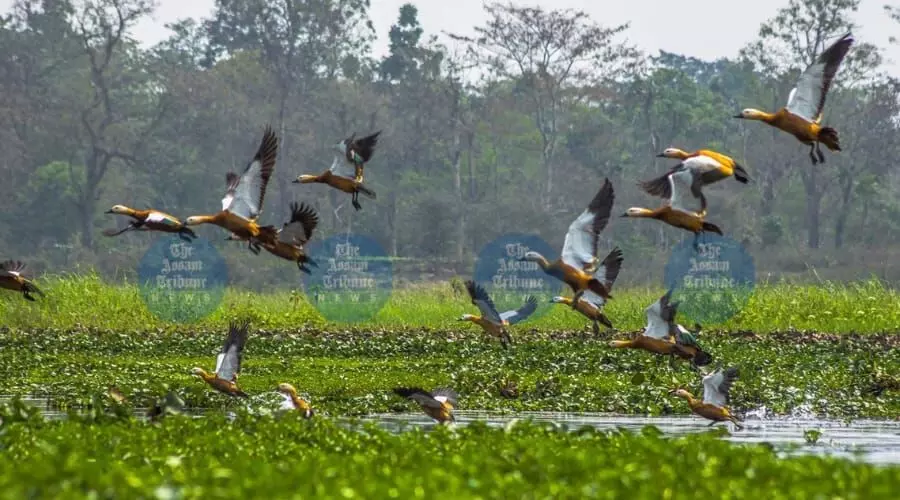
Covering an area of 33.9 sq km, Panidihing was designated as a bird sanctuary in December 1996. A field survey during this the study revealed that there were only 15 wetlands covering an area of 0.82 sq. km within the sanctuary.
The study titled Shrinking wetland: Spatio-temporal dynamics of the Panidihing Bird Sanctuary has been published in the Australian Geographer.