
Breathing dust: Why Guwahati’s air is turning poor by the day
Health experts, residents alarmed as city’s AQI peaks at 294 this February amid dust, emissions & dry spell
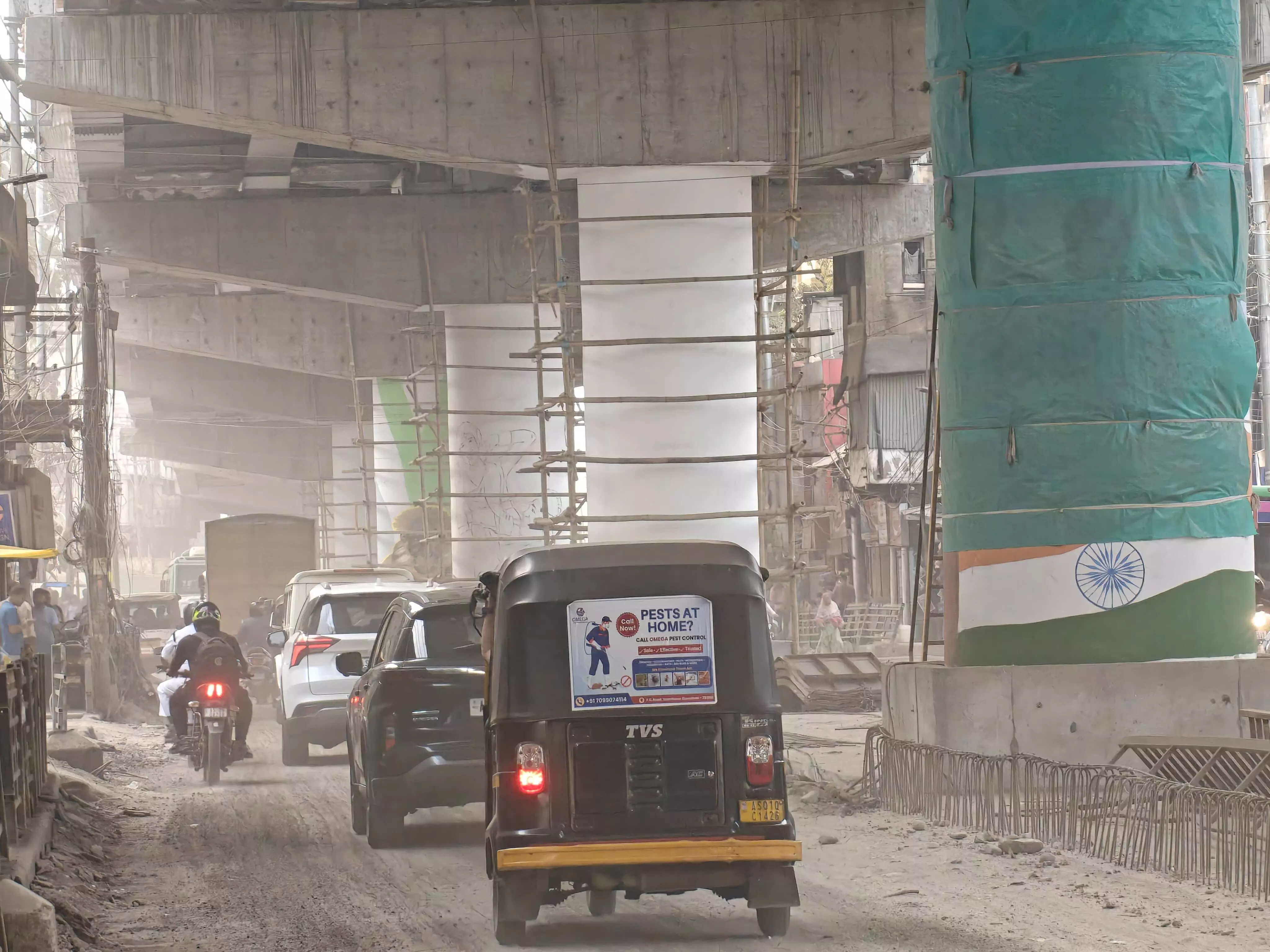
Smoggy mornings and dusty streets signal a growing environmental challenge for Guwahati (AT Image/ Kangkan Bordoloi)
The mornings in Guwahati now begin with a haze that refuses to lift. The distant hills look blurred, the air feels heavier and a layer of dust lingers throughout the day.
This February, the city’s air quality index (AQI) climbed to 294, placing it in the “poor” category and triggering concern among health experts and environmental authorities alike.
For many residents, the smoky skyline, dry dust and constant throat irritation are daily reminders that the air they breathe is steadily worsening.
A city blanketed in dust
Guwahati’s air quality has shown a marked decline this month, with pollution levels fluctuating between ‘satisfactory’ and ‘poor’ categories. Data from the Assam Pollution Control Board indicate that while the Air Quality Index (AQI) remained in the 100–200 range between February 17 and 22 — technically classified as satisfactory — the respite was brief.
Earlier in the month, from February 1 to 3 and again between February 12 and 16, the AQI climbed to the 200–300 bracket, categorised as poor. On February 16, it peaked at 294, one of the highest readings recorded this season, signalling a significant deterioration in ambient air quality.
The worsening trend has been compounded by the absence of rainfall, which typically helps disperse pollutants and improve air circulation.
Construction activities across the city, vehicle emissions and sand blowing from the banks of the Brahmaputra have further intensified the pollution.
Dr. Gautam Kumar Mishra, Chief Environmental Scientist of the Pollution Control Board, said the current trend follows a familiar seasonal pattern. He explained that pollution levels rise every year between January and March due to dry weather and stagnant atmospheric conditions.
“This year is no exception. However, compared to the last two or three years, the air quality is slightly better. The AQI between 100 and 300 falls within the range from satisfactory to poor. Rainfall would significantly reduce pollution,” he noted.
What is polluting Guwahati’s air?
Pollution Control Board (PCB) says that the primary pollutants in the city are PM10 and PM2.5, which are microscopic particles that enter the respiratory system and pose serious health risks.
PM10 particles, which are relatively larger but still harmful, are mainly generated from:
- Dust and construction activities: 32%
- Vehicle emissions: 19%
- Industrial smoke: 16%
- Burning of wood, coal or biomass: 9%
On the other hand, PM2.5 particles are far more dangerous due to their smaller size, allowing them to penetrate deep into the lungs and bloodstream. In Guwahati, these are largely produced by:
- Vehicle emissions: 52%
- Road dust: 16%
- Household and commercial cooking: 16%
- Industrial smoke: 6%
- Construction: 4%
- Burning crop residue and leaves: 3%
These numbers, provided by PCB, clearly show that vehicles are the biggest contributor to fine particulate pollution in the city.
With construction dust and vehicle smoke in the air, Guwahati residents brace for a season of poor air quality
Pollution hotspots and rising health concerns
Certain areas, including Bamunimaidam, have witnessed a sharper rise in pollution levels. According to Dr. Mishra, this is partly due to insufficient preventive measures such as regular water sprinkling on roads and stricter control of construction dust.
“These fine dust particles are extremely harmful. They can easily enter the body through the nose and lungs. People should wear masks and avoid unnecessary outdoor activities during this period,” he advised.
Doctors warn that rising pollution increases the risk of respiratory illnesses, asthma, allergies and long-term cardiovascular diseases. Children, the elderly and those with pre-existing health conditions are particularly vulnerable.
Waiting for the rain
Relief, however, may depend on the skies. The regional meteorological centre has indicated the possibility of light rainfall in Assam and the broader northeastern region over the next five days. But expectations remain cautious.
Dr. Sanjay O’Neill, head of the Regional Meteorological Centre, said that while some parts of Assam, Arunachal Pradesh, Meghalaya and Nagaland may receive light showers, the chances of rain in Guwahati remain low. Cloudy weather is expected in the city for the next seven days.
“Even two spells of rain could significantly reduce pollution levels. But until March, the AQI is likely to remain in the satisfactory to poor range. From April onwards, there may be some relief,” he said.
A growing urban challenge
The rising pollution in Guwahati reflects a larger urban reality. Rapid construction, increasing traffic, expanding commercial activity and inadequate environmental management are combining to create a new challenge for the city.
While authorities have taken some measures, experts say long-term solutions are needed. These include stricter monitoring of construction sites, promotion of public transport, better road maintenance, expansion of green cover and stronger awareness campaigns.
For now, residents continue to live with the haze adjusting routines, wearing masks and hoping for rain.
But as the situation persists, the question remains - will Guwahati act before the air becomes even harder to breathe?