
Beyond art, Vrindabani Bastra reflects Assam’s spiritual imagination: T. Richard Blurton
The British Museum archaeologist highlights the bastra as a cultural imagination shaped by devotion, community and narrative traditions.
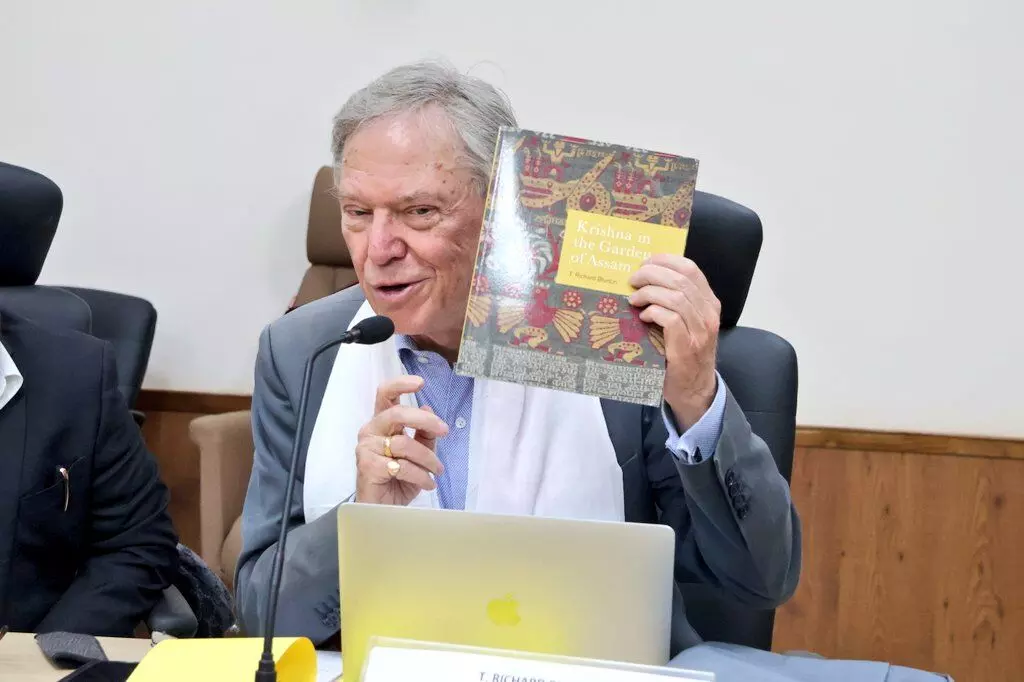
British Museum archaeologist T. Richard Blurton
Guwahati, Feb 27: Internationally acclaimed archaeologist T. Richard Blurton emphasised that the historic Vrindabani Vastra of Assam should be understood not merely as an artistic masterpiece but as a profound cultural expression shaped by faith, collective memory and storytelling traditions.
His remarks underscored the need to reframe the textile within a wider global and civilisational context.
Blurton, former Head of the South and South East Asia Section at the British Museum, was addressing scholars and students during an academic interaction in Guwahati, where he explored the artistic, devotional and narrative depth embedded in the Vrindabani Vastra.
Placing the textile in an international framework, he noted that it reflects the interconnected nature of religious devotion, craftsmanship and community participation.
Describing the artefact as “more than a work of art,” Blurton said the Vrindabani Vastra represents a cultural imagination shaped over centuries through shared faith and storytelling.
He highlighted how the textile, associated with the Vaishnavite tradition of Mahapurush Srimanta Sankaradeva, illustrates episodes from sacred narratives while simultaneously embodying the social and spiritual ethos of the time.
He further pointed out that such heritage objects provide critical insight into how societies communicate values, beliefs and collective identities.
According to him, the Vrindabani Vastra stands as a testimony to Assam’s rich artistic heritage and its place in the broader history of devotional art across South and Southeast Asia. He stressed that global scholarship must engage more deeply with regional traditions to fully understand their historical and philosophical significance.
Blurton also highlighted the importance of preserving traditional knowledge systems and crafts that sustain such cultural expressions. He noted that heritage is not static but evolves through reinterpretation and continued community engagement.
In this regard, he called for collaborative research, documentation and conservation initiatives to ensure that future generations remain connected to these living traditions.
The session also sparked discussion on material culture, sacred traditions and artistic expression, with participants exploring how textiles, performance and ritual practices continue to shape Assam’s cultural identity.
Scholars emphasised that heritage such as the Vrindabani Vastra bridges the past and present by transmitting values across generations.
Vice Chancellor Prof. Nani Gopal Mahanta reflected on the enduring legacy of Srimanta Sankardeva and the central role of devotion and craftsmanship in Assam’s spiritual consciousness.
He noted that institutions like the Naamghar and traditions such as Ankiya Bhaona represent the synthesis of faith, philosophy and art that continues to guide society.
Blurton’s interaction reaffirmed the importance of positioning Assam’s civilisational heritage within global academic discourse while recognising the region’s unique cultural contributions.
His remarks also underscored the growing international interest in Assam’s artistic traditions, particularly those that combine narrative, devotion and community participation. The programme was attended by senior academics and dignitaries.
Earlier, on Feb22, Chief Minister Himanta Biswa Sarma laid the foundation stone of the Cultural Museum Project to house the much-anticipated 500-year-old sacred Vrindavani Vastra.
“I believe within 1.5 years we will complete the construction,” Sarma said after the bhoomi poojan at the site in Khanapara.