
Two flood-rescued rhino calves released back into Kaziranga National Park
The male calves, Chandra and Kanai, were rescued during separate floods that ravaged Kaziranga in 2020 & 2021
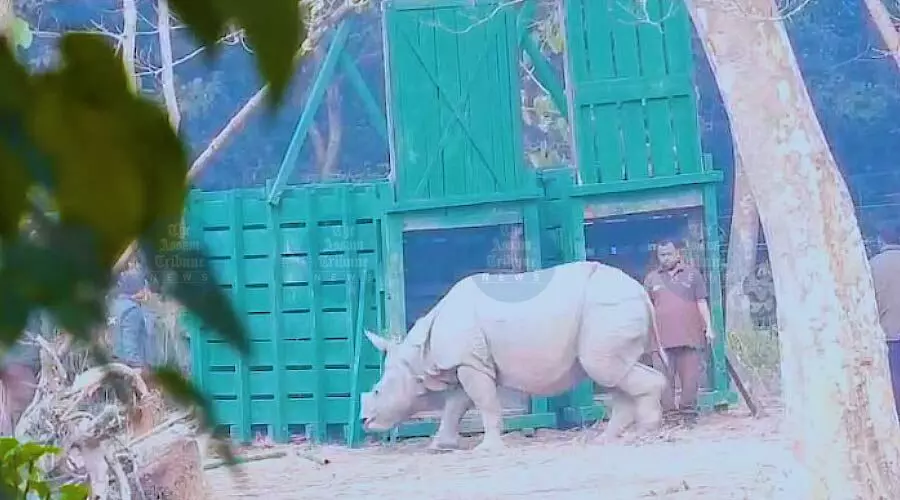
Arrangements for the release were made with the rhinos transported in specially designed wooden crates (AT Image)
Jorhat, Jan 20: Two male one-horned rhinoceros calves were formally released into Kaziranga National Park on Tuesday after spending nearly four to five years under intensive care at a wildlife rehabilitation centre.
Arrangements for the release of Chandra and Kanai were made early on Tuesday morning, with the two rhinos transported in specially designed wooden crates to a secure, well-vegetated location inside the park.
Director of Kaziranga National Park Sonali Ghosh described the release as a successful outcome of the post-COVID wildlife rescue and rehabilitation strategy.
“This is a proud moment for us. These two rhinos lost their mothers during the devastating floods of 2020 and 2021. Our animal keepers raised them with care and dedication, almost like mothers. Today, Chandra and Kanai are finally returning home to the wild where they belong,” she said.
Chandra is around five years old, while Kanai is approximately four years old.
Forest officials said the exact release site has been kept confidential to ensure the animals’ safety and smooth reintroduction into the wild.
The two calves were rescued during separate flood incidents that had ravaged Kaziranga in consecutive years.
On August 2, 2020, Chandra was rescued near the Mihimukh entrance of the Kohora forest range amid severe flooding.
A year later, on August 31, 2021, Kanai was rescued from a shed near the Bagori forest area after being separated from its mother during floods.
Both calves, barely a year old at the time of rescue, were shifted to the Borjuri Wildlife Rescue and Rehabilitation Centre for treatment, monitoring, and long-term nurturing.
Divisional Forest Officer Arun Bigness said the calves were provided not just medical care but also a nurturing environment essential for their development.
“When Chandra and Kanai were rescued, they were extremely young and vulnerable. At the rehabilitation centre, they received treatment, nutrition, and motherly care from trained animal keepers. Over time, they have learned to feed independently and their dependence on humans is now minimal,” he said.
He added that post-release, the rhinos will be closely observed without intrusive monitoring methods.
“No microchips have been implanted. An independent team will manually monitor their movement and behaviour. Only behavioural patterns will be observed to ensure they adapt well to the wild,” the DFO said.
The relocation and release process was supervised by Dr Bhaskar Choudhury, Head of the Wildlife Rescue and Rehabilitation Centre, with veterinary support from Dr Saurabh Burhagohain, Dr Mohit Nyal, and Dr Mehdi.
Additional support was extended by wildlife expert Dr Rathin Barman, along with Kaushik Baruah and Anupam Sharma, among others.
Forest officials also informed that the rehabilitation centre is currently caring for several other rescued animals, including a female rhino calf, elephants, a male elephant calf, and leopards.