
Stop sand excavation in Jorhat before Brahmaputra shifts course, warns Jadav Payeng
Payeng submits memorandum to Jorhat Forest Dept & DC, demanding immediate halt to sand excavation along the river's southern bank
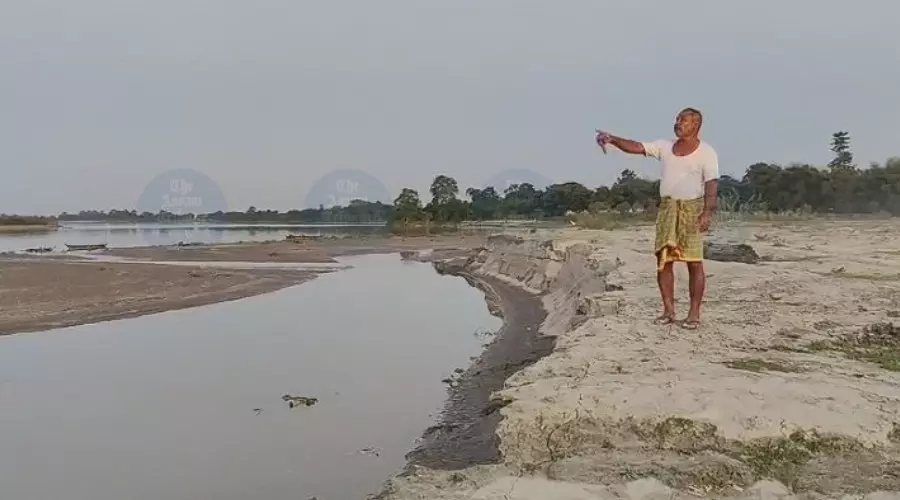
Jadav Payeng near the Brahmaputra River bank in Jorhat.
Jorhat, Oct 18: Environmental activist and Padma Shri awardee Jadav Payeng, widely known as the “Forest Man of India”, has expressed deep concern over the ongoing sand excavation from the Brahmaputra riverbed in Jorhat
Payeng alleged that despite the absence of sand deposits in several stretches of the river, excavation continues; a practice he warned has diverted the Brahmaputra’s natural course southward, causing several rivers in Majuli to dry up
To address the issue, Payeng submitted a memorandum to the Jorhat Forest Department and the Deputy Commissioner on Friday, urging an immediate halt to all sand excavation activities along the southern bank of the river.
"The sand excavation process for the four-lane national highway project in Jorhat is already complete. Earlier, the Forest Department and the Deputy Commissioner had granted permission for excavation for this purpose. Though there were initial hurdles, my efforts ensured that the work was carried out. However, even after the project’s completion, sand excavation continues at several points along the river,” said Payeng.
He explained that during dry months, the riverbed is dug up to six or seven feet deep, and when the monsoon arrives, the river’s flow shifts southward.
“As a result, several rivers in Majuli have vanished. Studies by the Land Survey Department show that the Brahmaputra’s main channel is gradually shifting south. The formation of 58 new sandbars has been recorded and therefore, sand excavation in Jorhat must be stopped immediately,” he said.
Payeng further said that the Guwahati-based Forest Department office has been informed about the need for research and surveys to identify the location and extent of these newly formed sandbars.
“These sandbars should be used to grow food sources for elephants and monkeys. This would help reduce human-animal conflicts,” he added.
If the state government lacks funds for such initiatives, Payeng said he is willing to invite Indian-origin NGOs working abroad to take up the project.
“Some NGOs already have experience working on restoration activities along the Brahmaputra,” he noted.
Outlining his long-term vision, Payeng said, “My goal is to make the Brahmaputra stretch—from Dibru-Saikhowa to Kaziranga—lush and green once again.”
He appealed to the authorities to immediately stop all forms of excavation along the southern bank of the river to protect its fragile ecosystem.