
Six dry months threaten livelihoods of 2,000 Tengani tea growers in Golaghat
No irrigation, no rainfall & fading crops leave Tengani’s tea-dependent families staring at an uncertain future
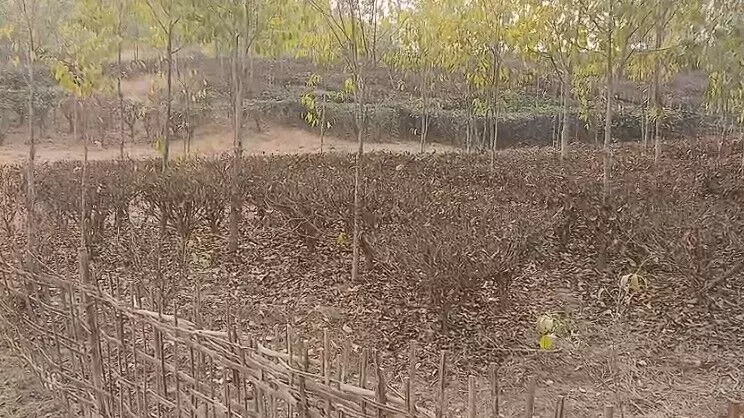
Tea bushes wither under prolonged dry conditions in Tengani
Jorhat, Mar 2: With no rainfall for nearly six months, small tea growers in Tengani under Sarupathar subdivision of Golaghat district are staring at an uncertain future as their tea bushes wither under prolonged dry conditions.
Once lush and green, tea gardens in the region are now turning brown. Acres of plantations have begun to dry up, leaving farmers anxious about their livelihoods.
With no irrigation facilities in place, growers say they feel helpless as the drought-like situation worsens.
In a desperate appeal for rain, farmers recently gathered in their tea gardens to offer prayers, seeking divine intervention to save their crops.
“Our primary source of livelihood in Tengani is tea cultivation,” said Dilip Phukan, a resident of Gerukani village.
“Through tea farming, we earn our yearly income and support our children’s education and household expenses. But this time, due to the prolonged dry spell, our tea bushes are drying up. If this continues, our situation will become extremely difficult,” he added.
Phukan said that with no alternative employment opportunities, many farmers are struggling to make ends meet.
“We urge the government to provide irrigation facilities. There has been no rainfall for six months. If a proper water supply or irrigation system is arranged, we will be grateful. As small tea growers, we humbly appeal for assistance,” he said.
Tengani, where tea cultivation is the primary source of income, produces nearly 15 lakh kilograms of green tea leaves annually. On average, around 75,000 kilograms of green leaves are sold daily from the region.
Spread across 42 villages, nearly 2,000 small tea growers depend entirely on tea cultivation for their sustenance.
The prolonged dry spell has also affected betel nut and agarwood trees, which are gradually drying up, compounding the crisis for farmers. Another grower from Gerukani village echoed similar concerns.
“We are hoping for some government support. Without water supply, we fear ruin. In previous years, our tea bushes would be full of leaves at this time. Now, there are hardly any. I have around 10 bighas under tea cultivation, and the condition is bad everywhere. We must come together as a community to find a solution,” he said.
With livelihoods hanging in the balance, Tengani’s small tea growers now wait anxiously for rain to revive their fields or for timely government intervention to rescue their fading hopes.