
Seven years on, Kalahi villagers still await permanent bridge despite assurances
Residents of Dakuapara and neighbouring villages in south Kamrup continue to suffer and rely on a fragile bamboo structure rebuilt annually after monsoons.
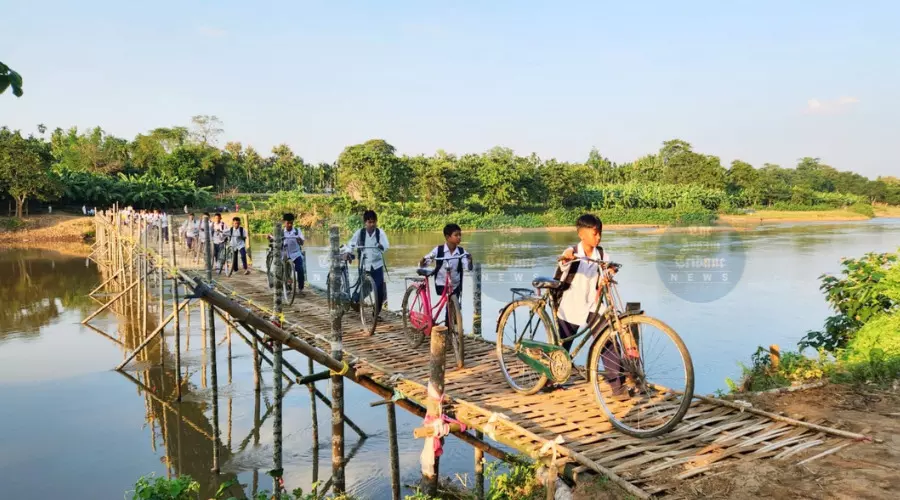
The makeshift bamboo bridge over Kalahi river (AT Image)
Palasbari, Nov 13: The tall claims of the State government on improved connectivity fell flat, as residents of Dakuapara under the Gobardhan Council area of the Rabha Hasong Autonomous Council (RHAC) in south Kamrup continue to brave hardship due to the absence of a permanent bridge over the Kalahi river.
Located barely a kilometre and a half east of the Pantan High School playground, the villagers' temporary bamboo bridge remains the only lifeline connecting several tribal-dominated villages in southern Chhaygaon.
Each year, after the monsoon subsides, residents painstakingly rebuild the 300- metre structure using nearly 200 bamboo poles and 100 areca nut trees. However, as the rains return, the Kalahi floods wash it away taking with it another year's worth of toil and hope.
The bridge has been serving hundreds of students commuting daily to institutions like Chhaygaon College and Pantan High School. Parents and residents from Dakuapara, Bananigaon, Andheri, Jugibari, Balijuri, Baklipara, Phalaghat, Kahua and Ratanpur live in constant anxiety over the safety of children and elders crossing the shaky link.
Local residents expressed deep resentment, recalling that on July 23, 2018, a delegation from Dakuapara, Bananigaon, Jogipara, and Phalaghatgaon Development Committee submitted a memorandum to the then PWD Minister, now Chief Minister Himanta Biswa Sarma, seeking the construction of a permanent bridge. The minister had assured that the demand would be fulfilled soon.
However, even after seven years, no visible action has been taken yet. The villagers alleged that the promises made by the Chief Minister were nothing but a 'gimmick'.
They have once again renewed their appeal to the government to construct a permanent bridge over the Kalahi river, ending a yearly ritual of rebuilding and the long-standing neglect that flows unbroken through their lives.