
Satellite study flags rapid loss of green cover in Assam’s protected areas
The study conducted over a period of 20 years showed that the forest cover within Panidihing Bird Sanctuary of Sivasagar district has significantly decreased.
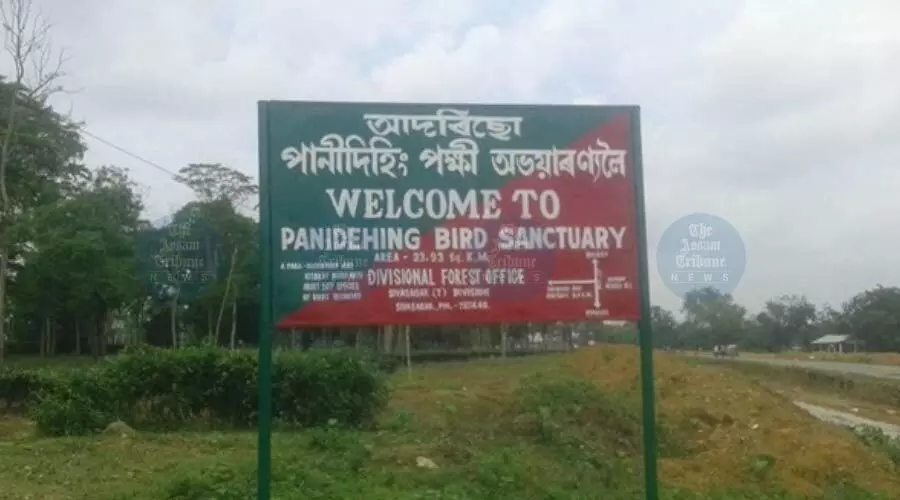
Panidihing Bird Sanctuary of Sivasagar district
Guwahati, Jan 5: A satellite imagery-based study has revealed that green cover is vanishing even from protected areas in the State, highlighting a systemic failure to protect even legally designated areas.
The study conducted over a period of 20 years showed that the forest cover within Panidihing Bird Sanctuary of Sivasagar district has significantly decreased due to human activities, resulting in environmental alterations.
Cropland in the sanctuary had encompassed a major share (25.7 per cent) of the overall protected area in 2001. By 2021, cropland area increased to 42.5 per cent of the sanctuary (a 65 per cent increase). The built-up area also increased, whereas the forest area had reduced by 5.77 per cent from 2001 to 2021. The most substantial changes occurred in the grassland category, which declined from nearly half of the sanctuary in 2001 to about one-third in 2021.
The grassland decreased by 11.2 sq km during 2001-2021. A total area of 15.1 sq km was converted from grassland to cropland, while the other classes like forest and sandbar had also been converted to cropland from 2001 to 2021 in the sanctuary, according to the study conducted by Namita Sharma and Anup Saikia of Gauhati University and Scott M Robeson of Indiana University (USA).
The sanctuary is a diverse ecosystem and encompasses an area of about 34 sq km.
Compared to the total net changes of forest loss from 2001 to 2021 at 5.14 per cent, the loss of core forest was 4.56 per cent. So, even the interior, least fragmented forest patches have been somewhat degraded or lost within the area, it noted.
“Based on fieldwork during the months of December 2022 and January 2023, we observed limited patrolling and protective measures resulting in smallholder agriculture with mustard and potato cultivation,” the researchers observed.
The land use and land cover change results, which indicate a decline in grasslands and an increase in cropland and built-up regions surrounding the study area, raise the possibility that the patches have been converted to non-natural land uses. This suggests that even while the proportion of degraded patches had decreased, it is possible that some patches have been completely eliminated, they felt.
Citing the findings regarding changes in landscape fragmentation and changes in vegetation density, the research team concluded that the general health of the sanctuary and its buffer zone may be jeopardized “since grassland is fast vanishing and forest fragmentation has intensified, both of which are likely to adversely affect the sanctuary’s fauna.”