
Proposed industrial park endangers Dorabeel Wetland, thousands of livelihoods at risk
Dorabeel is much more than a wetland. Aside from supporting wide-ranging plants, mammals its ecosystem overlaps with grassland.
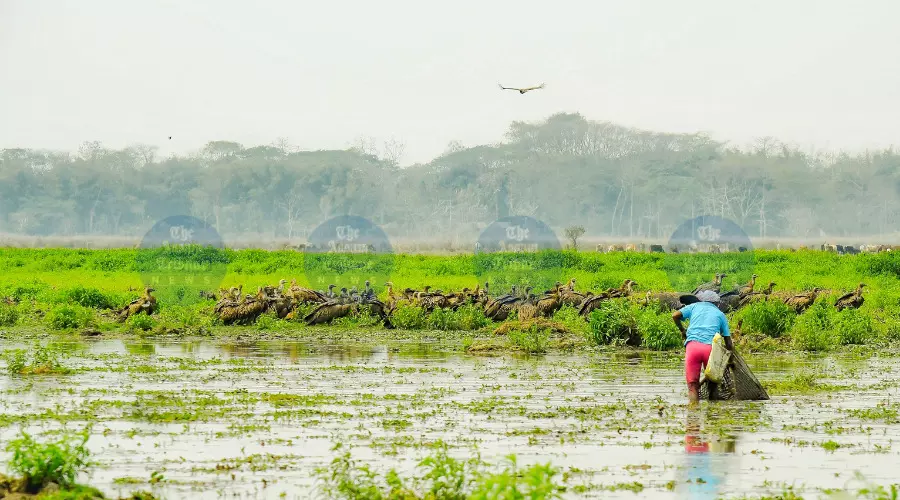
File image of Dorabeel Wetland (Photo: AT)
Bijoynagar (Kamrup), Oct 4: A unique wetland that has supported biodiversity and mass livelihoods for generations runs the risk of annihilation today, thanks to a highly-intrusive model of development pursued by the State government.
As per the government’s plans, an industrial park is set to come up on the wetland – a disturbing move that has triggered a mass protest by the local populace.
Located near Bijoynagar area, Dorabeel is much more than a wetland. Aside from supporting wide-ranging plants, mammals (including the endangered Gangetic river dolphin), birds (four endangered species of vultures), fish, reptiles and birds, its ecosystem overlaps with grassland (which sustains a village grazing ground) and fertile farmland. This makes the entire area of around 1,800 bighas (excluding agri land) a haven for diverse species as well as a constant livelihood provider for the local populace who are into tilling and fishery.
No less significant is the cultural worth of the wetland, which is rooted in local lore and has been at the centre of traditional cultural and religious practices for generations.
“Once the 150-bigha logistics park comes up, over 3,000 families directly dependent on livestock rearing in the grazing field will lose their livelihoods. During the monsoon, the grazing area merges with Dorabeel, transforming it into a fishing haven. At this time, about 2,000 families from 10 villages engage in fishing activities. The park will irreversibly impact their livelihoods,” Prasanna Kalita, a local resident and conservation activist, told The Assam Tribune.
Some 500 families from 12 surrounding villages are also engaged in pottery, as the soil from the field is considered the best. They fear industrial and commercial activities will put an end to this livelihood.
“As for agriculture, around 1,000 families depend on agriculture in the fertile floodplain soils. Their livelihoods, too, will be endangered,” Kalita added.
Echoing similar fears, retired teacher and village elder Ashwini Majumdar said that polluting industries that had already come up near the area were polluting soil, water and air.
“We apprehend that an industrial park will worsen environmental degradation, harm public health, and spell doom for both biodiversity and livelihoods. Heavy vehicular movement and influx of outsiders will threaten the social security of the local population,” he said.
Pointing out that the grazing ground is steeped in religio-cultural traditions for generations, Majumdar said that people of seven villages have been celebrating the Suwori festival and the community Meji bonfire, and following other folk-cultural practices for well over a century.
“Acquiring this land will endanger our cultural identity and existence. The continuity traditional knowledge systems will be disrupted, as folk knowledge flows through culture,” he added.
The industrial park will permanently damage the wetland’s biodiversity, especially the Gangetic river dolphin, which breeds in the Kolohi river connected to Dorabeel.
Villagers pointed out that during floods, the grazing field holds the overflow waters of Dorabeel and as such any shrinkage in the floodplain will inundate nearby villages, creating a disaster. Construction will also reduce groundwater recharge, leading to scarcity of drinking water and irrigation problems for local people.
Dorabeel’s biodiversity is corroborated by the documentation of over 200 species of resident and migratory birds that are dependent on both Dorabeel and the grassland. In addition, 74 fish species, 26 ornamental plants, 7 edible/medicinal plants, 6 plant species used as manure, and 3 species used for making household items, have been documented.
While the 10 mammal species include river dolphin, fox, jackal, civet, mongoose, jungle cat, etc.), the 23 reptile species comprise turtles, monitor lizards, snakes, geckos, etc., 68 butterfly species, and numerous frogs, snails, insects, and other fauna, add to its biodiversity.
When asked, Kamrup district commissioner Deba Kumar Mishra said that objections from local people and organizations were being taken for the second time (from September 1 to October 1) and a public hearing would soon follow.
“We had also effected a change in the site through an official notification following public protest. Now the matter will be settled through the public hearing,” he added.
The local people are unhappy with the second notification, saying that it only consolidates the previously proposed two plots into a single plot of 150 bighas for the construction of the logistics park.
“We will continue with our fight to protect the wetland and the grazing ground, which is our collective heritage,” said Md Nizamuddin Ahmed of the Dorabeel Grazing Field Protection Committee.