
Moran Tea Estate weaves empowerment beyond tea with women-led initiative
The tea estate set up a community-driven weaving centre, fostering sustainable livelihoods, cultural heritage, and social development beyond tea production.
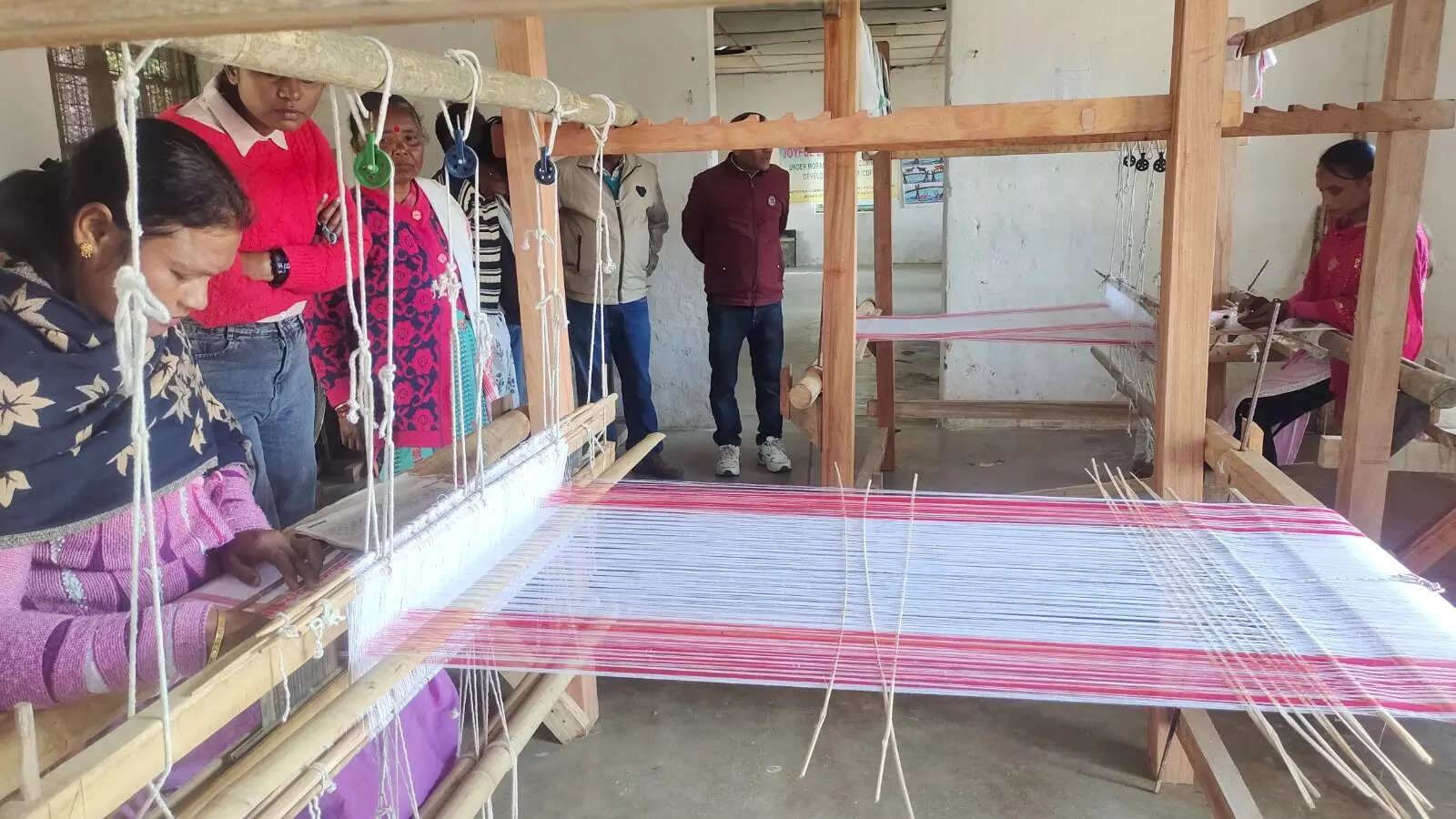
The weaving center at Moran tea estate (AT Image)
Dibrugarh, Jan 16: From tea bushes to the rhythmic clatter of looms, Moran Tea Estate is quietly weaving a story of empowerment, culture and community resilience.
In a commendable initiative that goes beyond tea production, the estate has set up a weaving centre aimed at preserving traditional crafts, creating sustainable livelihood opportunities, particularly for women and empowering the community through various interventions.
Owned by the Luxmi Tea Co Private Limited, Moran Tea Estate employs over 2,000 workers during peak season, around 70% of whom are women.
Yet the estate’s vision extends far beyond employment in the tea fields. Recognizing the untapped potential of retired workers, homemakers, and women from surrounding villages, the management has launched a community-driven weaving initiative aimed at preserving traditional crafts while creating and promoting sustainable livelihood opportunities.
The weaving centre, established by Luxmi Tea Co Private Limited under the guidance of Ethical Tea Partnership’s (ETP) Community Development Forum (CDF) and spearheaded by senior manager Subhabrata Sikdar, Moran Tea Estate, Luxmi Tea Co Private Limited has quickly become more than just a workspace.
It is a hub where women learn to weave gamochas, hankies, and other traditional garments, the skills that keep age-old cultural practices alive while fostering financial independence. With sewing machines also provided and a master trainer guiding them in weaving and embroidery, participants are turning creativity into income and confidence.
“For us, the looms provide more than just work; they offer dignity, creativity, and a sense of belonging,” said Manjula Kahar, the programme mobilizer at Moran Tea Estate.
She said the enthusiasm among women is palpable, and although the centre is still in its early stages, there are ambitious plans for expansion.
The initiative is just one part of a broader effort by Luxmi Tea Co Private Limited under the CDF initiative, which addresses seven key areas: Education, Social Security, Health, Water, Sanitation and Hygiene (WASH), Women Empowerment, Child Protection, and Youth Development.
“Through these interventions, the tea estate aims to uplift the lives of garden workers and their families,” said the estate’s welfare officer Mantu Barhoi.
The impact goes beyond skill development. Kahar shared, “We also work to prevent child marriage, reduce school dropouts, and encourage healthy lifestyles.
Sports are an important part of this: several of our young people have represented the district and state teams in football and hockey, while others have secured government jobs,” she added.
CDF initiatives also help workers access essential government services by ensuring every individual has bank accounts, Aadhaar cards, Ayushman cards, and ration cards, etc.
These measures enable families to access healthcare, education, financial and social benefits, fostering long-term stability.
At the heart of these transformations are the woman leaders of the tea estate like the Sardarni of Moran Tea Estate and ACMS unit secretary Monumati Kalandi. Electing her as the Assam Chah Mazdoor Sangha’s garden union secretary and appointing her as CDF secretary has been a landmark move.
“Monumati Kalandi single-handedly mobilizes women for various activities. She educates, manages, and leads with confidence, inspiring others to step forward. Programme mobilizer Manjula Kahar, too, is vibrant and proactive, leading most community initiatives. Together, these women have become role models, inspiring others to step forward and influence change in their families and communities,” Sikdar told The Assam Tribune.