
Kaziranga Wildlife Society hosts symposium on ecosystem awareness in Bokakhat
The symposium was attended by several prominent resource persons, including Prof Parimal Bhattacharya and others.
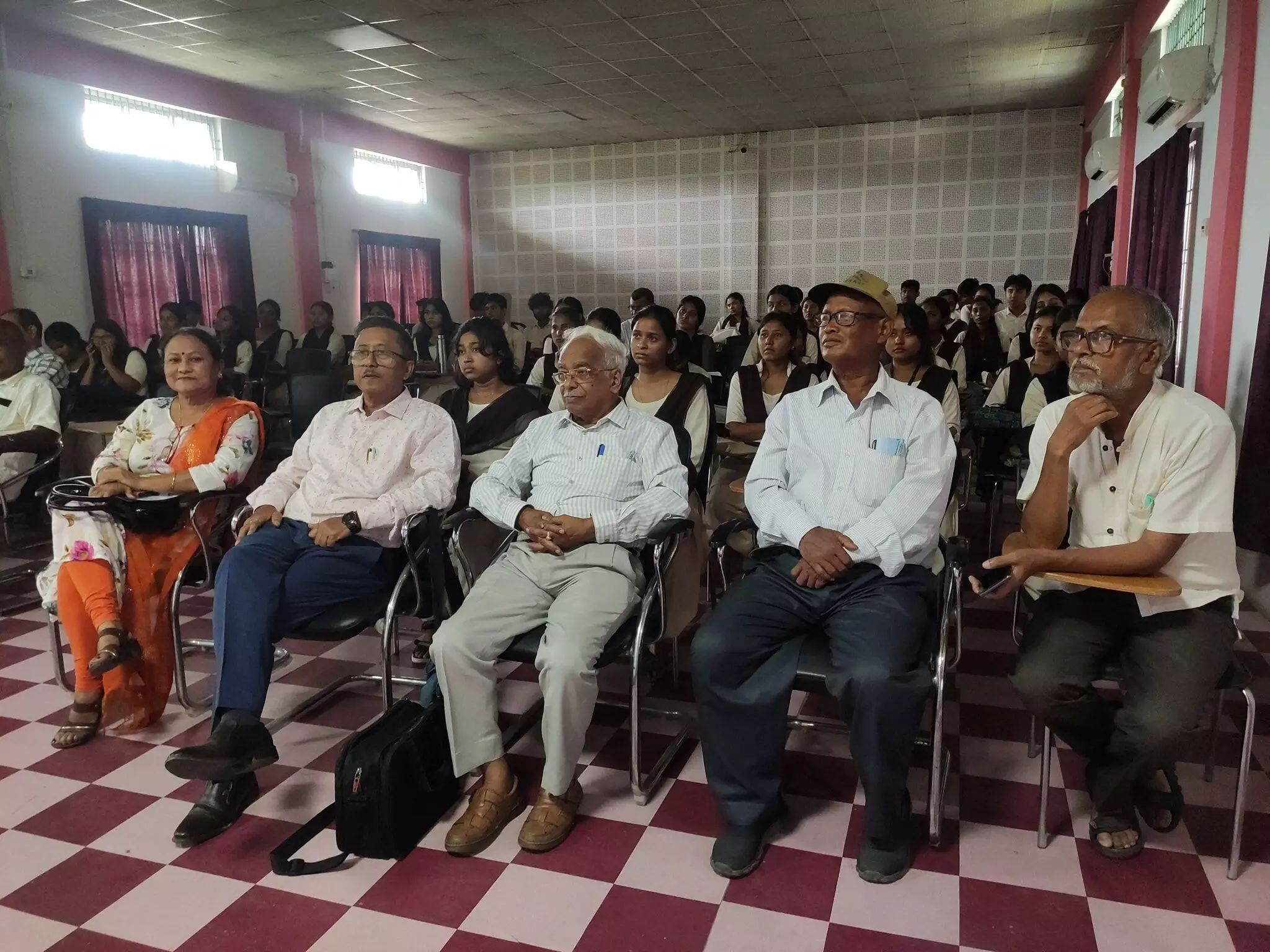
Symposium of Kaziranga WL Society on Maintaining Wildlife Ecosystem at CNB College, Bokakhat. Photo: (Iswar Chandra Barua/Meta)
Kaziranga, Sept 1: With the objective of creating awareness among the student community, a symposium on ‘Maintaining Wildlife Ecosystem’ was organised at the CNB College in Bokakhat on Saturday.
The symposium was attended by several prominent resource persons, including Prof Parimal Bhattacharya, former head of the Department of Zoology of Gauhati University and emeritus trustee of the Wildlife Trust of India, Prof Iswar Chandra Baruah, retired scientist of the Assam Agricultural University, Jorhat, and Assam Gaurav awardee Dharani Dhar Boro.
The participating students were imparted knowledge on various topics related to wildlife and ecosystem management at the symposium, which was organised by the Kaziranga Wildlife Society in association with the CNB College.
In his deliberations, Prof Parimal Bhattacharya highlighted the value of wildlife. He further defined the ecosystem of the Kaziranga National Park and Tiger Reserve where the grasslands account for 64 to 70 per cent and the wetlands account for around 6 per cent of the ecosystem. Prof Bhattacharya spoke about ecosystem diversity in a region, which involves a variety of habitats, communities, and ecological processes. He said that interaction between any two ecosystems is continuous, adding that grassland and forests are two interdependent ecosystems relying on each other for various ecological functions. Grasslands can influence forest expansion and dynamics, while forests can provide resources and habitat for species that also utilise grasslands.
Prof Bhattacharya also said that two distinct ecosystems influence each other through various processes like water flow, nutrient cycling, and habitat provision. He said that wetlands, characterised by shallow water and water-saturated soils, can influence grassland ecosystems by affecting water availability and soil moisture, while grasslands can, in turn, impact wetland hydrology and water quality through the root systems of plants and vegetation. He pointed out that seed dispersal by animals is crucial to forest expansion.
Prof Iswar Chandra Baruah deliberated extensively on the impact of alien invasive weeds in maintaining the grassland ecosystem of the Kaziranga National Park and Tiger Reserve. He said that weeds are more successful than any other plant due their rapid germination and growth, coupled with substantial seed production, efficient seed dispersal, and long dormancy period. He said that weeds have a highly competitive ability to tap essential resources.
Assam Gaurav Dharani Dhar Boro spoke about his lifelong experiences while dealing with wild animals in the Kaziranga National Park and Tiger Reserve as well as the Manas Tiger Reserve. He urged upon the student community to become involved in the cause of protection of wildlife and the environment and preserve them for future generations.
Earlier, the welcome address was delivered by Karuna Sharma, secretary of the Kaziranga Wildlife Society. He laid stress on evolving a long-term strategy for maintaining the wildlife ecosystem through a scientific approach.
The symposium was initiated by Dr Dilip Bora, faculty member of the CNB College.
By
Correspondent