
Kaziranga tiger deaths highlight territorial stress in high-density habitat
Three tiger deaths due to infighting within 20 days have renewed concerns over rising tiger density, with conservationists warning of saturation
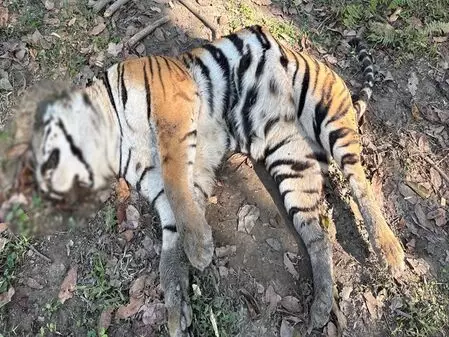
The carcass of a four-year-old tigress. (Photo:IANS)
Guwahati, Jan 25: The death of three tiger in Kaziranga within 20 days – all due to infighting – have put the spotlight back on the growing density of the big cat in the national park.
The latest incident was reported on January 18, when the carcass of a female tiger was recovered at Kathpora area of Bagori.
Earlier, the carcass of a young male tiger was recovered at Thute Chapori of Eastern Range on January 14, while a female tiger was found dead at Paschim Bimoli area of Western Range Bagori on January 4.
Post-mortem and investigations suggested that all the deaths were due to infighting. Conservationists have been saying that the tiger population in Kaziranga may have reached the saturation point.
Kaziranga National Park and Tiger Reserve (KNPTR) ranks third globally in terms of tiger density, with approximately 18 tigers per 100 sq km. According to a report released last year, 148 adult tigers were identified across the three divisions of the Kaziranga Tiger Reserve (KTR), up from 104 in 2022.
This increase is particularly significant due to the first-time sampling of the Biswanath Wildlife Division, which recorded 27 tigers and substantially contributed to the overall rise in numbers.
In the core Eastern Assam Wildlife Division, the tiger population increased from 104 in 2022 to 115 in 2024.
Tigers are solitary and territorial big cats that require large areas to survive and reproduce. Studies indicate that adult male tigers can occupy territories up to 100 sq km, while females generally occupy between 40 and 60 sq km.
The size of a tiger’s territory varies depending on factors such as habitat quality, terrain, and prey availability, and can differ significantly across landscapes.
“Tiger is territorial by nature and they defend the territory and fight with the intruders leading to fatality sometimes. As the tiger population in Kaziranga is growing and the sub-adult wants to make its space leading to intrusion into the territory of other adult tigers, fierce infighting often takes place", Aaranyak secretary general Bibhav Talukdar said.
"Natural dispersal of wild animals needs landscape connectivity. Some tigers are now also making their shelter in Majuli and other riverine islands, some may even go to Arunachal as part of the natural dispersal,” he added.
Conservationist Smarajit Ojha also feels if Kaziranga is seen in isolation “it appears that the tiger density is nearing saturation”.
“But if one takes into the account the char/chapori areas of the Sixth Addition, First Addition of Burachapori Wildlife Sanctuary and Second Addition of Orang National Park – which is a continuous landscape, a lot of dispersal area is there. These additions and the corridors need to be secured. Kaziranga should never be seen as a single tiger habitat. It must be treated as a key core area within Assam’s and Northeast India’s wider protected area landscape,” he pointed out.
Park director Sonali Ghosh, however, said it is difficult to say tiger density is increasing on the basis on the recent three deaths.
But she added, “Tiger infighting – where sub-adults are killed or expelled in territorial battles – is the raw essence of natural selection and survival of the fittest. Far from tragedy, it sustains a thriving, balanced eco-system.”