
Kaziranga fishing during Magh Bihu exposes lax enforcement despite High Court ban
With elections nearing, political reluctance & administrative inaction allowed fishing to continue inside Kaziranga National Park
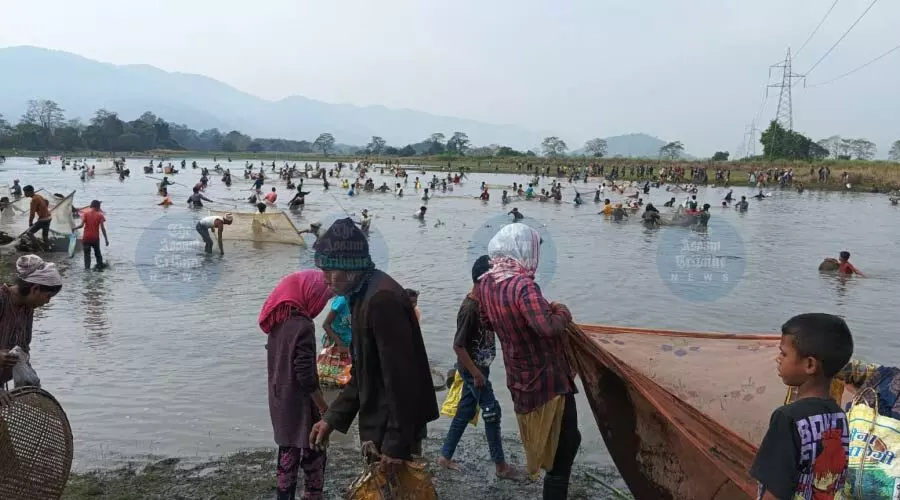
Illegal community fishing in Kaziranga National Park (Photo: AT)
Guwahati, Jan 18: The failure of the State government – the Kaziranga National Park and Tiger Reserve authority and the district administrations in particular – in preventing large-scale “community fishing” inside the protected forest despite there being a strict Gauhati High Court directive to that effect raises disturbing questions over securing long-term conservation goals.
Worryingly, what was once a traditional fishing activity by a small community living in the park’s periphery for Magh Bihu’s community feasting has today expanded beyond the customary practice to assume commercial aspects. Fish caught during the festival end up in markets in the nearby districts on Saturday.
The Gauhati High Court had through its strongly-worded directive last month asked the State government, the KNP authorities and the Nagaon and Golaghat district administrations to take appropriate steps to enforce the ban on fishing in the park’s wetlands during Magh Bihu festival.
The State government’s action, however, did not go beyond issuing prohibitory orders on fishing. As no matching preventive measures were taken, people in their hordes fished inside the national park for two days, exposing slack arrangements and a complete lack of intent.
It also exposes the lack of goodwill on the part of the State government which has all along been taking a lenient view of the matter.
The issue has political connotations as well, with no political party, including the one in power reluctant to antagonize the local tribal and tea-tribe communities over fishing.
And with the assembly elections round the corner, the ruling party was more than willing to look the other way while fishing activities continued unhindered.
A top Forest official wishing anonymity told The Assam Tribune that it was next to impossible to stop the practice, as use of brute force to curb fishing would create serious law-and-order situations besides triggering long-term enmity of the local inhabitants.
“We need to evolve a holistic approach that can respect the sentiment of the local communities and at the same time ensure that the practice is actually restricted to fishing for feasting purposes only for an hour or two. Regulated fishing for an hour once a year cannot harm the park’s ecology. But under no circumstances should the situation be allowed to be used for commercial fishing. The local communities should be sensitized on fishing only for feasting and they must keep outside elements out of the social custom,” he added.
Unfortunately, recent years have seen the growth of a syndicate that is using the local communities as a shield to indulge in commercial sale of fish from Kaziranga.
An official source, while admitting the growing fishing activities, said that the government must treat the matter seriously and step in firmly to curb fishing, particularly done for commercial purposes.
A Forest official, however, advocated a blanket ban on fishing. “It is a protected area and no such activity should be allowed here, as it violates forest, wildlife and conservation laws. It is evident that the menace is getting bigger and more complex with fishing for commercial purposes. The government should act firm in the greater interest of Kaziranga,” he said.
The High Court, while acting on a PIL (63/2025) filed by environmental activist Rohit Choudhury, had observed that “…in any view of the matter, the protection of such site is necessary or else there would be a violation of Wildlife Protection Act, 1972; Forest Conservation Act, 1980; and breach of various constitutional obligations under Article 48A of the Constitution of India and of international obligations as well.”
“We, therefore, deem it necessary to direct that the necessary prohibitory orders must be enforced,” the court added in its order.