
AT Photo
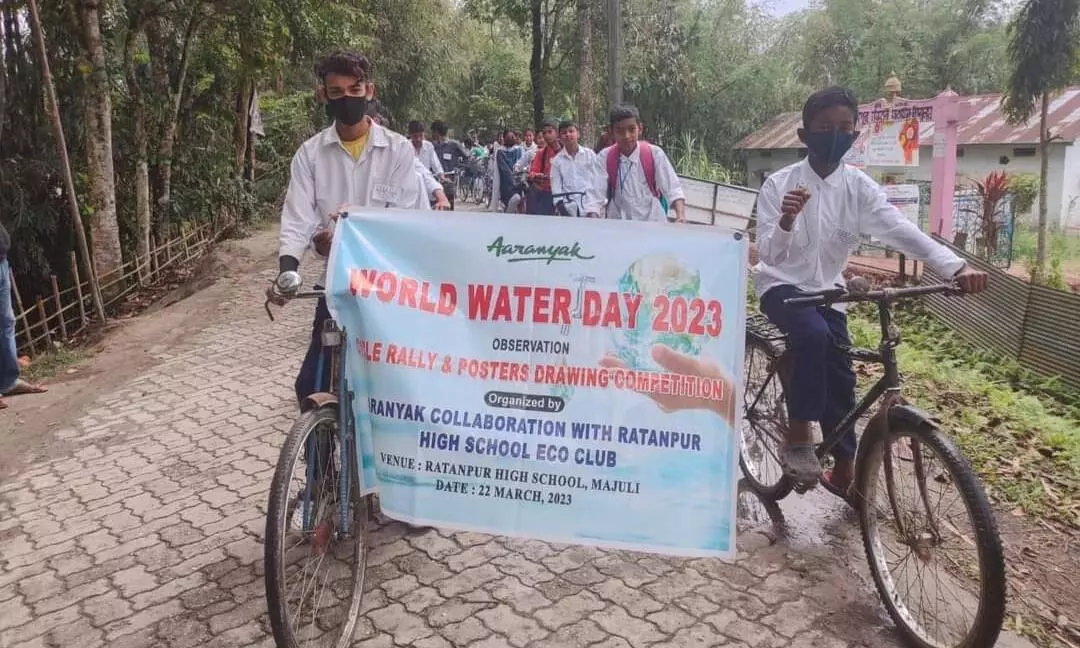
Guwahati, Jan 11: In the heart of the world’s largest river island, Majuli, where water flows abundantly, people were not very aware of the quality of the water they were drinking. A group of proactive students decided to tackle the issue head-on. The students from Ratanpur High School, when they learned about the perils of water-borne diseases in their school, took the stage with street plays and rallies to spread awareness.
Aaranyak, a research-based biodiversity conservation organisation, collaborated with the school in 2020 to facilitate an awareness campaign on the island.
Surprisingly, their efforts caught the attention of the government, prompting a joint initiative to address the quality of water in Majuli. As Sunil Bora, a teacher from Ratanpur High School, reflects, the Jalshala—a government initiative—not only increased awareness about water conservation but also received widespread support, eliminating initial doubts about the necessity of such programmes in a region seemingly rich in water resources. “There is an abundance of water in Majuli, but it is not worth consumption, however, the students came to know about the importance of water conservation in school. The Jalshala improved their understanding significantly and they started creating awareness in the area surrounding their villages regarding water wastage. The programme carried out by JJM (Jal Jeevan Mission) got a huge response and the students were also eager to learn about water conservation. The students also received the cooperation of the people,” Bora said while speaking to The Assam Tribune.
The inquisitive students from the island raised pertinent questions about the purity of the water. In response, teachers from Ratanpur High School took the initiative to educate children on the importance of water conservation and preservation. Subsequently, the school organised a series of awareness campaigns, engaging both students and the local community to highlight the importance of water.
The awareness campaign, featuring activities like cycle rallies, street plays and interactive sessions with villagers, garnered exclusive media coverage. The government took note of this noble initiative and the students, referred to as ‘Jaldoots’, were to be inducted in Jalshala.
The primary objective of the Jal Doot Programme is to unite students in Classes VIII through XII as committed volunteers, acting as changemakers in their communities. Exclusive to Assam, this programme by Jal Jeevan Mission is envisioned as a model for the entire country. It seeks to instil leadership traits in young individuals, motivating them to contribute to community improvement.
In a noteworthy development, several students from the school were appointed "Jaldoots" in November 2023. Their role is to spread awareness about the importance of consuming healthy water and reduce its wastage.
Alakesh Gogoi, who is the District Co-Ordinator, IEC, PHE, Majuli, while speaking to The Assam Tribune, highlighted the success of last year's Jalshala at Ratanpur High School, where 40 students educated the community about water conservation and sanitation. “The campaign led to increased awareness, improved health measures, and willingness to pay for the monthly tariff associated with the water supply project. Consequently, Ratanpur Gram Panchayat was recognised as the best,” Gogoi added.
Chinmoy Saikia, a class 8 student, shared insights from completing Jaldoot training, emphasising the importance of responsible water usage and the benefits of a piped water system in preventing waterborne diseases. Saikia stated, “After receiving the training, we started creating awareness. The water supplied through the project should be used for consumption only and not for other purposes like washing vegetables, dishes, or clothes. Moreover, one should not keep the water tap open and waste water, because when we waste water, others are unable to procure it."
“There have been several diseases due to the consumption of unclean water, so when we received lessons in our school about water-borne diseases, we took up the initiative to raise awareness by conducting street plays and rallies. The government took cognisance of our efforts and joined hands to further this initiative,” said another student associated with the programme.
Gogoi further informed that the people also agreed to pay a monthly tariff for the water supply project, which they were initially reluctant to pay. Speaking about the students, Gogoi added that earlier they were unaware that there are several parameters that help measure the quality of water that can impact their health. But following the campaign, they understood that water quality parameters can be tested or monitored based on the desired water parameters of concern, including the chemical, physical and biological properties.