
Gauhati HC directs Assam govt to curb illegal fishing in Kaziranga ahead of Magh Bihu
The court also called for putting on record the steps taken by the respondents in controlling such activities in the Park & the ways in which such activities could be effectively controlled.
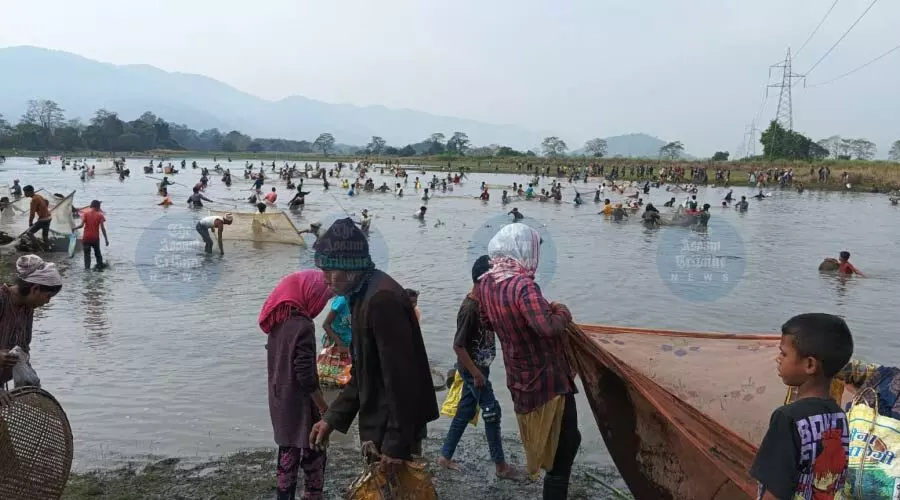
Illegal community fishing in Kaziranga National Park (Photo: AT)
Guwahati, Dec 19: Taking serious note of large-scale community fishing inside Kaziranga National Park during the Magh Bihu celebrations in mid-January, the Gauhati High Court has directed the Assam Government and its various departments concerned and the Kaziranga authorities to enforce the necessary prohibitory orders to curb illegal fishing.
The High Court bench comprising Chief Justice Ashutosh Kumar and Justice Arun Dev Choudhury, while acting on a PIL (63/2025) filed by environmental activist Rohit Choudhury, observed that “…in any view of the matter, the protection of such site is necessary or else there would be a violation of Wildlife protection Act, 1972; Forest Conservation Act, 1980; and breach of various constitutional obligations under Article 48A of the Constitution of India and of international obligations as well.”
“We, therefore, deem it necessary to direct that the necessary prohibitory orders must be enforced,” the court added in its recent order.
The court also called for putting on record the steps taken by the respondents in controlling such activities in Kaziranga National Park and the ways in which such activities could be effectively controlled.
“The matter requires immediate attention of the respondents,” it added.
The court sought an affidavit to be filed by the next date “as to the steps taken for preventing such activities in the first and second week of January in the Kaziranga National Park.”
The PIL filed by Choudhury sought urgent judicial intervention to curb large-scale fishing in the waterbodies of Kaziranga National Park and Tiger Reserve. A Phukan, advocate for the petitioner, informed the court how people in their multitudes enter the park annually during the Magh Bihu festival – which is celebrated between January 13 to 14 – to carry out their traditional practices which include fishing in the protected waterbodies in the Kaziranga. This has been going on in flagrant violation of the wildlife protection laws and has a cascading effect which disrupts the already fragile ecosystem of the park, he reasoned.
Such actions threaten the park’s biodiversity including the endangered species such as the one-horned rhinoceros, varieties of migratory birds and approximately 42 species of fish. With these activities going unchecked, the status of the park is compromised.
Kaziranga National Park is also a UNESCO World Heritage Site and an Important Bird Area (IBA).
D Gogoi, Standing Counsel of the Forest Department, submitted that the respondents “are cognizant of this and, therefore, prohibitory orders have been issued regularly to control such illegal fishing in the waterbodies in Kaziranga National Park.”
However, there appears to be some difficulty in executing such prohibitory orders for the reason of large number of people congregating at that site with religious fervour.