
From village looms to global markets: Assam’s silk story from Dhemaji
At 82, Narahari Mahanta’s looms power a thriving rural silk economy ahead of Rongali Bihu demand
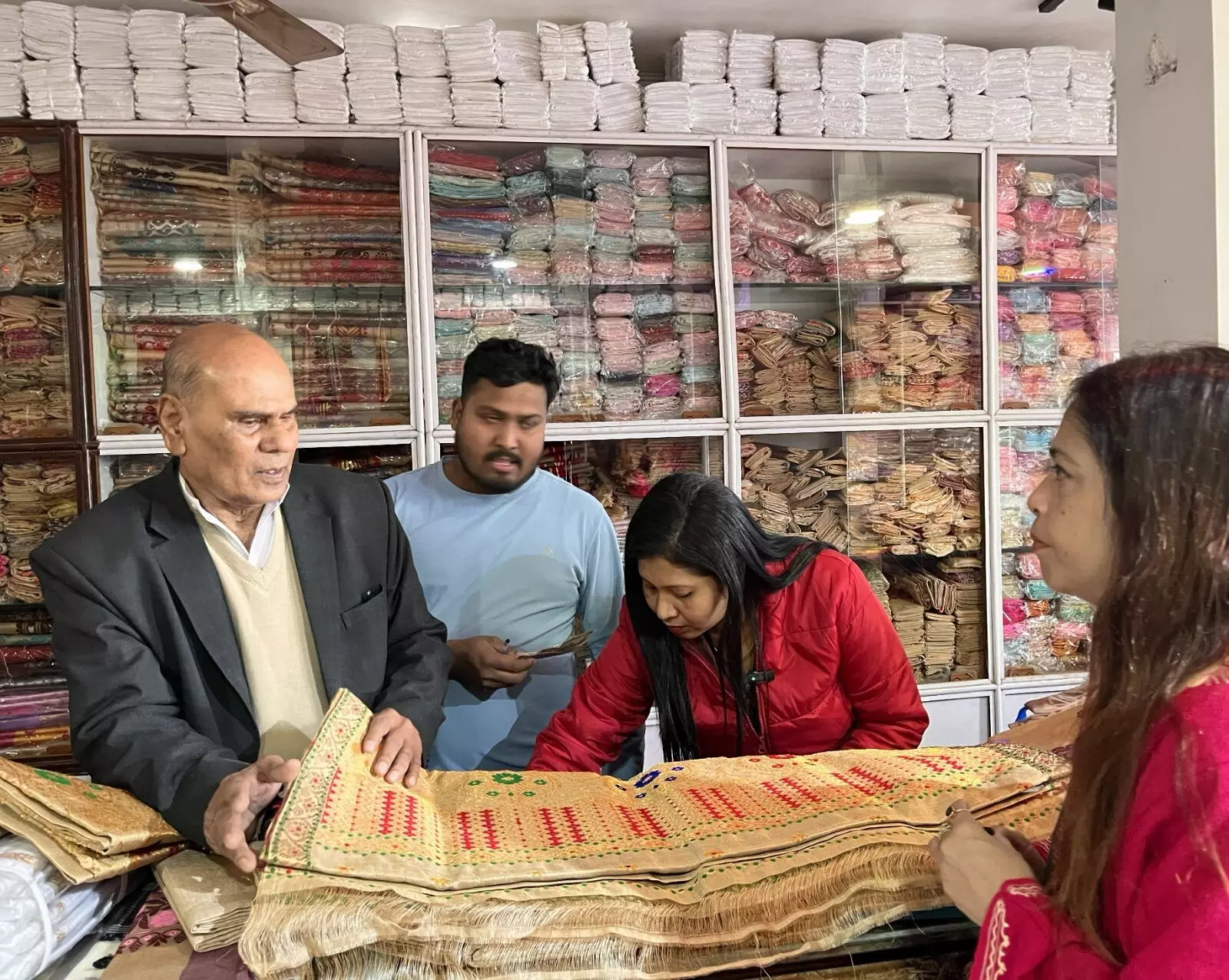
Narahari Mahanta (left) supervising the flow of customers in his store. (AT Photo)
Dhemaji, March 16: With Rongali Bihu just four weeks away, business is brisk at a large garment outlet tucked inside the rural stretch of Machkhowa Chariali in Dhemaji district, near the Lakhimpur border.
Inside the sprawling store of Mahanta Silk House, wholesale buyers from Majuli and various parts of Lakhimpur browse through stacks of Tussar and Muga silk products, mekhela-chadors, cotton garments and traditional gamochas woven from pokuwa suta (braided yarn).
Amid the bustle stands 82-year-old Narahari Mahanta, quietly supervising the flow of customers and orders.
Alongside wholesale buyers, a steady stream of retail shoppers fills the outlet. For Mahanta and his team, such scenes have become routine as the festive season approaches and demand for handloom textiles surges.
Yet behind this thriving rural enterprise lies a story that began with little more than determination.
“I came to Dhakuakhana from Sualkuchi in 1976 with less than Rs 100 in my hand and started selling handloom garments collected locally on my bicycle,” Mahanta recalls.
The veteran entrepreneur nurtured a dream of building an Assam silk industry in the Dhakuakhana region.
In 1985, he set up his first loom, weaving four pairs of plain Muga silk mekhela-chadors. As demand grew, he expanded steadily.
By 2002, Mahanta opened his current outlet at Machkhowa Chariali and established several looms producing Muga, Eri and other organic yarn-based textiles.
Success followed quickly, driven by a strict commitment to quality and traditional design. Today, the two-storey outlet sells handloom garments, yarns, threads and textiles, while a large shed behind the store houses dozens of looms weaving Muga, Tussar and cotton fabrics, producing traditional garments such as riha, mekhela-chador and gamocha.
Mausumi Saikia Mahanta in the store. (AT Photo)
“Quality and authenticity are the hallmarks of our products,” says Mausumi Saikia Mahanta, Mahanta’s daughter-in-law, who helps run the family enterprise.
She notes that there have been attempts to replicate Muga silk sheets by mixing Tussar threads, but the business maintains strict quality control.
Their insistence on authenticity has helped the brand reach far beyond Assam. “Our products are now sold in the United States, the United Kingdom and Gulf countries,” she says.
Mahanta also remains fiercely proud of Assamese weaving traditions. “No one from outside can challenge Assamese patterns and designs,” he says, claiming that many motifs seen in Banarasi silk draw inspiration from Assam’s traditional designs.
Over the decades, Mahanta’s enterprise has grown into a rural economic hub. Apart from running his own looms, he sources textiles from more than 100 looms operated by women weavers in nearby villages across Dhemaji and Lakhimpur.
The steady demand for handwoven textiles has significantly improved the livelihoods of these rural artisans.
However, the veteran weaver is also concerned about the future of Muga silk, one of Assam’s most prized natural fibres.
According to Mahanta, ecological degradation in the Dhakuakhana region, particularly the expansion of tea plantations near Som plantations, the host plants of the Muga silkworm, has begun affecting silk production.
“The growth of tea gardens close to Som trees is impacting the growth and development of Muga silk,” he says.
Even so, as Bihu approaches and customers crowd his store, Mahanta remains optimistic that Assam’s handloom heritage will endure, woven carefully through the looms of rural artisans and sustained by generations who continue to cherish its timeless craft.