
From leaf to label: Karbi women turn tea craft into market-ready enterprise
What began as rural initiative now turns market-ready as Karbi women gain recognition for premium, single-origin tea production
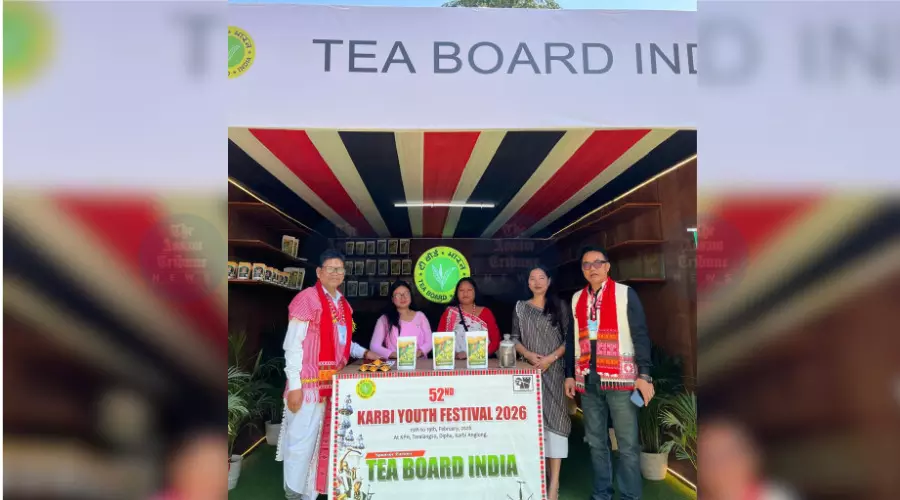
Tea Board Stall at the 52nd Karbi Youth Festival (Photo: AT)
In February, as the winter sun softened over Taralangso, the 52nd Karbi Youth Festival unfolded with its familiar blend of music, colour and community pride.
Organised by the Karbi Cultural Society, the festival once again celebrated identity and tradition. Yet alongside the cultural festivities, another narrative was quietly taking shape at the stall of the Tea Board of India.
It was the story of rural women gradually transitioning from suppliers of raw green leaves to producers of finished tea, and of a market beginning to recognise that transformation.
Visitors initially approached the stall out of curiosity, but many left with a clearer appreciation of the tea on display. A visitor from Jorhat remarked that although he had travelled to the festival for the performances, what stayed with him most strongly was the tea itself.
He spoke about women stepping forward as entrepreneurs and villages building their own industries, describing it as an important moment for the region. His reaction felt less like polite encouragement and more like recognition.
Another visitor, a health-conscious consumer, admitted he sampled the tea with a degree of scepticism.
“We drink tea every day,” he said, “but this one is different.” After taking a second sip, that scepticism faded and turned into approval.
A doctor from Guwahati, after tasting the Premium Karbi Artisanal Green Tea, observed that when quality is evident, it does not need aggressive marketing. What he saw was not just a beverage but the possibility of an industry capable of generating employment and sustaining itself through merit.
These responses were not merely emotional endorsements. They reflected a form of consumer validation. Curiosity may draw people to a product, but sustained demand depends on expectations being met.
From symbolism to market viability
Being invited to present at the Tea Board of India stall during the festival was not simply a ceremonial inclusion.
It indicated a degree of institutional acknowledgement. Ramen Lal Baishya, Deputy Director of the Tea Board of India, noted that many green teas available in the market often fall short of expected standards and that much of what is sold as Assam tea is blended elsewhere, sometimes diluting its identity.
By contrast, authentic single-origin Assam tea that is pure and traceable has strong demand.
That distinction carries significance. For years, rural initiatives have often been appreciated primarily for their intent — empowerment, cultural preservation or community resilience.
Markets, however, respond to different criteria: consistency, traceability, quality assurance and clear differentiation.
When a senior Tea Board official speaks about demand for single-origin tea, he is referring to market logic rather than sentiment.
The changes unfolding in Karbi Anglong therefore represent a structural transition.
Moving from selling raw leaves to producing finished, branded tea alters the economic position of producers.
Raw-leaf suppliers usually depend on prices set by intermediaries, whereas finished-product producers retain higher margins, control branding and negotiate from a stronger position.
This shift affects not only income prospects but also bargaining power and long-term sustainability. It reshapes perception as well — from beneficiaries of development programmes to entrepreneurs exercising agency.
A few weeks earlier, the Tea-RWE State-Level Convention at Moniram Langneh Auditorium in Deithor had already signalled this growing maturity.
Nearly 500 rural women entrepreneurs gathered under the Udyamini programme, facilitated by Transform Trade with Grassroots Tea Corporation serving as the technical partner.
The discussions at the convention were practical and technical. Participants focused on composting techniques, dryer design, standard operating procedures, packaging strategies, bio-pesticides and home-based processing units. The vocabulary of the gathering was not symbolic but operational.
Representatives from the Tea Board spoke about plans for a dedicated marketplace in Guwahati for handmade and artisanal teas, while NABARD indicated institutional support for scaling women-led enterprises.
Trade licences for several clusters were also under consideration. These developments were not abstract promises but responses to tangible groundwork.
When institutional engagement follows demonstrated capacity, it suggests that the initiative has moved beyond aspiration and entered a phase of structured growth.
Culture, confidence and a converging moment
The Karbi Youth Festival remains one of the largest ethnic festivals in Northeast India, celebrating identity through music, dance and language.
This year, tea became part of that cultural expression in a new way. It appeared not simply as a commodity but as an extension of community confidence.
The same collective ethos that sustains festivals — cooperation, family-backed effort and pride in heritage — is now supporting this women-led tea enterprise.
The Rural Women Entrepreneurship initiative under Udyamini is doing more than teaching processing techniques. It is building clusters, strengthening networks and embedding enterprise within cultural identity. This combination of culture and commerce gives the initiative a certain durability.
For years, conversations about local enterprise have revolved around potential. What distinguishes this moment is the convergence of several factors: consumer validation, institutional recognition and organised production capacity.
Quality is being tested and appreciated by both customers and officials. Market positioning is increasingly defined by premium, single-origin identity rather than volume.
Clusters are emerging with technical knowledge and awareness of compliance standards. These are the essential components of a functioning value chain, not merely the signs of a promising experiment.
The developments seen at the RWE Convention and the Karbi Youth Festival suggest that 2026 could mark a transition from experimentation to consolidation.
When visitors offer appreciation based on quality, when institutions respond with structural support and when producers themselves articulate their enterprise with confidence and technical clarity, it indicates that a broader shift may be underway.
People are no longer sampling this tea purely out of curiosity. They are approaching it with expectation.
And expectation is what ultimately turns a product into a market.
By Jini Thomas