
Four years on, Lohit Khabalu villages face poor connectivity & healthcare woes
Four years after being added to Majuli district, 27 villages continue to battle isolation, floods, & crumbling infrastructure
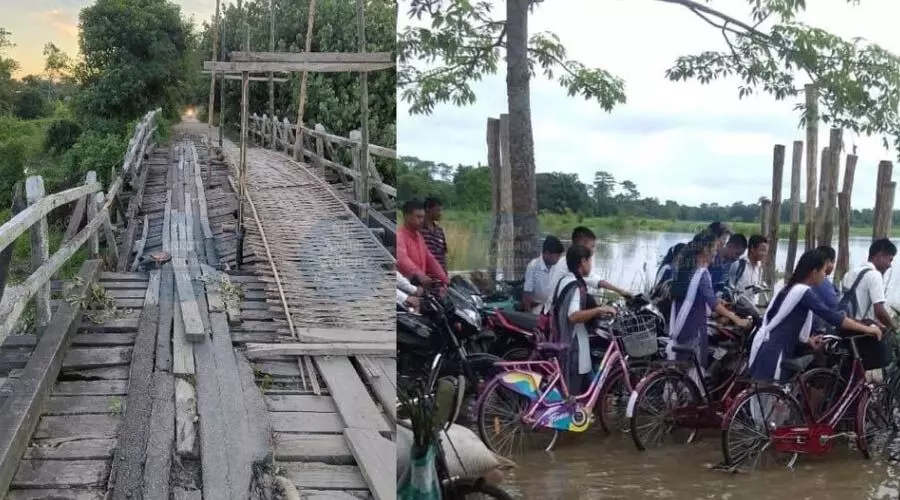
Dilapidated condition in Lohit Khabalu villages (Photo: AT)
North Lakhimpur, Oct 22: The villages in question were once known for their finest dairy products and exotic fishes that were served on the plates of the rich. At the same time, the villages of the riverine Lohit Khabalu area, among other issues, had the basic problem of surface communication in accessing vital services like healthcare in Lakhimpur, which was at least 10 to 15 kms away with no bridges to cross the two streams of the Brahmaputra.
Predominantly inhabited by the Mising community with its vibrant cultural practices, the area was part of Lakhimpur district and separated from the mainland and the district headquarters of North Lakhimpur by two streams of the Brahmaputra – Subansiri and Lohit.
There have been dozens of incidents of patients losing their lives while being transported to healthcare centres in Lakhimpur on boats, of women in labour dying on boats or giving births under the open sky while being carried on boats or handcarts, and also of children bitten by snakes dying due to wretched road conditions delaying their arrival in hospital.
There are 27 villages with a population of approximately 30,000 under the Lohit Khabalu Gaon Panchayat, which were ceded from Lakhimpur district in December 2021 and added to Majuli district with the objective of augmenting communication with administrative installations and facilities.
The Lohit Khabalu Gaon Panchayat area of approximately 70 square kilometres is connected to Majuli through three wooden bridges – the Kharjanpar-Nagargaon bridge and the two Garamur-Patharichuk bridges. While the Kharjanpar-Nagargaon bridge connects the upper Lohit Khabolu area, the two wooden bridges from the Garamur Civil Hospital to Pathorichuk connect the lower Lohit Khabalu area. These three wooden bridges are the only major communication links for the movement of people and goods to Majuli from the entire area.
However, the dilapidated condition of these three wooden bridges and the roads forces the villagers endure daily ordeals to access vital services like healthcare and education. During the monsoon season, floods force the villagers to cross the river on country boats at great risk, as the bridges cannot sustain any heavy load on the turbulent water.
Unabated river bank erosion by the Brahmaputra and siltation on the river beds of the Lohit and Subansiri have also affected the traditional livelihood of the Mising community – fishing and farming – in this riverine area. The effects of climate change on their traditional livelihood practices, among other things, have led to migration of its youth to the urban centres of the State.
Along with the climate-induced calamities, the villagers of the Lohit Khabalu area are enduring daily challenges when it comes to surface communication. The current state of communication bottlenecks in the Lohit Khabolu area is depriving people of access to some of the basic amenities of public service. The situation remains the same as it was during the area’s inclusion in the revenue and administrative map of Lakhimpur district.
The people of the 27 villages of this area still have to carry patients on handcarts, on bamboo stretchers, on horse-drawn carts, or on tractor trailers to the 200-bed Sri Sri Pitambar Dev Goswami State Hospital at Garamur, which is 4 km away. But this 4-km journey is an ordeal of uncertainty and obstacles, with muddy and slippery roads in monsoon and bumpy dusty ones during the winter season putting the lives of the patients at risk before they reach the hospital. Many patients in critical and advanced stages of illness fail to make it alive to the hospital in Garamur due to the time-consuming and arduous road trip.
On October 12, 2018, a 70-year-old retired headmaster of the Patharichuk LP School, Sashidhar Payeng, died while being transported on a country boat from his village in Patharichuk in Lohit Khabalu to the hospital in Garamur following a stroke. Earlier on August 17 of the same year, late Payeng had lost his son Sushil Kumar Payeng (46), an assistant professor at the Sri Sri Pitambar Dev Goswami College, Majuli, under similar cirumstances.
On September 12, 2018, one Aimoni Payeng from Patharuchuk village of Lohit Khabalu gave birth to a male child under the open sky amidst rain and wind while returning from the Sri Sri Pitambar Dev Goswami State Hospital. She had been admitted for delivery at the hospital but was sent home by the attending doctor and asked to return after four days. She experienced labour pain while returning home after crossing the Lohit stream, and was forced to give birth under the open sky without any medical assistance.
These are only a couple of instances of how inaccessibility of vital services in this riverine area has impacted the local people in the recent past.
In fine, the non-existence of motorable roads and connectivity bottlenecks due to weak bridges still affect the lives of thousands of villagers in the Lohit Khabalu area, despite its transfer to Majuli district from Lakhimpur for better connectivity four years ago.