
Electrified rail line poses deadly threat as Hoolock Gibbon dies in sanctuary
The death of the endangered gibbon inside Hollongapar Gibbon Wildlife Sanctuary raised concerns over rail-line electrification and habitat fragmentation
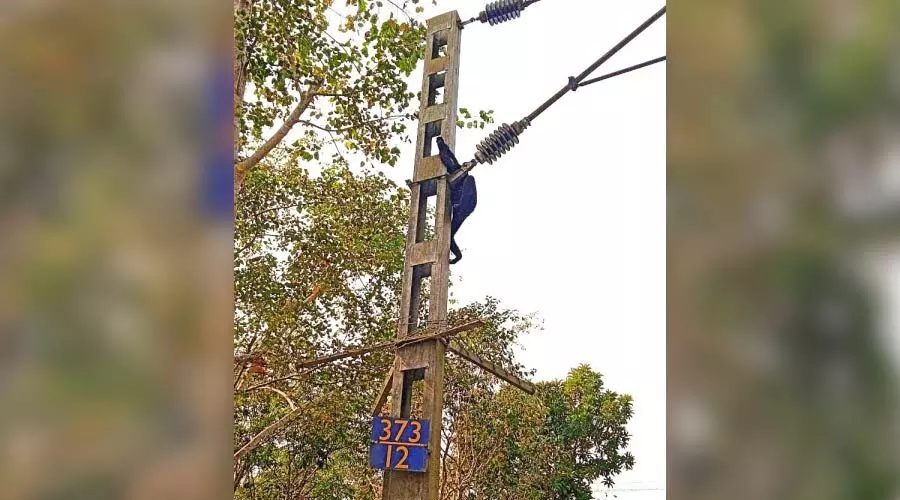
Recent electrification of the railway track without putting in place mitigation measures has heightened the danger manifold (AT Image)
Guwahati, Feb 10: Confirming the worst fears of conservationist, an endangered hoolock gibbon died of electrocution on the railway track that cuts through the heart of Assam’s one of most biologically-diverse forests, bringing to the fore the peril posed by the rail track.
While the train track always posed a hazard to its wildlife, especially arboreal creatures like hoolock gibbon, recent electrification of the railway track without putting in place mitigation measures has heightened the danger manifold.
Confirming the incident, Monica Kishore, DFO, told The Assam Tribune said that the gibbon, an adult male, died of electrocution at the Hollongapar Gibbon Wildlife Sanctuary at Mariani in Jorhat district yesterday.
Arboreal animals rarely hit the ground as they tend to avoid open spaces. If ever they come down to the ground, they become particularly vulnerable to threats such as predation and collision with vehicles.
Gibbon families on either side of the railway line – especially the 4-5 gibbon families in the much smaller Compartment-I – remain effectively isolated from one another.
Hoolock gibbon which is India’s only ape species is accorded the highest legislative protection (placed in Schedule I) under the Wild Life (Protection) Act, 1972.
Despite experts calling for rerouting the 1.65-km-long broad-gauge railway line that has fragmented the sanctuary into two disproportionate parts, the State Government and the Railway authorities went ahead with their plans of track electrification, jeopardizing long-term survival of the ape species.
There have also been suggestions and recommendations from conservation bodies including the Wildlife Institute of India (WII) for erecting artificial canopy bridges at strategic locations for arboreal creatures to cross over from one part of the forest to the other. Even then, most conservationists feel that shifting the small railway track outside the sanctuary will end the problem once and for all.
“This short-distance track of less than 2 km can easily be rerouted outside the sanctuary in the greater interest of wildlife. This is a busy railway line, and at risk are not just the hoolock gibbons but all other animals which need to move from one part of the forest to the other. The best option is to have the railway line outside the sanctuary,” primatologist Dr. Dilip Chetry who is a Vice-Chair of IUCN/SSC Primate Specialist Group of South Asia, said.
The earlier exercise of erecting artificial canopy bridges at the sanctuary was a failure because the structure remains unused by arboreal mammals due to deficiencies in design which did not conform to the gibbons’ specialized form of movement in the canopy.
The dissection of the sanctuary by the train track has rendered it a ‘forest island’ bereft of connectivity with surrounding forest patches.
“Animals like gibbons which are exclusively arboreal inhabiting the forest upper canopy have been the worst-hit, as they are particularly sensitive to canopy gaps. Disturbingly, the genetic variability of the gibbon population has thus been adversely affected, worsening their already threatened survival in the sanctuary,” Dr. Chetry said.
The Wildlife Institute of India which had suggested setting up seven artificial canopy bridges to ease the situation also warned that any doubling of the railway line (a distinct possibility) would completely negate the prospects of artificial canopy bridge installation.
The sanctuary spread across an area of just 20.98 sq km shelters as many as seven species of primates – the highest in Assam — including the western hoolock gibbon. Their population at the sanctuary is around 125 individuals in 26 groups.